Showing posts with label Luminous Mysteries. Show all posts

Saturday, June 1, 2013

First Saturday Meditation: The First Luminous Mystery-The Baptism of Jesus


Today, June 1, is the First Saturday of the Month. The First Saturday Devotion to the Immaculate Heart of Mary was first mentioned by Our Lady of Fatima on July 13, 1917. After showing the three children a vision of hell she said, "You have seen hell where the souls of poor sinners go. To save them, God wishes to establish in the world devotion to my Immaculate Heart. If what I say to you is done, many souls will be saved and there will be peace... I shall come to ask for... the Communion of reparation on the first Saturdays..." The First Saturday devotion is as follows:
It consists in going to Confession, receiving Communion, reciting five decades of the Rosary and meditating for a quarter of an hour on the mysteries of the Rosary on the first Saturday of five consecutive months. The Confession may be made during the eight days preceding or following the first Saturday of each month, provided that Holy Communion be received in the state of grace. Should one forget to form the intention of making reparation to the Immaculate Heart of Mary, it may be formed at the next Confession, occasion to go to confession being taken at the first opportunity.
Today I wish to meditate upon the First Luminous Mystery, which is the baptism of our Blessed Lord in the River Jordan by his cousin, John. John and Jesus were born approximately six months apart. When the angel, Gabriel, announced to the Virgin Mary that she was to be the Mother of God, he told her that her cousin, Elizabeth, who was past child bearing age, had also miraculously conceived and was now in her sixth month. Mary immediately went to be at Elizabeth's side. Elizabeth was carrying John the Baptist.  The meeting of Elizabeth and her unborn child and Mary and her unborn child involved the three holiest people who have ever lived:  Jesus, because He was God; Mary, the Mother of God who was conceived without sin; and John the Baptist, who was sanctified by Jesus while still in his mother's womb and about whom Jesus said, "among those born of women there has not risen anyone greater than John the Baptist." 

John could easily have followed in the footsteps of his father, Zachariah, and become a priest in the temple, but he eschewed that easy lifestyle and instead started what could be called a "rogue" ministry, going into the wilderness to announce the coming of the Messiah. He had, in effect, started this ministry while still in his mother's womb when he leaped at the presence of the Lord who was in His mother's womb.  Just as an aside, this meeting of the pre-born John and Jesus is surely one of the strongest arguments that can be had against abortion.


Luke 3:1-3 tells us this concerning John's ministry:
 "In the fifteenth year of the reign of Tiberius Caesar—when Pontius Pilate was governor of Judea, Herod tetrarch of Galilee, his brother Philip tetrarch of Iturea and Traconitis, and Lysanias tetrarch of Abilene— during the high-priesthood of Annas and Caiaphas, the word of God came to John son of Zechariah in the wilderness.  He went into all the country around the Jordan, preaching a baptism of repentance for the forgiveness of sins.
Tiberius Caesar reigned from 14 AD to 37 AD, so this was approximately 29 AD. John 3:3 tells us that the role of John the Baptist was described in the prophecy of Isaiah:
“A voice of one calling in the wilderness,
‘Prepare the way for the Lord,
make straight paths for him.’”
As a central part of preparing the way of the Lord, John began a ministry of baptism, as he explained: "I baptize you with water for repentance. But after me comes one who is more powerful than I, whose sandals I am not worthy to carry. He will baptize you with the Holy Spirit and fire."  (Matthew 3:3) Like Mary, the mother of Christ, everything John said and did was to point away from himself and to Christ. As John said, "He must increase, but I must decrease." (John 3:30) It is no accident that the Feast of the Nativity of John the Baptist is June 24, a time in the Northern Hemisphere when daylight hours begins to decrease. Six months later, when we celebrate the birth of Jesus, daylight hours begin to increase.

John the Baptist had completely separated himself from the established religious leaders of that time, and in fact called them out when they came to see him:  "You brood of vipers! Who warned you to flee from the coming wrath?"  (Matt. 3:7). John, to use the vernacular, "called 'em as he saw 'em." He showed no fear of anyone or anything but just total dedication to his ministry of preparing the way for the Lord. The people were drawn to him no doubt because of the sincerity and forcefulness with which he preached.

Our Lord, who had kept a low, private profile up to this time, came from Galilee to the River Jordan where John was preaching and baptizing. As soon as John saw his cousin walking towards him, the words poured out of his mouth:
Behold the Lamb of God, which taketh away the sin of the world.

These words are used in the Mass to this very day when the priest holds up the consecrated Host for us to adore and worship.

No one had to tell John who Jesus was. He knew, and he shouted it for all the world to hear. Jesus then asked John to baptize him. John was completely taken aback by this request:  "I need to be baptized by you, and do you come to me?"  (Matt. 3:14).  Why would Jesus, who was and is the Son of God, completely without sin, need to be baptized? The same question could be asked of His entire life: why did He have to be born as a helpless babe; why did he have to be purified at the temple after being born; why was He subject to the authority of Mary and Joseph; why wasn't he born as an earthly king with all the privileges that come with such earthly rank?

Our Lord did all of this in order to become one with mankind. While losing none of His Divinity, he became as human as we are, and humbled and subjected himself as completely as possible to the human experience. As Hebrews 5:8 tells us, "Even though Jesus was God's Son, he learned obedience from the things he suffered."  He knows firsthand what it means to be a human being in our fallen world and face the trials and obstacles that we endure. Hebrews 4:15-16 says: "For we do not have a high priest who is unable to empathize with our weaknesses, but we have one who has been tempted in every way, just as we are—yet he did not sin. Let us then approach God’s throne of grace with confidence, so that we may receive mercy and find grace to help us in our time of need."

Jesus was also our trailblazer, cutting out and showing the path to Heaven. Jesus received the sacrament of Baptism to show us that this is the path we also must walk. As Jesus said in answer to John's question, "Let it be so now; it is proper for us to do this to fulfill all righteousness."  (Matt. 3:15).  Our Lord did not leave us in the dark, trying to figure out on our own the way to salvation. He showed the way by putting Himself literally into each step. As Jesus told the Pharisee, Nicodemus, "Very truly I tell you, no one can enter the kingdom of God unless they are born of water and the Spirit. Flesh gives birth to flesh, but the Spirit gives birth to spirit."  (John 3:5-6)

We must be born of water, which is baptism, as shown by our Lord. Jesus also showed us what it means to be born of the Spirit when the Holy Spirit descended upon Jesus in the form of a dove at his baptism, as John the Baptist told us: "I saw the Spirit descending from heaven like a dove, and it abode upon him."  (John 1:32)  We saw something similar to this when, after Jesus ascended to Heaven, the Holy Spirit in the form of tongues of fire descended upon Mary and the Apostles at Pentecost.

The concept of baptism did not start with John the Baptist. St. Peter tells us that the Great Flood in the time of Noah was a baptism (I Peter 3:20-21):
. . . to those who were disobedient long ago when God waited patiently in the days of Noah while the ark was being built. In it only a few people, eight in all, were saved through water, and this water symbolizes baptism that now saves you also—not the removal of dirt from the body but the pledge of a clear conscience toward God.
St. Paul tells us that baptism was also seen when the Israelites passed through the Red Sea while escaping from the Egyptians (I Cor. 10:1-2):
For I do not want you to be ignorant of the fact, brothers and sisters, that our ancestors were all under the cloud and that they all passed through the sea. They were all baptized into Moses in the cloud and in the sea.

Baptism is the way in which our sins are washed away and we are made clean before God.  Our Lord subjected Himself to baptism, leaving us with no excuses.  As Jesus said, we must be born of water and the Spirit, and He showed us exactly how it is done.

When Christ came up out of the waters of baptism, the Holy Spirit descended upon Him, and a voice was heard: "This is my beloved Son, in whom I am well pleased." (Matt. 3:17). The Trinity - Father, Son and Holy Spirit - have placed themselves in the Sacrament of Baptism. This is where Our Lord started His ministry, and this is where we start our Christian walk, cleansed from our sins and born of the Spirit.


Saturday, April 6, 2013

Meditation on the Second Luminous Mystery: The Miracle at the Wedding of Cana


Today, Saturday, April 6, is the First Saturday of the Month. The First Saturday Devotion to the Immaculate Heart of Mary was first mentioned by Our Lady of Fatima on July 13, 1917. After showing the three children a vision of hell she said, "You have seen hell where the souls of poor sinners go. To save them, God wishes to establish in the world devotion to my Immaculate Heart. If what I say to you is done, many souls will be saved and there will be peace... I shall come to ask for... the Communion of reparation on the first Saturdays..." The First Saturday devotion is as follows:
It consists in going to Confession, receiving Communion, reciting five decades of the Rosary and meditating for a quarter of an hour on the mysteries of the Rosary on the first Saturday of five consecutive months. The Confession may be made during the eight days preceding or following the first Saturday of each month, provided that Holy Communion be received in the state of grace. Should one forget to form the intention of making reparation to the Immaculate Heart of Mary, it may be formed at the next Confession, occasion to go to confession being taken at the first opportunity.
The Mystery I have chosen this month on which to share a meditation is the Second Luminous Mystery - the miracle at the wedding of Cana.  I'm going to do some plagiarizing with this one.  I am right now reading one of the deepest and most enlightening books on the life of Christ that I have personally come across.  It is called, amazingly enough, "Life of Christ" by Venerable Fulton Sheen.  I was very young and even stupider than I am now when Bishop Sheen was alive, and I never had any appreciation for him at all, but I have since come to a great appreciation for this most wonderful, holy priest.

Since coming back to the Church, I have been listening to Bishop Sheen's TV program, "Life is Worth Living", and to sermons and retreats that he gave, many of which can be found on YouTube, and I've started reading many of the things he wrote.  I am completely blown away by his sanctity and depth of thought.  Since he lived here in NYC, I have met people who personally knew him, and they have told me he was most definitely the real deal.  He spent an hour every day, despite his unbelievably busy schedule, in prayer in front of the Blessed Sacrament.  At one point someone let him stay in a very large, luxurious apartment in the city.  He confined himself to two small rooms. He always had time for anyone and everyone.  He was responsible for the conversion and re-conversion of untold numbers of people.  He is someone every Catholic should still get to know through his writings and TV program.

Venerable Fulton J. Sheen
The Luminous Mysteries of the Rosary, of course, were not given to us by Blessed John Paul II until long after Bishop Sheen's death, but I have no doubt that the good Bishop would have encouraged their use. The cover of his book, "Life of Christ", as you can see above, pictures the first Luminous Mystery - the baptism of our Lord.

In this same book, Bishop Sheen devotes a chapter to what is now the second Luminous Mystery - the miracle of the Wedding at Cana in which Christ changed water into wine. He entitled this chapter, "The Beginning of 'The Hour'". As Bishop Sheen explained, whenever the term "The Hour" is mentioned in the Gospels, it is referring to Christ's death. As Bishop Sheen further explains, the miracle at the Wedding of Cana was the start of Jesus' public ministry.

At this point in Jesus' life, He had been baptized by John the Baptist and He had chosen 5 of his 12 apostles: John, Andrew, Peter, Philip and Nathanael, but He had not yet formally begun His public ministry. Jesus and his mother, Mary, had been invited to a wedding feast in Cana, and Jesus brought his five new apostles with Him to the feast. In those days, wedding feasts would last for eight days. At one point the wine gave out. Bishop Sheen submits that one of the probable reasons for the wine running out was that Our Lord had brought in so many uninvited guests.

As Bishop Sheen explains in his book, Mary was the instrument of Christ's "first miracle, or sign, that He was what He claimed to be, the Son of God." Bishop Sheen tells us in his book that "In the temple [when Christ was presented as a baby to God] and in the Jordan [when He was baptized], Our Lord received His Father's blessing and sanction to begin His work of Redemption. At Cana, He received the assent of His human parent."

Mary, the mother of Jesus, noticed the dwindling supply of wine before anyone else. Without a second thought, she turned to the One Person she knew could help: Her Son. She said to Him, "They have no wine left." (John 2:3). Bishop Sheen wrote:
"It was not a personal request; she was already a mediatrix for all who were seeking the fullness of joy. She has never been just a spectator, but a full participant willingly involving herself in the needs of others. The mother used the special power which she had as a mother over her Son, a power generated by mutual love."
Christ answered his mother's request with what almost seems like a rebuke and on the surface, even disrespectful and uncaring (John 2:4)
Woman, what is that to Me and to thee?
My Hour is not yet come.

As mentioned above, anytime Jesus uses the words "My Hour", He is speaking of His Passion, death and glory. Bishop Sheen writes:
The "Hour," therefore, referred to His glorification through His Crucifixion, Resurrection and Ascension. At Cana, Our Lord was referring to Calvary and saying that the time appointed for beginning the task of Redemption was not yet at hand. His mother was asking for a miracle; He was implying that a miracle worked as a sign of His Divinity would be the beginning of His Death. The moment He showed Himself before men as the Son of God, He would draw upon Himself their hatred, for evil can tolerate mediocrity, but not supreme goodness. The miracle she was asking for would be unmistakably related to His Redemption.
Bishop Sheen points out that there were two times in Christ's life when He seemed to balk at what was asked of him:
"In the Garden, He asked His Father it it be possible to take away His chalice of woe. . .The same apparent reluctance was also manifested in the face of the will of His mother. Cana was a rehearsal for Golgotha. He was not questioning the wisdom of beginning His Public Life and going to death at this particular point in time; it was rather a question of submitting His reluctant human nature to obedience to the Cross. There is a striking parallel between His Father's bidding Him to His public death and His mother's bidding Him to His public life."
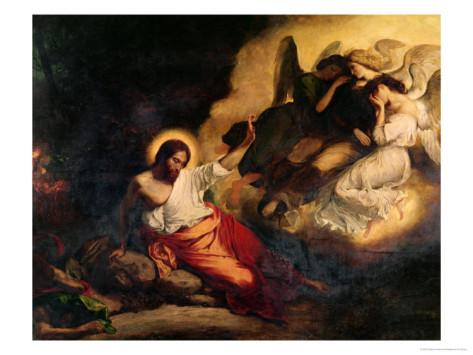
Christ in the Garden of Olives, 1827 by Eugene Delacroix
As we know, Christ submitted to the will of His Mother at Cana and the Will of his Heavenly Father in the Garden. But as Bishop Sheen says, when Mary asked Jesus to perform His first public miracle:
"she was virtually pronouncing a sentence of death over Him. Few are the mothers who send their sons to battlefields; but here was one who was actually hastening the hour of her Son's mortal conflict with the forces of evil. If He agreed to her request, He would be beginning His hour of death and glorification. To the Cross He would go with double commission, one from His Father in heaven, the other from His mother on earth."
Bishop Sheen tells us that "now that He was launched on the work of Redemption, she would no longer be just His Mother, but also the mother of all His human brethren whom He would redeem."  As St. Louis Marie de Montfort said, "The Son of God became man for our salvation but only in Mary and through Mary."  This is why Christ now referred to Mary not as "Mother" but as "Woman."  From Bishop Sheen:
"The 'Woman" did have a seed, and it was her Seed that was standing now at the marriage feast, the Seed that would fall to the ground and die and then spring forth into new life. . .If He was to be the new Adam, the founder of a redeemed humanity, she would be the new Eve and the mother of that new humanity."
I find it interesting that Bishop Sheen refers to Mary as "the mother of all His human brethren whom He would redeem."  God is the Father of all humanity, but Mary is mother only to the "redeemed."  This would explain why only those in the Catholic Church - the only Church founded by Jesus Christ - recognize Mary as their mother.  The rest of the world does not recognize our Lady as their mother because she is not their mother.  She becomes our mother only when we stand with her at the foot of the Cross as the Apostle John did, and thus are redeemed by the Cross.  Bishop Sheen writes:  "On the Cross, He consoled His mother by giving her another son, John, and with him the whole of redeemed humanity" [my emphasis].


When our Blessed Mother asked Jesus to reveal who He was by performing this first miracle at the wedding at Cana, she was in effect giving Him to us as our Sacrifice, and also sealing her own fate in this Sacrifice.  Bishop Sheen explains:
"At Cana, the prophecy that Simeon made to her in the temple was confirmed: henceforth, whatever involved her Son would involve her, too; whatever happened to Him would happen to her. If He was destined to go to the Cross, so was she; and if He was now beginning His Public Life, then she would begin a new life too, no longer just as the mother of Jesus, but as the mother of all whom Jesus the Savior would redeem . . . Just as she was at His side as He began that Hour, so would she be at His side at its climactic finish. When she took Him away from the temple as a boy of twelve, it was because she sensed that His Hour had not yet come; He obeyed her then and returned to Nazareth with her. Now, He told her that His Hour had not yet come, but she bade Him begin it, and He obeyed. At Cana, she gave Him as a Savior to sinners; on the Cross He gave her as a refuge to sinners."
Mary willingly and with great love gave her Son to the world to be our Redemptive Sacrifice, and as Bishop Sheen explains, went to the Cross with Him.  Does this not explain why St. Alphonsus Maria de Liguori said:
'Mary having co-operated in our redemption with so much glory to God and so much love for us, Our Lord ordained that no one shall obtain salvation except through her intercession.'
Bishop Sheen compares Mary's request to Satan's temptations in the wilderness:
Thus [Jesus] did at a marriage feast what He would not do in a desert; He worked in the full gaze of men what He had refused to do before Satan.  Satan asked Him to turn stones into bread in order that He might become an economic Messias; His mother asked Him to change water into wine that He might become a Savior.  Satan tempted Him from death; Mary 'tempted' Him to death and Resurrection.  Satan tried to lead Him from the Cross; Mary sent Him toward it.  Later on, He would take hold of the bread that Satan had said men needed, and the wine that His mother had said the wedding guests needed, and He would change them both into the memorial of His Passion and His death.  
As Venerable Fulton Sheen explained to us, the miracle of the Wedding at Cana is the beginning of Christ's "Hour": the time of his Passion, Resurrection and Glory. We see that his Blessed Mother was an integral part of this. Arnold of Bonneval, a Medieval author and a Benedictine monk who was a great friend and biographer of St. Bernard of Clairvaux, said that on Calvary "there could certainly be seen two altars: one in the heart of Mary, the other in the body of Christ. Christ was immolating His flesh, Mary her spirit."

Our Lord and his Mother gave everything for us:  unhesitantly, willingly and with great love.  It is Christ's sacrifice that saves us from our sin, but it was Mary who presented Him at the altar of Calvary.    

Blessed William Joseph Chaminade, a French Catholic priest who lived during the French revolution and founded the Society of Mary, also known as the Marianists, said:  "The honor of Mary is so intimately connected with the honor and glory of Jesus that to deny the one is at the same time a denial of the other."


“May the Mother of Jesus and our Mother, always smile on your spirit, obtaining for it, from her Most Holy Son, every heavenly blessing.”

--Saint Padre Pio


Sunday, March 3, 2013

Meditation on the Fourth Luminous Mystery of the Rosary: The Transfiguration of Christ


Yesterday, March 2, was the First Saturday of the Month. The First Saturday Devotion to the Immaculate Heart of Mary was requested by Our Lady of Fatima on July 13, 1917. After showing the three children a vision of hell she said, "You have seen hell where the souls of poor sinners go. To save them, God wishes to establish in the world devotion to my Immaculate Heart. If what I say to you is done, many souls will be saved and there will be peace... I shall come to ask for... the Communion of reparation on the first Saturdays..." The First Saturday devotion is as follows:
It consists in going to Confession, receiving Communion, reciting five decades of the Rosary and meditating for a quarter of an hour on the mysteries of the Rosary on the first Saturday of five consecutive months. The Confession may be made during the eight days preceding or following the first Saturday of each month, provided that Holy Communion be received in the state of grace. Should one forget to form the intention of making reparation to the Immaculate Heart of Mary, it may be formed at the next Confession, occasion to go to confession being taken at the first opportunity.
We live in very unsettling and sometimes downright scary times when cultural foundations such as marriage and the family that once seemed unshakable are shifting and changing under our feet. There is a great old song from the 60's called "How Can I Be Sure", which asked the question, "How can I be sure in a world that's constantly changing?" Our wonderful Blessed Lord anticipated this question in the First Century shortly before His Crucifixion. Jesus gave three of the apostles - James, John and Peter - a sign that showed them He was bigger than anything on this earth, and therefore they should not fear anything that man can do.

That sign given to the three apostles is the fourth Luminous Mystery, the Transfiguration of Jesus Christ. As an aside, many traditional Catholics refuse to acknowledge the Luminous mysteries because they were added to the Rosary by Blessed John Paul II in 2002, hundreds of years after the Rosary was initially given by our Lady to St. Dominic, founder of the Dominican Order, in 1214. I believe that to reject these beautiful Mysteries given to us by Blessed John Paul II is a great mistake and anyone who chooses to ignore these mysteries is doing so to his or her own spiritual harm. Read Pope John Paul II's apostolic letter on the rosary, "ROSARIUM VIRGINIS MARIAE", and you will have little doubt that he was directly inspired to add the Luminous Mysteries to the Rosary.

During his ministry, Our Lord did what he could to prepare his apostles for the crucifixion. Matthew 16 tells us in verse 21: "From that time on Jesus began to explain to his disciples that he must go to Jerusalem and suffer many things at the hands of the elders, the chief priests and the teachers of the law, and that he must be killed and on the third day be raised to life."  This is not what the apostles, and most particularly impetuous Peter, wanted to hear, : "Peter took him aside and began to rebuke him. “Never, Lord!” he said. “This shall never happen to you!” (Verse 22).  This seems like a very normal reaction to hearing that someone you love is going to be killed.  You would naturally want to protect someone who says he is going to be in such danger.

Get Thee Behind Me, Satan, illustration for 'The Life of Christ', c.1886-94
However, this is not what Our Lord thought: "Jesus turned and said to Peter, “Get behind me, Satan! You are a stumbling block to me; you do not have in mind the concerns of God, but merely human concerns.”  

This no doubt left much confusion and consternation in the minds of the apostles. Wasn't Jesus here to free them from the Romans and set up a kingdom? What is all this talk about suffering and dying? Who can accomplish anything when they're dead?

Then Jesus goes on to confuse them even more with the following statement:  "Whoever wants to be my disciple must deny themselves and take up their cross and follow me. . . What good will it be for someone to gain the whole world, yet forfeit their soul?"  All of this talk about suffering, dying, taking up your cross, losing your soul - this is not the stuff that would inspire confidence in the average person. Christ finished his admonition to the apostles with this most strange statement: “Truly I tell you, some who are standing here will not taste death before they see the Son of Man coming in his kingdom.” I'm sure that at this point at least some of the apostles were just shaking their heads and thinking, there goes Jesus, talking that weird stuff again. First he says he is going to die, he gets mad at Peter for saying he won't let that happen, then Jesus says we will see him coming in his kingdom. Who can figure out any of this?

The very next verses, Matthew 17:1-3, says:
After six days Jesus took with him Peter, James and John the brother of James, and led them up a high mountain by themselves. There he was transfigured before them. His face shone like the sun, and his clothes became as white as the light.  Just then there appeared before them Moses and Elijah, talking with Jesus.

Jesus literally pulled back the veil of his humanity and allowed these three apostles - Peter, James and John - to see him in his glory along with the two men representing the law (Moses) and the prophets (Elijah). As Matthew 17:1 says: "His face shone like the sun, and his clothes became as white as the light." As the Church dogmatically teaches, Jesus Christ was equally God and man. That means that although he was clothed with humanity while on earth, He was also still God in all his glory and majesty. And this Divine nature is what our Lord showed to the three apostles.  Peter, James and John, as Jesus said in the previous chapter of Matthew, were seeing "the Son of Man coming in his kingdom." There is also the great significance of Moses and Elijah standing with Jesus, as the entire purpose of the law and the prophets was to point to Jesus and His Kingdom.

But in this meditation, I wish to concentrate on the meaning of the Transfiguration in the life of the three apostles and the great meaning it has for us in the 21st Century. As I have shown, just a few days before Jesus revealed his Divine Glory to Peter, James and John, he had been talking of the scandal of the cross and the great suffering he was to endure culminating in his ignominious death. The immediate future for Christ's disciples was one of persecution and ridicule by the world and the death of their leader. This very closely mirrors the future of the Catholic Church in the 21st Century.

The present day Church is entering, and in many way has already entered on, the road to Calvary. Just as it was necessary for our Lord to take on the suffering of the world in His crucifixion, so it is necessary for His Mystical Body, the Church, to suffer to bring salvation to the world. Our Lord died for the very ones who killed him, and so it may be necessary for us to spiritually and in some cases, literally give our lives to help save those who persecute us. As Venerable Fulton Sheen said:
The law He gave us was clear: life is a struggle. Unless there is a cross in our lives, there will never be the empty tomb — unless there is a crown of thorns, there will never be the halo of light — unless there is a Good Friday, there will never be an Easter Sunday.
Mt. Tabor
In the Transfiguration, which tradition says occurred on Mount Tabor, our Lord wanted his apostles to be able to look beyond the ominous dark clouds they could see with their eyes to the glorious future that could be theirs if they would just trust in him. So he gave them a glimpse into the future, to what awaited them at the end of the hardship and pain for which they were destined as His followers.

To get to the reality shown in the Transfiguration, it means we must walk by faith and not by sight, as the Apostle Paul wrote in II Corinthians 5:7.  We must not fear or draw back because of physical circumstances. But where can we get the courage we need to face the trials of this life? When we begin to be weighed down by the physical world around us and it seems we are surrounded by ominous dark clouds, that is when we, like Peter, James and John, must go up to Mount Tabor and see the Glorious Risen Christ, to refresh in our minds what awaits us.

Like these three apostles, this means following Jesus where He goes. The three apostles would have never seen Christ in His Divine Glory if they had not been willing to separate themselves from the others and follow Jesus up the mountain. For us, this means separating ourselves from the world and spending quiet, prayerful time with the Blessed Sacrament in adoration. Unlike Peter, James and John, we will not see the glorified Christ. We will see only the appearance of bread that covers Our Lord. But He is as much there in His glorified state as He was on Mount Tabor. Our physical eyes will not see Him, but our souls will be fed and strengthened.

Jesus wanted the three apostles to see him in His Divine Glory so they could understand why Peter was wrong when he said of Christ's crucifixion, “Never, Lord! This shall never happen to you! The apostles needed to understand that Mount Tabor was possible only if Jesus walked the road of Calvary.    That is why Jesus addressed Peter as Satan who was trying to stop the Crucifixion.    This message did not resonate with the Apostles right away. In fact, they did not understand the meaning of the Transfiguration until after Christ's resurrection. But when the time came for them to walk their own personal road of Calvary, we can be sure the image of the Glorified Jesus was front and center in their minds, giving them the courage and strength they needed to endure their suffering.

Moses descending from Mt. Sinai with his face glowing
Spending time with Jesus in the Blessed Sacrament may at times actually seem like a meaningless exercise. The world sees us as just worshiping a piece of bread. But we, the followers of Jesus Christ, don't let our physical sight or our emotions determine our actions. "We walk by faith, not by sight." When Moses spent 40 days and nights on Mt. Sinai receiving the commandments of God, he came back with his face glowing from being in the Lord's Presence. When we spend time with our Lord and open our minds and hearts to Him, we will also be transformed by His Glorified Presence.

When we go before the Blessed Sacrament, we are entering into the Transfiguration. We will receive the encouragement and strength we need to carry on in this world so opposed to Jesus and the saving truth of the Gospel. Our Lord showed the three apostles His Divine Glory to strengthen them to endure the scandal of the Cross. Allow Him to share that same Glory with you, especially as the Church collectively enters on the Road to Calvary.

How can you be sure in a world that is constantly changing? By spending time in the Glorified Presence of the One who will never change.


Related Posts  0