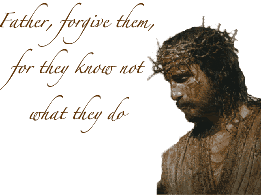
The Ninth Station of the Cross is the third fall of Jesus. If you have ever done the Stations of the Cross in a Catholic Church, you may have noticed that in comparing the stations in which Jesus falls - the third, seventh and ninth stations - you will see that each time our Lord falls, it is closer to the ground, so that by his third fall he is usually laying flat on the ground. Our Lord is physically and literally drained, having lost a good portion of his blood and also suffering from severe dehydration. He has no physical strength left. But as St. Paul wrote in II Corinthians 12:10:
For when I am weak, then I am strong.
And in the prior verse, verse 9, we are told:
My grace is sufficient for you, for my power is made perfect in weakness.
God cannot work with or through those who are "feeling their oats", who feel strong and independent. Our Lord gave us the example of what it means to be a servant of God. St. Paul told us in the book of Philippians that Christ emptied himself (Philippians 2:5-8):
Have this mind among yourselves, which is yours in Christ Jesus, who, though he was in the form of God, did not count equality with God a thing to be grasped, but made himself nothing, taking the form of a servant, being born in the likeness of men. And being found in human form, he humbled himself by becoming obedient to the point of death, even death on a cross.
No one in all of human history was stronger than Jesus when he struggled in physical weakness to walk the Road of Calvary and then hang helpless on the Cross. It was through this act, done by a man so physically weak he could not stand up, that salvation came to the world. The smaller we make ourselves and the weaker we are, the closer to God we will be and the more He will work in us. This lesson was taught by one of our greatest modern saints, St. Thérèse of Liseux, both a saint and a doctor of the church:
[U]nderstand that to love JESUS, to be His Victim of Love, the weaker one is, without desires, or strengths, the more apt one is for the operations of that consuming and transforming Love. . . let us love our littleness, love to feel nothing, then we shall be poor in spirit, and JESUS will come for us, far off as we are. He will transform us in love's flames.
If we are to walk in Christ's steps, we must become as dependent upon the Father as he was. Self-help programs are anathema to the Christian. There is no such thing in a Christian life as "pulling yourself up by your bootstraps." In fact, in many ways there is no such thing as "self" in the Christian life. Any time we start focusing on ourselves and our "abilities", we are excluding Christ. It is when we are down on the ground and unable to stand up, as Christ was on the road of Calvary, that Our Lord can really work in us.
What was it really that made Christ so weak? Certainly his physical weakness came from his multitude of physical wounds and loss of blood. But this is what St. Francis tells us in his Way of the Cross:
Jesus, arriving exhausted at the foot of Calvary, falls for the third time to the ground. His love for us, however, is not diminished, not extinguished. What a fearfully oppressive burden our sins must be to cause Jesus to fall so often! Had He, however, not taken them upon Himself, they would have plunged us into the abyss of Hell.
The real cause of Christ's weakness was our sins which He had taken upon Himself, and that is the same cause of our own personal weakness. Sin has a way of deluding us into thinking that we are powerful and self sufficient, that we have no need of God in our lives. Too often, it is when we think we are the strongest that we are the most removed from our Creator. Sin "puffs up", it makes us think we are something we are not. As St. Francis wrote, if Christ had not taken our sins upon himself, we would have quite literally been plunged into hell.
In walking the road to Calvary with our Lord, we too will often find ourselves on the ground unable to help ourselves. That is when we need to remember that this is a time when we can be strongest because the obstacles to the Holy Spirit are being removed from our lives. When we are weakest, then we are strongest.
Most merciful Jesus, I return Thee infinite thanks for not permitting me to continue in sin and to fall, as I have so often deserved, into the depths of Hell. Enkindle in me an earnest desire of amendment; let me never again relapse, but vouchsafe me the grace to persevere in penance to the end of my life.
Our Lord continues on the Way of the Cross. After experiencing unspeakable cruelties and humiliations, we have just seen an act of loving compassion in the kindness of Veronica, who ran out with no regard for her physical safety to wipe the blood, sweat and spittle from Jesus' face. But this act of kindness has no effect on the Roman soldiers, who continue to force Jesus beyond his human ability. He is suffering from severe blood loss and dehydration. There is no part of his body that has not been wounded or bruised in some way. Although Veronica has wiped his face, the blood from his head wounds continues to pour into his eyes, and he can barely see. Notwithstanding the help of Simon of Cyrene who was taking the major load of carrying the Cross, Jesus' physical strength gives out and once more Our Precious Lord falls to the ground.
The Roman soldiers show no mercy and continue to beat him and yell for him to get up. Once again, in their cruelty the Roman soldiers are actually helping our Lord continue on to Calvary where He will save the world.
We know that Jesus was walking this cruel road to Calvary completely on his own human strength, or lack thereof. Yet He is the same one who cured the lame, blind and deaf and even brought the dead back to life. How could one who had the power of the universe and more at his fingertips be in such a powerless position and subject to such unspeakable cruelty?
As Jesus said in the Garden of Gethesame when he was arrested, (Matthew 26:53-54):
Or do you think that I cannot appeal to My Father, and He will at once put at My disposal more than twelve legions of angels? How then will the Scriptures be fulfilled, which say that it must happen this way?”
The soldiers like Pontius Pilate, may have thought they were in charge. Here was a man so weak that a tiny child could have overpowered him. He had no physical strength left and was very close to death.
But the soldiers were wrong. Jesus was in complete control of everything that was happening to him. At one point Pontius Pilate said to Jesus, "Don’t you realize I have power either to free you or to crucify you?" Jesus answered him:
You would have no power over me if it were not given to you from above.
Likewise, the soldiers had power to inflict cruelty on Jesus only because this power was given to them from above.
Why would the great Creator God allow himself to be so humiliated and apparently powerless in the face of his enemies? One very strong message that our Lord was sending us is that without the Grace of God, we have less strength and means to resist our Adversary than Jesus had physical strength to carry His Cross at this point. And we will surely fall if we try to use our own strength to resist sin just as we see our Lord physically fall.
St. Francis said in the Way of the Cross that it was not the weight of the cross or even the cruelty of the soldiers that caused Jesus' fall, but our sins:
The suffering Jesus, under the weight of His cross, again falls to the ground; but the cruel executioners do not permit Him to rest a moment. Pushing and striking Him, they urge Him onward. It is the frequent repetition of our sins which oppress Jesus. Witnessing this, how can I continue to sin?
The physical torture did not cause Jesus any where near the pain he felt as when he took on our sins. The weight of the Cross - far more than his weakened body could handle - was as light as air when compared to the weight of our sins. The actual cause of Jesus' fall, as St. Francis tells us, was our sins. When we see Jesus laying on the ground and physically spent, we must realize that it was our sins which put him there.
When we look at the physically torn and weakened body of Jesus, we are looking at the result of our sins.
St. Francis offers this prayer:
O Jesus, Son of David, have mercy on me! Offer me Thy helping hand, and aid me, that I may not fall again into my former sins. From this very moment, I will earnestly strive to reform: nevermore will I sin! Thou, O sole support of the weak, by Thy grace, without which I can do nothing, strengthen me to carry out faithfully this my resolution.
Is anyone else as overwhelmed by the bad news in this world as I am? Here in the United States our government is playing with our financial future, fighting and squabbling with each other while the US economy hangs in the balance. We have been warned for months about the "fiscal cliff", but here it is only a few hours before it happens, and Washington is still fighting about it.
And that is actually some of the least of the bad news. There is the ongoing persecution of Christian beliefs by our government in which we are being told that we must abide by the law no matter how it goes against our religious doctrines. Hobby Lobby, which is valiantly standing up to the federal government and refusing to pay for birth control for its employees, will now be fined over $1 million a day for choosing to obey God rather than man. Same sex marriage and homosexual rights are making vast inroad into our culture, and now even catholic politicians like Newt Gingrich are telling us we have to get with the program. From gingpac.org:
According to Gingrich, the GOP and conservatives are just going to have to accept same-sex marriage as a political reality in America.
Gingrich, who is currently on his third wife, after having committed adultery against the previous two, says that we must accept gay marriage because it “is in every family, it is in every community.”
He continues: “The momentum is clearly now in the direction in finding some way to… accommodate and deal with reality. And the reality is going to be that in a number of American states — and it will be more after 2014 — gay relationships will be legal, period.”
And speaking of catholic politicians caving, Bobby Jindal, catholic governor of Louisiana, recently wrote an Op Ed for the Wall Street Journal saying that, for the good of the party, the GOP needs to get on the birth control bandwagon as well. From the New York Daily News:
Louisiana Gov. Bobby Jindal is recommending that the GOP endorse over-the-counter birth control as a prescription for the Republican Party’s political health.
In an opinion piece for The Wall Street Journal, the Republican governor argued that allowing birth control pills to be sold without a prescription — as recommended by the American College of Obstetricians and Gynecologists — “would take contraception out of the political arena.”
“As a conservative Republican, I believe that we have been stupid to let the Democrats demagogue the contraceptives issue and pretend, during debates about health-care insurance, that Republicans are somehow against birth control,” Jindal said. “It's a disingenuous political argument they make.” [So what else are Republicans "pretending" to be against??]
He said requiring a prescription for birth control only drives up health care costs and boosts pharmaceutical company profits. [Gov. Jindal, the fact that you're Catholic and your church teaches that birth control is intrinsically evil has no bearing on anything? "Cost" is the only thing that matters?]
Things are much worse in other parts of the world. A judge in England just ruled that "Christians have no right to decline working on Sunday as it is not a 'core component' of their beliefs." From The Telegraph:
A new ruling by a High Court judge - the first on the issue in nearly a decade - says that Christians have no right to decline working on Sunday as it is not a “core component” of their beliefs.
The judgment - which upholds an earlier decision - means that individual Christians do not have any protection from being fired for not working on Sundays.
Campaigners said the decision puts Christians at a disadvantage to other religions and means the judiciary are deciding what the core beliefs of Christians can be, which they say is an interference in the right to practise religion.
The really sad part about this is that most Christians really aren't even going to notice because Sunday is just another day to them anyway. Only about 2% of Anglicans go to Church on Sunday, and about 25% of Catholics attend. Nonetheless, this ruling definitely represents an attack against Christianity and as stated in the article, the UK government is now deciding the validity of Christian beliefs, just as they are doing here in the United States.
Persecution of Christians has gone much further in other parts of the world. From cnn.com:
At least 22 people have been killed in three separate attacks in northeastern Nigeria since Friday, including 15 Christians shot Sunday inside a church, according to officials.
In Sunday's attack, gunmen entered a church in Chibok, also in Borno state, and killed at least 15 worshipers, said Mohammed Kana, a regional official for the National Emergency Management Agency.
"Some of the people had their throats slit," Kana said, citing NEMA staff who responded to the scene.
Sunday's violence comes six days after attackers raided two churches during Christmas Eve services, killing 12 people.
And of course, the legal, systematic killing of our children continues unabated in abortion clinics throughout the United States and the entire world. Here in New York City, 41% of all pregnancies end in abortion, with some parts of the city having a 60% abortion rate.
A dark, dark veil has descended upon this world, and it grows darker with each day. I don't know specifically what our immediate future holds, but it sure don't look good.
Today, December 1, is the First Saturday of the Month. The First Saturday Devotion to the Immaculate Heart of Mary was first mentioned by Our Lady of Fatima on July 13, 1917. After showing the three children a vision of hell she said, "You have seen hell where the souls of poor sinners go. To save them, God wishes to establish in the world devotion to my Immaculate Heart. If what I say to you is done, many souls will be saved and there will be peace... I shall come to ask for... the Communion of reparation on the first Saturdays..." The First Saturday devotion is as follows:
It consists in going to Confession, receiving Communion, reciting five decades of the Rosary and meditating for a quarter of an hour on the mysteries of the Rosary on the first Saturday of five consecutive months. The Confession may be made during the eight days preceding or following the first Saturday of each month, provided that Holy Communion be received in the state of grace. Should one forget to form the intention of making reparation to the Immaculate Heart of Mary, it may be formed at the next Confession, occasion to go to confession being taken at the first opportunity.
We are seeing the persecution of Christians around the globe today. There is a story in recent days out of Syria of a Catholic priest, Father Fadi Haddad, who had gone out to negotiate the release of one of his parishioners. His lifeless body was found several days later with his eyes gouged out. There has been active persecution of Christians in Syria, as well as in Lebanon, Egypt, Iraq, and a whole host of countries in the Middle East. We have heard of the terrible Church bombings and killings of Christians in Africa.
Now, of course, we have the beginning of active persecution of Christians, and specifically Catholics, here in the United States. And this persecution is more than the HHS Mandate which forces Catholics to violate their religious beliefs. We are also talking about the active war on God in the public marketplace, which we see in full force now that the Christmas season has begun as, across the nation, nativity scenes which were a part of communities for generations are being forcibly removed. Christmas trees are now referred to as "holiday" trees.
These situations are going to worsen as Christianity is rejected by the world's elite. The re-election of Barack Obama as President has ensured that persecution of Christians, and the Catholic Church in particular, will become more acute in the United States as Christian beliefs are dismissed by the general society as intolerant and even hateful.
All of this amounts to being handed a very heavy Cross which we must bear, just as our Lord was handed His Cross to carry to Calvary where He was crucified. And that leads us to the Fourth of the Sorrowful Mysteries of the Rosary: Christ Carries His Cross.
Why was it so important that Our Lord carry His Cross? Why should He have to suffer such a terrible death and even carry the instrument upon which He so tortuously died? I found a beautiful meditation on this from how-to-pray-the-rosary-everyday.com, and one particularly profound statement from this meditation:
In Carrying the cross, Jesus shows how embracing suffering is the only way to peace. . . . Jesus carrying the cross demonstrates the need to embrace suffering and carry your own cross as the only way to peace and serenity.
This statement seems, on its face, to be totally contradictory. How can carrying our Cross - which stands for that which causes us great pain and suffering - be the "only way to peace and serenity"? In our western culture especially we have been taught that we should avoid pain at all costs. We have medications to take care of every pain possible. We are told that we should relax and enjoy life as much as we can. "You deserve a break today." One big problem with this philosophy is that it goes completely against the command of our Lord:
I'm certainly not saying that it is wrong to alleviate pain in our life by taking painkillers once in a while. But if we make our whole life about running away from hardship and pain, we may be running away from our salvation.
When our Lord was given His Cross to carry to Calvary, this instrument upon which He was nailed and died, He actually embraced and kissed the Cross, because this was the means by which He would save mankind from death and destruction. If our Lord had run away from His Cross, He would have been running away from the very purpose for which He was born. He would have gained temporary reprieve from His great suffering, but the end result would be the loss of all of mankind. Our Lord actually did ask that this heavy price be lifted from Him, but He ended his prayer to the Father with, "Not my will, but yours be done."
If we run away from the Cross which our Lord gives us to carry, we will be running away from our own personal salvation and possibly cause the loss of salvation for many others. Our Cross is our own personal road to Heaven, custom made by Our Lord just for us. This personally tailored Cross is the only sure way to Heaven and eternity with the Holy Trinity. All other roads lead to damnation. If we decide that we don't like the Cross we have been given by Christ and try to make our own, if instead of praying that the Father's Will be done, as Christ did, and we instead choose our own way, then we are no longer on the road to salvation. Unless we repent of our willfulness, we will pay the price with the loss of salvation.
We look at great athletes and know that the only way they achieved their success was by denying themselves and pushing their bodies beyond what they thought they could endure. We look at great musicians, writers and artists, and we know that they achieved greatness only by giving everything they had to their craft. No one has ever achieved success by giving in to their own wants and desires. As the old saying goes, "No pain, no gain." Our Lord told us that we must deny ourselves and take up the Cross He gives to us. Just as He did, we must carry our cross, and that cross that will lead to peace and happiness beyond our imagination.
Right now Christianity as a whole has been given a very heavy cross to bear: persecution and tribulation at the hands of our fellow man. We can't run away from this. We must face up to it and all of its implications. Many Christians are literally paying the price with their lives, and in doing so, they are giving great witness to the world and glory to God. Many others will be led to salvation because these faithful Christians did not run away from their cross. We must pray for the grace and the strength to do the same. Our vision and understanding is extremely limited. As we are told in Proverbs, "There is a way that seems right to a man, but its end is the way of death." (Proverbs 14:12). We must learn to trust the One who gives us every breath we breathe, the one who gave His Life for us on the Cross of Salvation. It may seem like we are surrounded by darkness and despair, but Our Lord is always right alongside carrying the Cross with us.
1 Who hath believed our report? and to whom is the arm of the Lord revealed?
2 And he shall grow up as a tender plant before him, and as a root out of a thirsty ground: there is no beauty in him, nor comeliness: and we have seen him, and there was no sightliness, that we should be desirous of him:
3 Despised, and the most abject of men, a man of sorrows, and acquainted with infirmity: and his look was as it were hidden and despised, whereupon we esteemed him not.
4 Surely he hath borne our infirmities and carried our sorrows: and we have thought him as it were a leper, and as one struck by God and afflicted.
5 But he was wounded for our iniquities, he was bruised for our sins: the chastisement of our peace was upon him, and by his bruises we are healed.
6 All we like sheep have gone astray, every one hath turned aside into his own way: and the Lord hath laid on him the iniquity of us all.
7 He was offered because it was his own will, and he opened not his mouth: he shall be led as a sheep to the slaughter, and shall be dumb as a lamb before his shearer, and he shall not open his mouth.
8 He was taken away from distress, and from judgment: who shall declare his generation? because he is cut off out of the land of the living: for the wickedness of my people have I struck him.
9 And he shall give the ungodly for his burial, and the rich for his death: because he hath done no iniquity, neither was there deceit in his mouth.
10 And the Lord was pleased to bruise him in infirmity: if he shall lay down his life for sin, he shall see a long-lived seed, and the will of the Lord shall be prosperous in his hand.
11 Because his soul hath laboured, he shall see and be filled: by his knowledge shall this my just servant justify many, and he shall bear their iniquities.
12 Therefore will I distribute to him very many, and he shall divide the spoils of the strong, because he hath delivered his soul unto death, and was reputed with the wicked: and he hath borne the sins of many, and hath prayed for the transgressors.
Today, Good Friday, is the most solemn day of the year for Christians. Today we commemorate the crucifixion and death of our Lord and Creator, Jesus Christ, who came to this earth, taking on the form of a man, and spilling His Precious Blood to redeem us from the sure damnation that we all face. The suffering Christ on the Cross is the picture of what love is all about - giving your life for others.
I have posted a video below which takes scenes from Mel Gibson's Passion of the Christ. As graphic and gruesome as this video may be, it still does not show the full extent of the suffering of our Lord. Please watch this video in prayerful meditation, and then get down on your knees and gave thanks to our most beloved Lord Jesus for his great and awesome sacrifice, offering his Life on the Cross to pay for our sins.
What does it mean to truly follow Christ? Pope Benedict XVI gives great insight into this question in his sermon given on Palm Sunday. He starts out by telling us that Christ our King is going to Jerusalem to fulfill Scripture and to be nailed to the Cross, which the Holy Father calls "the throne from which he will reign for ever, drawing to himself humanity of every age and offering to all the gift of redemption." This is in direct contrast to what the world views as a king. We see Christ nailed to the Cross, unable to even move, and yet the Holy Father tells us He is accomplishing the greatest work in the universe. By His suffering, he is redeeming mankind from eternal damnation. The Holy Father calls Christ "the conquerer of death."
This goes against the "feel good" message that so many preach about Christ, that he came to relieve the physical suffering of humanity. Certainly that is part of the Gospel message, but ultimately, Christ's greatest concern is not to free us from physical suffering, but from sin and eternal death. And the only path to that redemption is through the Cross, which is Christ's throne. Christ calls to us from the Cross, His Throne. We must go to the Cross with Him.
As always, there is tremendous depth and meaning to the Pope's sermon. It is worth reading and re-reading to gain all the many insights which it contains. I have highlighted a few things that stand out to me. I am sure there is much I have missed.
Full Text: Pope's Homily on Palm Sunday
Dear Brothers and Sisters, Palm Sunday is the great doorway leading into Holy Week, the week when the Lord Jesus makes his way towards the culmination of his earthly existence.He goes up to Jerusalem in order to fulfil the Scriptures and to be nailed to the wood of the Cross, the throne from which he will reign for ever, drawing to himself humanity of every age and offering to all the gift of redemption. We know from the Gospels that Jesus had set out towards Jerusalem in company with the Twelve, and that little by little a growing crowd of pilgrims had joined them. Saint Mark tells us that as they were leaving Jericho, there was a “great multitude” following Jesus (cf. 10:46).
On the final stage of the journey, a particular event stands out, one which heightens the sense of expectation of what is about to unfold and focuses attention even more sharply upon Jesus. Along the way, as they were leaving Jericho, a blind man was sitting begging, Bartimaeus by name. As soon as he heard that Jesus of Nazareth was passing, he began to cry out: “Jesus, Son of David, have mercy on me!” (Mk 10:47). People tried to silence him, but to no avail; until Jesus had them call him over and invited him to approach. “What do you want me to do for you?”, he asked. And the reply: “Master, let me receive my sight” (v. 51). Jesus said: “Go your way, your faith has made you well.” Bartimaeus regained his sight and began to follow Jesus along the way (cf. v. 52). And so it was that, after this miraculous sign, accompanied by the cry “Son of David”, a tremor of Messianic hope spread through the crowd, causing many of them to ask: this Jesus, going ahead of us towards Jerusalem, could he be the Messiah, the new David? And as he was about to enter the Holy City, had the moment come when God would finally restore the Davidic kingdom?
The preparations made by Jesus, with the help of his disciples, serve to increase this hope. As we heard in today’s Gospel (cf. Mk 11:1-10), Jesus arrives in Jerusalem from Bethphage and the Mount of Olives, that is, the route by which the Messiah was supposed to come. From there, he sent two disciples ahead of him, telling them to bring him a young donkey that they would find along the way. They did indeed find the donkey, they untied it and brought it to Jesus. At this point, the spirits of the disciples and of the other pilgrims were swept up with excitement: they took their coats and placed them on the colt; others spread them out on the street in Jesus’ path as he approached, riding on the donkey. Then they cut branches from the trees and began to shout phrases from Psalm 118, ancient pilgrim blessings, which in that setting took on the character of messianic proclamation: “Hosanna! Blessed is he who comes in the name of the Lord! Blessed is the kingdom of our father David that is coming! Hosanna in the highest!” (v. 9-10). This festive acclamation, reported by all four evangelists, is a cry of blessing, a hymn of exultation: it expresses the unanimous conviction that, in Jesus, God has visited his people and the longed-for Messiah has finally come. And everyone is there, growing in expectation of the work that Christ will accomplish once he has entered the city.
But what is the content, the inner resonance of this cry of jubilation? The answer is found throughout the Scripture, which reminds us that the Messiah fulfils the promise of God’s blessing, God’s original promise to Abraham, father of all believers: “I will make of you a great nation and I will bless you ... and by you all the families of the earth shall bless themselves” (Gen 12:2-3). It is the promise that Israel had always kept alive in prayer, especially the prayer of the Psalms. Hence he whom the crowd acclaims as the blessed one is also he in whom the whole of humanity will be blessed. Thus, in the light of Christ, humanity sees itself profoundly united and, as it were, enfolded within the cloak of divine blessing, a blessing that permeates, sustains, redeems and sanctifies all things. [Without Christ, humanity has no hope.]
Here we find the first great message that today’s feast brings us: the invitation to adopt a proper outlook upon all humanity, on the peoples who make up the world, on its different cultures and civilizations. The look that the believer receives from Christ is a look of blessing: a wise and loving look, capable of grasping the world’s beauty and having compassion on its fragility. Shining through this look is God’s own look upon those he loves and upon Creation, the work of his hands. We read in the Book of Wisdom: “But thou art merciful to all, for thou canst do all things, and thou dost overlook men’s sins, that they may repent. For thou lovest all things that exist and hast loathing for none of the things which thou hast made ... thou sparest all things, for they are thine, O Lord who lovest the living” (11:23-24, 26).
Let us return to today’s Gospel passage and ask ourselves: what is really happening in the hearts of those who acclaim Christ as King of Israel? Clearly, they had their own idea of the Messiah, an idea of how the long-awaited King promised by the prophets should act. Not by chance, a few days later, instead of acclaiming Jesus, the Jerusalem crowd will cry out to Pilate: “Crucify him!”, while the disciples, together with others who had seen him and listened to him, will be struck dumb and will disperse. The majority, in fact, was disappointed by the way Jesus chose to present himself as Messiah and King of Israel. This is the heart of today’s feast, for us too. Who is Jesus of Nazareth for us? What idea do we have of the Messiah, what idea do we have of God? It is a crucial question, one we cannot avoid, not least because during this very week we are called to follow our King who chooses the Cross as his throne. We are called to follow a Messiah who promises us, not a facile earthly happiness, but the happiness of heaven, divine beatitude.So we must ask ourselves: what are our true expectations? What are our deepest desires, with which we have come here today to celebrate Palm Sunday and to begin our celebration of Holy Week? [Here the Holy Father is speaking to those who feel that Christ's Gospel message is one of social justice, of enriching the earthly, material lives of humanity. But as the Holy Father says, "we are called to follow our King who chooses the Cross as his throne." Our Lord did not choose physical comfort but suffering, and if we are to follow Him, we must choose this same Cross.]
Dear young people, present here today, this, in a particular way, is your Day, wherever the Church is present throughout the world. So I greet you with great affection! May Palm Sunday be a day of decision for you, the decision to say yes to the Lord and to follow him all the way, the decision to make his Passover, his death and resurrection, the very focus of your Christian lives.[The Holy Father is urging the young people to choose not the way of materialism, which leads to death, but the Way of the Cross, which leads to life. To do this, we must make Christ, not the things of this world, the center of our lives.] It is the decision that leads to true joy, as I reminded you in this year’s World Youth Day Message – “Rejoice in the Lord always” (Phil 4:4). So it was for Saint Clare of Assisi when, on Palm Sunday 800 years ago, inspired by the example of Saint Francis and his first companions, she left her father’s house to consecrate herself totally to the Lord. She was eighteen years old and she had the courage of faith and love to decide for Christ, finding in him true joy and peace.
Dear brothers and sisters, may these days call forth two sentiments in particular: praise, after the example of those who welcomed Jesus into Jerusalem with their “Hosanna!”, and thanksgiving, because in this Holy Week the Lord Jesus will renew the greatest gift we could possibly imagine: he will give us his life, his body and his blood, his love.Butwe must respond worthily to so great a gift, that is to say, with the gift of ourselves, our time, our prayer, our entering into a profound communion of love with Christ who suffered, died and rose for us. The early Church Fathers saw a symbol of all this in the gesture of the people who followed Jesus on his entry into Jerusalem, the gesture of spreading out their coats before the Lord. Before Christ – the Fathers said – we must spread out our lives, ourselves, in an attitude of gratitude and adoration. As we conclude, let us listen once again to the words of one of these early Fathers, Saint Andrew, Bishop of Crete: “So it is ourselves that we must spread under Christ’s feet, not coats or lifeless branches or shoots of trees, matter which wastes away and delights the eye only for a few brief hours. But we have clothed ourselves with Christ’s grace, or with the whole Christ ... so let us spread ourselves like coats under his feet ... let us offer not palm branches but the prizes of victory to the conqueror of death. Today let us too give voice with the children to that sacred chant, as we wave the spiritual branches of our soul: ‘Blessed is he who comes in the name of the Lord, the King of Israel’” (PG 97, 994). Amen!
We must forsake this world and all of its ways and cling to the Cross of our Lord, to His Throne, if we are to be saved.
Today is Palm Sunday, the beginning of Holy Week in which we commemorate the Passion of Jesus Christ when he suffered and died to redeem us from sin. This is the holiest week of the year in the Liturgical Calendar. Palm Sunday is that day in which Our Lord entered Jerusalem on a donkey in fulfillment of the scripture from Zachariah 9:9: "Rejoice greatly, O daughter of Sion, shout for joy, O daughter of Jerusalem: Behold thy king will come to thee, the just and saviour: he is poor, and riding upon an ass, and upon a colt, the foal of an ass." Jesus was greeted with great rejoicing by those who had just seen him raise Lazarus from the dead. But in only a few short days, many of these same people would be shouting for his death. But if these people had not been calling for the death of our Lord, it is possible that we would not have a Saviour. Read on for an explanation.
The Romans force Simon of Cyrene
to assist Jesus in carrying the Cross
In meditating upon the Stations of the Cross, I have always found the 5th Station, in which the Romans force Simon of Cyrene to assist Jesus in carrying the cross, to be very ironic. The Romans did not force Simon of Cyrene to assist Jesus out of any compassion for our Suffering Lord. It was to keep Jesus alive long enough to get Him to Calvary where they could nail Him to a Cross and crucify Him. Yet, it was the Romans and Jews, the ones who wanted Jesus dead and out of the way, who were the people who enabled Jesus to successfully fulfill his mission of dying on the Cross and redeeming mankind. The Apostle Peter, who professed great love and devotion to our Lord, actually tried to stop Jesus from dying, and our Lord's response to Peter was to call him Satan. If Peter had been successful, we would not have a Saviour.
I always took this lesson of the assistance of Simon of Cyrene to mean that often those who declare themselves our avowed enemies and seek only our destruction can sometimes be the very ones who will give us the help we need to succeed in gaining eternal life. Those who love us the most are sometimes the ones who are more harmful to us in the long run.
In the traditional breviary today, there is a sermon from St. Leo the Pope in which he describes this ironic scenario in which Satan, by stirring up such hatred against Jesus, actually defeated himself. It was Satan's intense desire to destroy Jesus through the Jews that Jesus was crucified and defeated our arch enemy and redeemed us from his hands. As St. Leo says in his sermon:
But he was undone by his own malice. For he brought upon the Son of God that death which is become life to all the sons of man. He shed that innocent blood which was to become at once the price of our redemption and the cup of our salvation.
Here is the entire sermon. Evil can never defeat our Lord, who actually uses evil to defeat itself.
The Lesson is taken from a Sermon by St. Leo the Pope
Dearly beloved, the Solemnity of the Lord's Passion is come ; that day which we have so desired, and which same is so precious to the whole world. Shouts of spiritual triumph are ringing, and suffer not that we should be silent. Even though it be hard to preach often on the same solemnity, and do so meetly and well, a priest is not free to shirk the duty of preaching to the faithful concerning this so great mystery of divine mercy. Nay, that his subject-matter is unspeakable should in itself make him eloquent, since where enough can never be said, there must needs ever be something to say. Let human weakness, then, fall down before the glory of God, and acknowledge itself unequal to the duty of expounding the works of his mercy. Let us toil in thought, let us fail in insight, let us falter in speech ; it is good for us to feel how inadequate is the little we are able to express concerning the majesty of God.
For when the Prophet saith : Seek the Lord and his strength ; seek his face evermore : let no man thence conclude that he will ever find all that he seeketh. For if he cease his seeking, he will likewise cease to draw near. But among all the works of God which weary the stedfast gaze of man's wonder, what is there that doth at once so ravish and so exceed the power of our contemplation as the Passion of the Saviour? He it was who, to loose mankind from the bonds of the death-dealing Fall, spared to bring against the rage of the devil the power of the divine Majesty, and met him with the weakness of our lowly nature.[Christ defeated Satan not with the nature of God, but with His lowly and weak Human Nature, a most cruel defeat for the Evil One.] For if our cruel and haughty enemy could have known the counsel of God's mercy, it had been his task rather to have softened the hearts of the Jews into meekness, than to have inflamed them with unrighteous hatred.Thus he might not have lost the thraldom of all his slaves, by attacking the liberty of the One that owed him nothing. [If Satan had not been blinded by his hatred of God and Goodness, he would have realized that allowing Christ to live would have given him victory. Killing Christ gave the victory to our Lord.]
He shed that innocent blood which was to become at once the price of our redemption and the cup of our salvation.[It was our enemy, who wants all of us dead, who shed the Precious Blood that gives us Life.] Wherefore the Lord hath received that which according to the purpose of his own good pleasure he hath chosen. And such was his loving-kindness, even for his murderers, that his prayer to his Father from the Cross asked not vengeance for himself but forgiveness for them.
The next time you are on the receiving end of persecution or cruelty and hatred of any sort, remember, this may very well be what will help you to gain eternal life.
As part of my Lenten practices, I have been trying to do the Seven Sorrows of Mary everyday, and also the Stations of the Cross. I don't have time to do these at church, so I actually pray them by using my Ipod. I guess it's the 21st Century way.
Doing these devotions has naturally led me to meditate on the Crucifixion of our Lord and also on the role of the Blessed Mother in our Lord's sacrifice. She was with him literally every step of the way, never turning away from the horror and the pain, suffering right along with him, and yet never turning against any of those who were torturing her Son. She was love personified. She was also a wall of strength to all who stayed by her side.
I attended a Lenten reflection last night, and one of the topics brought up by the priest giving the reflection was Mary's role in the sacrifice of Christ. I began to think more about that, and it dawned on me that at the Crucifixion, those who stayed with Mary also stayed with Christ, because that is where she was. To follow Mary was to follow Christ. All those who ran away - all but one of the apostles and all but a handful of the disciples - also abandoned Mary.
I believe this is true for every believer. If we will stay with Mary, Jesus' beloved mother whom he has given to us as our Mother, we will never stray from Christ. She will be our strength and help us carry our crosses just as she was with her own Son on his way to Calvary, and throughout his entire life on this earth. Those who stayed with Mary at the foot of the cross were given the courage and strength to face the horrors of that first Good Friday. There is nothing that we can face that can be more horrific than that day, when perfect Goodness and Purity was crucified so that we could be saved.
Here is a wonderful reflection on the martyrdom of Mary and her sufferings with her Son by St. Alphonsus Liguori from catholictradition.org
The Martyrdom of Mary Was Never Equaled
by St. Alphonsus Liguori
The words of the prophet Jeremias explain my meaning on this point:
To what shall I compare thee? or to what shall I liken thee, O daughter of Jerusalem? ... for great as the sea is thy destruction; who shall heal thee? (Lam. 2:13) No, the acuteness of the sufferings of Mary are not to be compared, even with those of all the Martyrs united. "The Martyrdom of Mary," says Saint Bernard, "was not caused by the executioner's sword, but proceeded from bitter sorrow of heart." In other Martyrs torments were inflicted on the body; but Mary's sorrow was in her heart and soul, verifying in her the prophecy of Simeon, Thy own soul a sword shall pierce. (Luke 2:35)
Arnold of Chartres writes that "whoever had been on Mount Calvary, to witness the great sacrifice of the Immaculate Lamb, would there have beheld two great altars, the one in the Body of Jesus, the other in the heart of Mary; for on that Mount, when the Son sacrificed His Body by death, Mary sacrificed her soul by compassion." So much so, says Saint Antoninus, that whereas other Martyrs sacrifice their own lives, the Blessed Virgin consummated her Martyrdom by sacrificing the life of her Son, a life which she loved far more than her own, and which caused her to endure a torment which exceeded all other torments ever endured by any mortal on earth.
As a general rule, the sufferings of children are also the sufferings of their mothers who are present at and witness their torments. This Saint Augustine declares, when speaking of the mother of the Machabees, who witnessed the execution of her children, Martyred by order of the cruel Antiochus: he says that "Love caused her to endure in her soul all the torments inflicted on each of her children." Erasmus adds that "Mothers suffer more at the sight of the sufferings of their children than if the torments were inflicted on themselves." This, however, is not always true; but in Mary it was verified; for she certainly suffered more in witnessing the sufferings of her Son than she would have done had she endured all the torments in her own person. "All the wounds," says Saint Bonaventure, "which were scattered over the Body of Jesus were united in the heart of Mary, to torment her in the Passion of her Son" so that, as Saint Lawrence Justinian writes, "The heart of Mary, by compassion for her Son, became a mirror of His torments, in which might be seen, faithfully reflected, the spittings, the blows, the wounds, and all that Jesus suffered."We can therefore say that Mary, on account of the love that she bore Him, was in heart, during the Passion of her Son, struck, scourged, crowned with thorns, and nailed to the very Cross of her Son.
The same Saint Lawrence considers Jesus on His road to Calvary, with the Cross on His shoulders, turning to Mary and saying to her, "Alas, My Own dear Mother, where are you going? What a scene will you witness? You will be agonized by My sufferings, and I by yours." But the loving Mother would follow Him all the same, though she knew that, by being present at His death, she would have to endure a torment greater than any death. She saw that her Son carried the Cross to be crucified upon it; and, adds Abbot William, she also took up the cross of her sorrows, and followed her Son to be crucified with Him. Hence Saint Bonaventure considers Mary standing by the Cross of her dying Son, and asks her, saying, "O Lady, tell me where did you then stand---was it near the Cross? No, you were on the Cross itself, crucified with your Son." About these words of the Redeemer, foretold by the prophet Isaias, I have trodden the wine-press alone, and of the Gentiles there is not a man with me. (Isaias 63:3) Richard of St. Lawrence says, "It is true, O Lord, that in the work of human redemption You did suffer alone, and that there was not a man that sufficiently pitied You; but there was a woman with You, and she was Your Own Mother; she suffered in her heart all that You endured in Your Body."
To show the sufferings endured by other Martyrs they are represented with the instruments of their torture; Saint Andrew with a cross, Saint Paul with a sword, Saint Lawrence with a gridiron; Mary is represented with her dead Son in her arms; for He alone was the instrument of her Martyrdom, and compassion for Him made her the Queen of Martyrs. On this subject of Mary's compassion in the death of Jesus Christ, Father Pinamonti gives expression to a beautiful and remarkable opinion: he says, that "the grief of Mary in the passion of her Son was so great, that she alone compassionated in a degree by any means adequate to its merits the death of a God made man for the love of man."
Blessed Amadeus also writes, that "Mary suffered much more in the Passion of her Son than she would have done if she herself had endured it; for she loved her Jesus much more than she loved herself," Hence Saint Ildephonsus did not hesitate to assert, that "the sufferings of Mary exceed those of all Martyrs united together." Saint Anselm, addressing the Blessed Virgin, says, "The most cruel torments inflicted on the holy Martyrs were trifling or as nothing in comparison with your Martyrdom, O Mary." The same Saint adds, "Indeed, O Lady, in each moment of your life your sufferings were such that you could not have endured them, and would have expired under them, had not your Son, the source of your life, preserved you." Saint Bernadine of Sienna even says, that "the sufferings of Mary were such that had they been divided among all creatures capable of suffering, they would have caused their immediate death." Who, then, can ever doubt that the Martyrdom of Mary was without its equal, and that it exceeded the sufferings of all the Martyrs; since, as Saint Antoninus says, "they suffered in the sacrifice of their own lives; but the Blessed Virgin suffered by offering the life of her Son to God, a life which she loved far more than her own."
The Martyrs suffered under the torments inflicted on them by tyrants; but Our Lord, Who never abandons His servants, always comforted them in the midst of their sufferings. The love of God, which burnt in their hearts, rendered all these sufferings sweet and pleasing to them. Saint Vincent suffered, when on the rack he was torn with pincers and burnt with hot iron plates; but Saint Augustine says that "the Saint spoke with such contempt of his torments, that it seemed as if it was one who spoke and another who suffered." Saint Boniface suffered when the flesh was torn from his body with iron hooks, sharp reeds were forced under his nails and melted lead was poured into his mouth; but in the midst of all, he could never cease to thank Jesus Christ, Who allowed him to suffer for His love. Saint Lawrence suffered when roasting on a gridiron; "but the love which inflamed him," says Saint Augustine, "did not allow him to feel the fire, or even that prolonged death itself."
The greater the love of the Martyrs for Jesus Christ, the less they felt their pains: and in the midst of them all, the remembrance of the Passion of Christ sufficed to console them. With Mary it was precisely the reverse; for the torments of Jesus were her Martyrdom, and love for Jesus was her only executioner. Here we must repeat the words of Jeremias: As the sea is all bitterness, and has not within its bosom a single drop of water which is sweet, so also was the heart of Mary all bitterness, and without the least consolation: Who shall heal you? Her Son alone could heal her and heal her wounds; but how could Mary receive comfort in her grief from her crucified Son, since the love she bore Him was the whole cause of her Martyrdom?
"To understand, then, how great was the grief of Mary, we must understand," says Cornelius a Lapide, "how great was the love she bore her Son." But who can ever measure this love?
Blessed Amadeus says, that "natural love towards Him as her Son, and supernatural love towards Him as her God, were united in the heart of Mary."
These two loves were blended into one, and this so great a love that William of Paris does not hesitate to assert, that Mary loved Jesus ''as much as it was possible for a pure creature to love Him." So that, as Richard of St. Victor says, ''as no other creature loved God as Mary loved Him, so there was never any sorrow like Mary's sorrow."
Now there stood by the Cross of Jesus His Mother. Let us stay awhile to consider these words before concluding our discourse; but I entreat you to renew your attention.
There stood. When Jesus was on the Cross, the disciples had already abandoned Him; they had done so from the moment in which He was taken in the Garden of Olives: then the disciples all leaving Him fled. (Matt. 26:56) The disciples abandoned Him; but His loving Mother did not abandon Him; she remained with Him until He expired.
There stood by. Mothers fly when they see their children suffer much, and are unablehers fly when they see their children suffer much, and are unable to give them relief; they have not the strength to endure the torment, and therefore fly to a distance. Mary beheld her Son in agony on the Cross; she saw that His sufferings were slowly depriving Him of life; she desired to relieve Him in that last extremity, but could not; but with all this she did not fly, she did not go to a distance, but drew nearer to the Cross on which her Son was dying.
She stood by the Cross. The Cross was the hard bed on which Jesus Christ had to die. Mary, who stood by its side, never turned her eyes from Him; she beheld Him all torn by the scourges, thorns, and nails; she saw that her poor Son, suspended by those three iron hooks, found no repose. She, as I have already said, would have desired to give Him some relief; she would have desired, at least, that He should have expired in her arms; but no, even this is forbidden her. "Ah, Cross!" she must have said, "restore me my Son; you are a gibbet for malefactors, but my Son is innocent." But wait, O sorrowful Mother; God's will is that the Cross should only restore you your Son when He has expired.
Saint Bonaventure, considering the sorrow of Mary in the death of her Son, writes, that "no grief was more bitter than hers, because no son was as dear as her Son." Since, then, there never was a son more worthy than Jesus, nor any mother who ever loved as Mary loved, what sorrow can be compared with the sorrow of Mary? "Ah, there never has been in the world a more amiable Son than Jesus," says Richard of St. Lawrence, "nor was there ever so loving a Mother. Had there been less love between this Mother and Son, His death would have been less cruel, their griefs would have been diminished: but the more tender were their loves, the deeper were their wounds." Mary saw that death approached her Son; therefore, casting her compassionate eyes upon Him, she seemed to say, "Ah, Son, You already depart, already You leave me; and are You silent? Give me a last remembrance." Yes, He did so. Jesus Christ left her a remembrance; it was this: Woman, He said, behold your son, referring to Saint John, who stood near; and with these words He bade her farewell. He called her woman, that by the sweet name of mother He might not increase her grief: Woman, behold your son, he will take charge of you when I am dead.
There stood by the Cross of Jesus His Mother. Let us finally observe Mary, who stood at the foot of the Cross and beheld her Son expire. But, a God, what Son was it that died? It was a Son Who from all eternity had chosen her for His Mother, and had preferred her in His love to all men and Angels: it was a Son so beautiful, so holy, so amiable; a Son Who had always obeyed her; a Son Who was her only love, for He was her Son and her God; and Mary had to see Him die before her eyes, of pure suffering. But behold, the hour of the death of Jesus has already come; the afflicted Mother saw her Son then enduring the last assaults of death; behold, again, His Body was already sinking, His head drooped down on His breast, His mouth opened, and He expired. The people cry out, "He is dead! He is dead!" And Mary also said, "Ah, my Jesus, my Son, You are now dead!"
When Jesus was dead, He was taken down from the Cross. Mary received Him with outstretched arms; she then pressed Him to her heart, and examined that head wounded by the thorns, those hands pierced with nails, and that body all lacerated and torn. "Ah, Son," she said, "to what has Your love for men reduced You!" But the disciples, fearing that with her Son clasped in her arms she would die of grief, out of compassion approached her, and with reverential determination, removed her Son from her arms, wrapped Him in the winding sheet, and carried Him away to bury Him. The other holy women accompanied Him, and with them the sorrowful Mother followed her Son to the tomb; where, having herself deposited Him with her own hands, she bade Him a last farewell and retired. Saint Bernard says, that ''as Mary passed along the way, her sorrow and grief were such, that all who met her were thereby moved to tears;" and he adds that "those who accompanied her were weeping rather for her than for Our Lord."
My readers, let us be devout to the sorrows of Mary. Saint Albert the Great writes, that ''as we are under great obligations to Jesus Christ for His death, so also are we under great obligations to Mary for the grief which she endured when she offered her Son to God by death for our salvation." This the Angel revealed to Saint Bridget: he said that the Blessed Virgin, to see us saved, herself offered the life of her Son to the Eternal Father: a sacrifice which, as we have already said, cost her greater suffering than all the torments of the Martyrs, or even death itself. But the Divine Mother complained to Saint Bridget that very few pitied her in her sorrows, and that the greater part of the world lived in entire forgetfulness of them. Therefore she exhorted the Saint, saying: "Though many forget me, don't you, my daughter, forget me." For this purpose the Blessed Virgin herself appeared in the year 1239 to the founder of the Order of the Servites, or Servants of Mary, to requested them to institute a religious order in remembrance of her sorrows; and this they did.
Jesus Himself one day spoke to Blessed Veronica of Binasco, saying, "Daughter, tears shed over My Passion are dear to Me: but as I love My Mother Mary with an immense love, the meditation of the sorrows which she endured at My death is also very dear to Me." It is also well to know, as Pelbart relates it, that it was revealed to Saint Elizabeth of Hungary, that Our Lord had promised four special graces to those who are devout to the sorrows of Mary:
1st, thatthose who before death invoke the Divine Mother, in the name of her sorrows, should obtain true repentance of all their sins:
2nd, that He would protect all who have this devotion in their tribulations, and that He would protect them especially at the hour of death:
3rd, that He would impress upon their minds the remembrance of His Passion, and that they should have their reward for it in Heaven:
4th, that He would commit such devout clients to the hands of Mary, with the power to dispose of them in whatever manner she might please, and to obtain for them all the graces she might desire.
+ + + + + + + + + + There are two kinds of Martyrs, one in open suffering, the other in the hidden virtue of the spirit. For many, enduring the snares of the enemy and resisting all carnal desires, because they have sacrificed themselves in their hearts to Almighty God, have also become martyrs in time of peace, and if they had lived in time of persecution, they could have been Martyrs in reality.
---Saint Isidore
I once heard a priest compare Mary to Abraham, who was asked to sacrifice his son upon the altar. But at the last moment, God spared Abraham from having to follow through and instead provided a lamb, which prefigured the Lamb of God, Jesus Christ. God said to Abraham: "I know that thou fearest God, and hast not spared thy only begotten son for my sake." (Gen. 22;12) For that, God made Abraham the father of many nations: "By my own self have I sworn, saith the Lord: because thou hast done this thing, and hast not spared thy only begotten son for my sake: I will bless thee, and I will multiply thy seed as the stars of heaven, and as the sand that is by the sea shore: thy seed shall possess the gates of their enemies. And in thy seed shall all the nations of the earth be blessed, because thou hast obeyed my voice." (Gen 22:16-18).
If this was true for Abraham, how much more is it true for our Blessed Mother, who gave us her Perfect Son, and was willing to watch him be so cruelly tortured and put to death for our sake as she herself suffered this death in her own heart. That is why we call her our Blessed Mother, the mother of all Christians. She is the one who will always lead us directly to her Son, and just as she never left the side of Jesus, so she will never abandon us. To stay by the side of Mary is to stay by the side of Jesus.
What a wonderful gift our Lord has given us in His Mother!