Saturday, March 21, 2015

Michael Voris: Faithful Catholic


The façade must be maintained at all costs. You can never be allowed to see the man behind the curtain because once the light is shined on all this, it all comes tumbling down – immediately recognizable for the joke that it is.
Michael Voris
Sleight of hand is a trick used by magicians.  Free Dictionary defines it as, "The performance of or skill in performing juggling or magic tricks so quickly and deftly that the manner of execution cannot be observed." It is also defined as " Deception or trickery." A good magician directs your attention away from what he is actually doing and fools you into believing something that did not, in fact, happen. David Blaine and David Copperfield are two of the best.

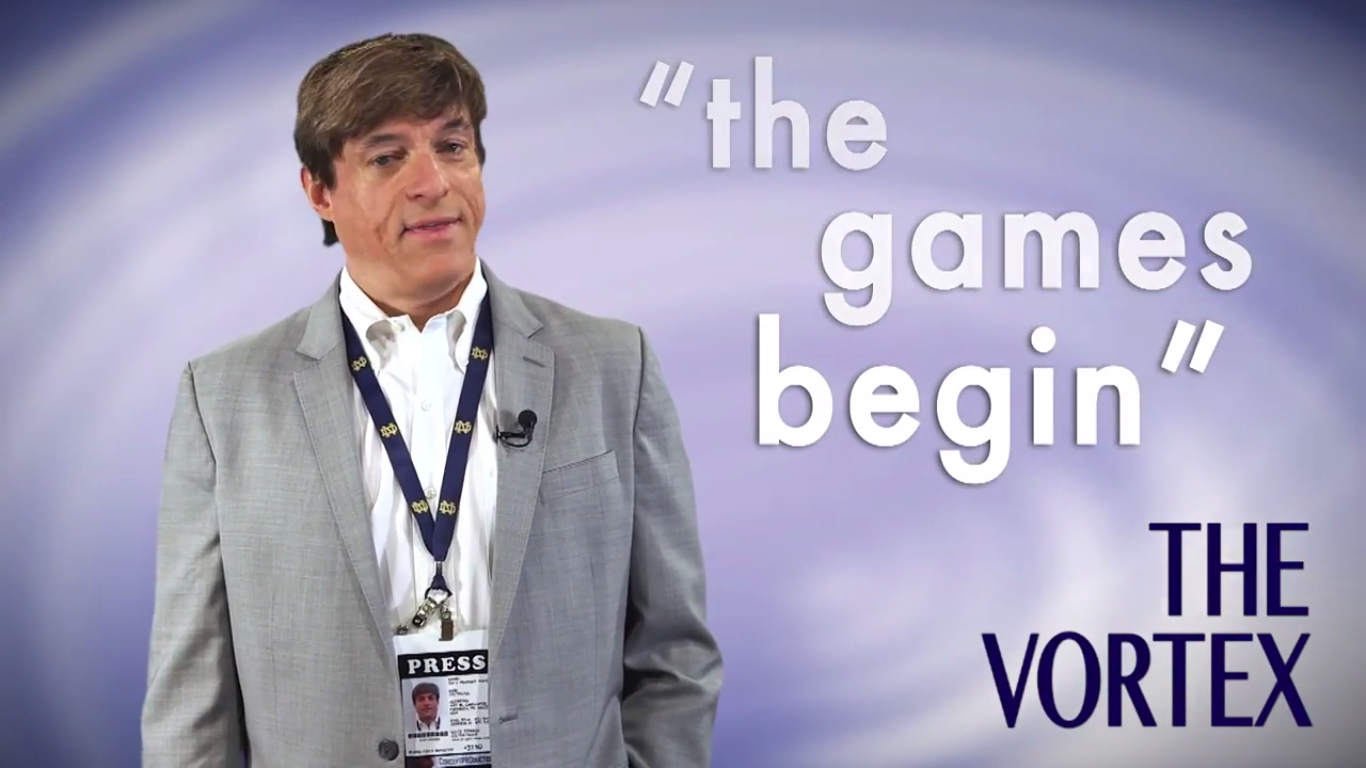
Another expert at sleight of hand is Michael Voris, and he had this on full display in his latest Vortex episode in which he allegedly exposes Cardinal Dolan as a thug.

Voris shows video taken right after his failed questioning of Cardinal Dolan in which we see the Cardinal say something to Joseph Zwilling, NY Archdiocese Communications, who then says something to another man.  This man then walks over and orders Voris and his cameraman out of the press area.


Now, one does wonder why it took two days to find this video. Why didn't they see it along with the video that was produced on the day of the parade? Was this somehow hiding and then just suddenly popped up? It seems somewhat suspicious, but nonetheless, I accept Voris's account as factual.

After showing us this video, Voris then says:
Is this how the archdiocese of New York, Cardinal Dolan and his staff treat faithful Catholics?
This is where the real sleight of hand comes in.  Did a "faithful Catholic" ask Cardinal Dolan the question that got him kicked out?


Wednesday, March 18, 2015

Michael Voris Spiritually Assaults Cardinal Dolan


Michael Voris came to town to report on the "scandal" of Cardinal Timothy Dolan and the St. Patrick's Day Parade. Voris didn't really get anything to report about Cardinal Dolan personally. However, Voris is now representing himself as Cardinal Dolan's victim, and the Catholic blogosphere is eating it up. Voris reports that he was "roughed up" by "Cardinal Dolan's handlers" at the St. Patrick's Day Parade in NYC and actually shows us this on video.

A closer look at the video completely disproves his story.

Monday, March 16, 2015

The Dangerous Superficiality of Traditionalism -- Part 2

St. Catherine of Siena
Credit:  www.discerninghearts.com
I recently did a post on traditional Catholics and the emphasis they place on external worship, citing the fact that this can be a very dangerous road. Just because something looks holy, that doesn't necessarily mean God is present. I gave the example of an Anglican high mass which looks very similar to a TLM. However, that is very deceptive because Jesus Christ is present in the TLM while the Anglican Mass truly is nothing more than smells and bells.

I have found great support for this argument in my Lenten reading.  Part of my spiritual reading for Lent has been The Dialogue by St. Catherine of Siena, a doctor of the Church.  The Dialogue is the record of conversations St. Catherine had with God the Father in which, while in a state of ecstasy, she dictated the Father's words which were written down verbatim by her secretaries (St. Catherine could not read or write, at least not until the end of her life).

In Section 68, God the Father talks about the difference between loving Him and loving the consolations we receive from Him.  He warns of the great danger that comes from loving the consolations more than Him.
Page 129-130 - But my servants, even though their love is still imperfect, seek and love me for my love's sake rather than for consolation and pleasure they find in me. Now I do reward every good deed -- but the measure of the reward is the recipient's love. . . .it is not my intention that the soul should receive this consolation foolishly, paying more attention to my gift than to me. I want her to be more concerned about the loving charity with which I give it to her, and to her unworthiness to receive it, than to the pleasure of her own consolation. If she foolishly takes only the pleasure without considering my love for her, she will reap the sort of harm and delusion of which I am about to tell you.

. . . When she has experienced my consolation and my visitation within her in one way, and then that way ceases, she goes back along the road by which she had come, hoping to find the same thing again. But I do not always give in the same way, lest it seem as if I had nothing else to give. No, I give in many ways, as it pleases my goodness and according to the soul's need. But in her foolishness she looks for my gift only in that one way, trying as it were to impose rules on the Holy Spirit.

That is not the way to act. Instead, she should cross courageously along the bridge of the teaching of Christ crucified, and there receive my gifts when, where and as my goodness pleases to give them. And if I hold back it is not out of hate but love, so that she may seek me in truth and love me not just for her pleasure, but humbly accept my charity more than any pleasure she may find. For if she does otherwise and runs only after pleasure in her own way rather than mine, she will experience pain and unbearable confusion when the object of her delight, as her mind sees it, seems to be taken away.

Such are those who choose consolation in their own way. Once they find pleasure in me in a given fashion they want to go on with just that. Sometimes they are so foolish that if I visit them in any other way than that, they resist and do not accept it, still wanting only what they have imagined.

This is the fault of their selfish passion in the spiritual pleasures they found in me. But they are deluded. It would be impossible to be always the same. For the soul cannot stand still; she has either to advance toward virtue or turn back. In the same way the spirit cannot stand still in me in one pleasure without my goodness' giving her more. And I give these gifts very differently: Sometimes I give the pleasure of a spiritual gladness; sometimes I give contrition and contempt for sin, which will make it seem as if the spirit is inwardly troubled. . . .
The words I highlighted in the last paragraph, "For the soul cannot stand still; she has either to advance toward virtue or turn back. In the same way the spirit cannot stand still in me in one pleasure without my goodness' giving her more" are very similar to those of Pope Francis when he celebrated Mass on the 50th anniversary of first Mass in a language other than Latin.  From an article by Crux:
Allowing priests to celebrate Mass in the language of the local congregation rather than in Latin allowed the faithful to understand and be encouraged by the word of God, Pope Francis said.
“You cannot turn back, we have to always go forward, always forward and who goes back is making a mistake,” he told parishioners after commemorating the 50th anniversary of the first time a pope celebrated Mass in the vernacular following the Second Vatican Council.
“Let us give thanks to the Lord for what he has done in his Church in these 50 years of liturgical reform. It was really a courageous move by the Church to get closer to the people of God so that they could understand well what it does, and this is important for us: to follow Mass like this,” he said as he left Rome’s Church of All Saints March 7.
Pope Francis at Anniversary of First Vernacular Language Mass
Credit:  www.catholicherald.co.uk
The Remnant Newspaper posted a typical traditionalist response to this message from the Holy Father:  "Pope Francis Celebrates Tragic Anniversary Today in Rome."  As this article states,
[T]he so-called "New Mass" and all of its Protestant trappings were imposed on the Church by modernist revolutionaries acting under the auspices of the demonic "spirit of Vatican II."
Father Z, who tries to appear more moderate than the extremist Remnant Newspaper, was basically in agreement with this statement [HERE].  Father Z deftly avoided any mention of the Mass or homily by Pope Francis.  He started out his post, entitled "Speaking of 50th anniversary of vernacular Masses… BUGNINICARE! (Revisited)",  with the following statement:
In some circles there has been some panting whoopdeedoo about the fact that 50 years ago Paul VI celebrated Mass for the first time in a Roman parish in Italian.
Yes, Father Z, and the one making the biggest "whoopdeedoo" about this was none other than Pope Francis.  The Vicar of Christ, unlike you, felt this was a very important event in Church history.

Father Z, as part of his response to the "whoopdeedoo" reprinted an old post about Msgr. Annibale Bugnini which Father Z entitled, "Bugninicare!  UNIVERSAL SPIRITUAL-CARE REFORM FOR THE CATHOLIC CHURCH."  After writing disparagingly of the New Mass, Father Z then  posted several pictures showing abuses of the Mass but disingenuously presented these pictures as the natural result of the "Bugnini" changes.  One of the comments was very typical of those posted:
Dundonianski says:9 March 2015 at 8:34 am
A wonderful tapestry of what was (and is) valid and licit; my sympathies to the SSPX!
But the one comment that everyone loved was this:
Henry Edwards says:9 March 2015 at 10:34 am One thing we did not hear from the Bugninicare reformers was “In [sic] you like your old Mass, then you can keep your old Mass.”

Why are traditionalists so insistent on the superiority of the TLM and the spiritual destructiveness of the "Novus Ordo" as they call it?  That answer was given recently by none other than the aforementioned Father Z.

Wednesday, March 4, 2015

Ain't No Mountain High Enough

/Credit:  pixgood.com
"Jesus is God, therefore His love, His Thirst, is infinite. He the creator of the universe,
asked for the love of His creatures.
He thirst for our love… These words:
‘I Thirst’ –
Do they echo in our souls?”
Mother Teresa
The most plaintive, agonizing words ever spoken in all of human history were uttered by Jesus Christ as He hung dying on the cross to bring salvation to a condemned world.  Part of these words, the seven last words spoken by Jesus from the cross, is given little fanfare in the gospels. All we are told in John 19:28 is:
Afterwards, Jesus knowing that all things were now accomplished, that the scripture might be fulfilled, said: I thirst.
But what does this really mean?  Was Jesus just complaining that he needed something to drink?  He had been beaten to such a point that he was barely recognizable as a human being.  The blood was almost completely drained out of his body.  He had not had any food or water for many hours and was in an extreme condition of dehydration.  Is that what he was talking about?  With all of the many other things he had suffered - mockings and insults, skin ripped from his body, bones pulled out of joint, hair pulled from his head and beard, a severe whipping which brought him to the point of death, nails driven into his hands and feet, struggling for each breath as he hung on the cross - why would his one complaint, if that is what it was, be about thirst?

Our Lord was talking about something much deeper than physical thirst.  He was talking about a thirst that had driven him his entire life.  He was talking about a thirst he felt even before becoming incarnate, when he shared glory with the Father in heaven (John 17:5).  He was talking of his great love for humanity, for the people who were responsible for all of the suffering he was experiencing.   His thirst is for you and me, for every single human being who has ever lived.  Our Lord thirsts for the worst sinner as well as the greatest saint.  No one is excluded.

Credit:  resource4christians.blogspot.com
In St. Faustina's diary, "Divine Mercy in My Soul", Jesus says to St. Faustina:
I desire that you know more profoundly the love that burns in My Heart for souls, and you will understand this when you meditate upon My Passion. Call upon My mercy on behalf of sinners; I desire their salvation.  (paragraph 186)
My daughter, look into the abyss of My mercy and give praise and glory to this mercy of Mine. Do it in this way: Gather all sinners from the entire world and immerse them in the abyss of My mercy. I want to give Myself to souls; I yearn for souls, My daughter. On the day of My feast, the Feast of Mercy, you will go through the whole world and bring fainting souls to the spring of My mercy. I shall heal and strengthen them.   (paragraph 206)
Credit:  www.pinterest.com
The only condition Jesus puts on His Love is that we say yes to him.   As He said to St. Faustina (paragraph 186), "Call upon My mercy on behalf of sinners; I desire their salvation."


Sunday, March 1, 2015

Are You Judge and Juror of Your Parish?


Only evil minded people profit from confusion in the hearts and minds of Catholics. They're able to sneak in their wicked agendas weakening the faith and self understanding of the faithful.
Michael Voris
Okay, okay, I know.  This is my third post in a row on Michael Voris and the "lies and falsehoods" that he promotes.  But he keeps putting out videos that are truly harmful and, if accepted, will most definitely "weaken the faith and self understanding of the faithful."  So I keep writing posts that counter him and give a different point of view, hopefully one that is true to the faith.

I have written in the past about all of the many times Voris has attacked and condemned lawfully ordained priests, bishops and cardinals of the Catholic Church and demanded that they resign or be fired.  Voris has also urged Catholics to withdraw their financial support from the Church.  One of my posts in particular got a lot of attention because Pewsitter linked to it for a few days.  You can read that post HERE.  As Voris said in that video,
Since money seems to be the only thing that motivates the Establishment Church – it is more than time for the faithful to begin withholding contributions. Why give money to a diocese that is gonna use that money to keep the status quo going – to abuse faithful Catholics while supporting fake Catholics – parishes and individuals.
First of all, as I showed in that post, it is a mortal sin to willfully withhold financial support from the Church. And further, what happens if people stop financially supporting their dioceses and parishes? Church closings, which means loss of access to the sacraments, and if allowed to take its natural course (which won't happen because the Holy Spirit will not allow it to happen), the destruction of the Catholic Church.

Voris is not only aware of the destruction that would result from Catholics withholding financial support, he celebrates it:
The whole thing is gonna blow up anyway – the sooner the better. What will emerge from the rubble is a purified Church, doctrinally, liturgically, morally, devotionally and clerically. Too bad Catholics didn’t know this about 50 years ago.
I would like to know where, in 2000 years of Church history, Catholics have ever been urged to destroy the Church in order to save her.  We have always been urged to pray and sacrifice for the Church and her leaders, but to actively participate in her destruction?  Sorry, Mike, but you're all alone on that one.
       

Now Voris has made a video in which he is urging Catholics to leave their Catholic parishes, which you can see HERE. Why would a person who claims to love the Catholic Church tell other Catholics to leave their parishes? This is the description of the video from the Churchmilitant.tv website:
Almost nothing that happens in your parish each Sunday has a thing to do with the Catholic Faith.

Thursday, February 26, 2015

Michael Voris Needs To Take His Own Advice

Credit:  insureblog.blogspot.com
Therefore you have no excuse, O man, every one of you who judges. For in passing judgment on another you condemn yourself, because you, the judge, practice the very same things.
Romans 2:1
I know I'm risking making myself into the anti-Voris blog, but it's my blog, and I'll blog what I want to (my apologies to the late Leslie Gore).  Michael Voris is so completely over the top that I feel someone needs to be calling him out.

Michael Voris has made his living from attacking and condemning Church hierarchy. He, on a regular basis, calls priests and bishops evil and destroyers of the faith. He warns them that they are all headed to hell. He tells them they should "Get Out!" as I recently blogged. He calls them "homosexualists" and makes statements that they are either actively homosexual or promote homosexuality. He says they should either resign or be fired. He constantly accuses our priests and bishops of not believing the faith, of being apostates. In other words, he tells priests, bishops and cardinals of the Catholic Church to shut up!


Recently, however, Voris went after someone else who did exactly what he does all the time:  tell a cardinal to shut up!  As Voris explains,
Father Timothy Scott, spokesman for the Basilian Order, re-tweeted one of the articles and most importantly sent his tweet to Cardinal Burke where—get this—a priest publicly, for the whole world to see, blatantly declared to a Prince of the Church “STFU.”
Here is a screen grab of Father Scott's tweet:


I want to make it emphatically clear that I do not support or defend Father Scott's actions in any way. There is no defense to his blatantly disrespectful and scandalous action. However, as even Voris admits, Father Scott realized how wrong he was and followed up with this tweet:


Voris wasted no words in condemning Father Scott:
That’s the language associated with gangs and thugs in drug-selling prostitution rings— not a man of God. To think it is bad enough; to say it out loud is appalling; to issue it publicly for the world to read means he should be immediately removed from his job as spokesman for the order.


Sunday, February 8, 2015

St. Catherine of Siena Warns Michael Voris and the Catholic Blogosphere


In January, Michael Voris did a Vortex episode entitled, "GET OUT!" in which he once again attacked the "homosexual and homosexual-friendly clergy" of the Catholic Church.  He, as is his usual custom, wasted no time in condemning those he accuses:
These weak men, these weak leaders have absolutely no right to work out their psychological illnesses and depravities through the priesthood and episcopate.

And yes, they are depravities. For a man who is a practicing homosexual, or struggling with trying to explore his identity, to do that on the Church’s watch is beyond horrible.
Voris played his usual deceptive games by talking about "gay priests" while showing films of gay pride parades which have nothing to do with any Catholic priests.  But it is a way of manipulating people into thinking that these priests he is accusing are right there in the parades.

And Voris makes his usual broad based judgments, condemning the majority of priests.  And he even tells us how we can make these same kind of prejudicial judgments:
A good deal of bishops and priests are gay or gay-friendly. Catholics need to know that.  If your priest or bishop exhibits an unusual amount of friendliness toward and/or acceptance of homosexuality—watch out!
Most of the time they won’t come right out and say it; they play it off as being compassionate and merciful. They want to slyly convince lay Catholics that there isn’t really anything that wrong.
But the truth is that large numbers of these priests have boyfriends or are sexually active —and it ain’t just priests.

To all of whom we say: have at least one bit of masculinity about yourselves and resign.

Go work out your errant psychology somewhere else. You should be working out your salvation, but since you choose to hide behind your collars and under your miters and work out your own pathologies, then get out.
Voris claims to get right inside the minds of these priests and bishops he is accusing and explains exactly what is wrong with them:
For the love of God, why do you stay in the clergy? But that question is somewhat rhetorical. We know the answer, don’t we? You don’t love God, and as a result, you want to corrupt and pervert.

You have a sick and demented vision of yourselves, and you want someone else to approve of your filth and sickness and spiritual depravity.
Michael Voris then goes on to quote from the writings of a doctor of of the Church - St. Catherine of Siena, from "The Dialogue" in which St. Catherine quotes from God the Father (Voris incorrectly says these are the words of Jesus Christ):
[T]his not only causes Me nausea, but displeases even the demons themselves, whom these miserable creatures [active homosexuals] have chosen as their lords.  For Me, this sin against nature is so abominable that, for it alone, five cities were submersed, by virtue of the judgment of My Divine Justice, which could no longer bear them. . . . It is disagreeable to the demons, not because evil displeases them and they find pleasure in good, but because their nature is angelic and thus is repulsed upon seeing such an enormous sin being committed. It is true that it is the demon who hits the sinner with the poisoned arrow of lust, but when a man carries out such a sinful act, the demon leaves.
This quote is taken from The Dialogue, Mystic Body of the Holy Church, section 124, page 237 in Noffke's translation from Classics of Western Spirituality.


Wednesday, January 7, 2015

The Dangerous Superficiality of Traditionalism

PLEASE SEE UPDATE BELOW. 

The above picture is one that is sure to warm the heart of every good Catholic traditionalist. Here is a priest celebrating the Mass ad orientem. This is the way Mass should be celebrated. This is the true Catholic tradition. In fact, Father John Zuhlsdorf recently wrote a post in which he said that this was the only way to achieve a true renewal in the Church [HERE]:
We need to rethink versus populum celebration of Holy Mass and adopt instead ad orientem worship. Joseph Ratzinger got it right in his The Spirit of the Liturgy. I’ll take Benedict XVI’s vision every day and as many times as it takes on Sunday.

As Klaus Gamber stated, and Ratzinger repeated, the shift from ad orientem worship to versus populum was the single most damaging change made in the name of the Second Vatican Council. Together with that came the jettisoning of Our Lord from sanctuaries, the de facto abolition of Latin along with worthy sacred music, irreverence due to Communion in the hand and the downplaying of kneeling and genuflection, etc. etc. etc.
The following pictures of the same Mass from above illustrate the beauty and sacredness which Father Z is promoting:


As Father Z wrote in another recent post:
As I have written a thousand times, unless there is a renewal of our sacred liturgical worship of God, no other initiative of “New Evangelization” will succeed.  It all comes back to worship.  That’s the activity, according to the virtue of Religion, that coordinates the hierarchy of our relationships with persons (Divine, angelic, human) and our loves (making sure that GOD has the throne of our hearts and minds).  If our relationship with God isn’t squared away, and that must include liturgical worship, everything else will be on shaky ground.  How can we who accept the claim that the Eucharist (the Sacrament and Its celebration) are the “source and summit” of our Catholic lives think that we can undertake something as sweeping as a New Evangelization apart from a renewal of Holy Mass, the Divine Office solemnly celebrated, and all our other rites?  And yet when we hear our leaders, our shepherds, go on and on and on about this or that project or initiative, how often do they connect it – heck, even mention – the centrality and urgency of sacred liturgical worship of God?
Of course, when Father Z and other traditionalists talk about "renewal" of the Mass, they mean a return to the Traditional Latin Mass. They want to see more - if not all - Masses celebrated as pictured above. Father Z and all of his traditionalist followers believe that the TLM is the salvation of the Church and the world. That is actually Father Z's motto: "Save the Liturgy. Save the World." Look at the reverence and sacredness. These people are serious about worship.

An article recently written for Crisis Magazine by a fellow Brooklynite explains very clearly the reasons for the traditionalists' belief that the Extraordinary Form of the Mass is essential for the salvation of the world.  The article is entitled, "What the Traditional Mass Means to Me." [HERE]  It is written by James Kalb. I know Mr. Kalb. We attended the same Mass at the one and only TLM here in Brooklyn.

Mr. Kalb is a convert from the Episcopalian Church. As stated by Mr. Kalb, he believes that the TLM is the true representation of Catholicism:
I came to the Church through the Traditional Latin Mass.
I would have converted anyway. It was becoming more and more obvious that the Church was where I belonged, and it seemed pointlessly obstinate and even artificial to remain apart from her. But the Traditional Mass made the situation clearer, because it made it more obvious what the Church is.
Mr. Kalb writes further:
The Traditional Mass made it clear that the Mass is something different from all that. The formality, the silences, the use of an ancient language, the orientation and gestures of the priest, the indifference to popularity—all those things meant the Mass wasn’t anything like an ordinary meeting. It wasn’t about the people present, and at bottom it wasn’t even their doing. To the contrary, those present evidently understood what was going on as awe-inspiring, mostly invisible, and dependent on someone other than themselves. There was no other way to make sense of how they were acting.
So the Traditional Mass made it clear that there’s a basic dimension in Catholic Christianity, the reliable concrete presence of God, that I couldn’t find anywhere else. That realization clarified what the Church is—she is the way God maintains a visible presence in the world—and the necessity of becoming part of her for those who want to live a complete life.
Notice all of the things which Mr. Kalb points to as setting the Traditional Mass apart: "formality, silences, use of ancient language, orientation, gestures of the priest."  Mr. Kalb feels it is these outward gestures and rubrics which make the Mass Catholic.  As Mr. Kalb writes, the "New Mass" is basically Protestant:
This discussion started as a conversion story, and every conversion has its more personal aspects, so I should also mention benefits the Traditional Mass had for me in particular. The New Mass, especially the earlier translation, was very close to the Episcopalian eucharistic service I was used to before becoming Catholic. The two had evidently been designed to be as similar as possible. That was a problem for me.
What the intentional similarity suggested to me was that the New Mass didn’t give nearly so distinctively Catholic a view of things. I won’t claim that view was fair or that I knew more about the needs of the Church than Bl. Paul VI did, but that was what I saw. The New Mass looked to me like it had been produced less by saints and the sensus fidei fidelium than by an interdenominational committee of credentialed experts and then modified in accordance with the demands of particular communions. For that reason I found it hard to trust unreservedly. It seemed to have been produced in cooperation with people I had good reason not to trust and wanted very much to escape from.
Mr. Kalb feels that the "Novus Ordo" Mass and the Episcopalian service he attended were intentionally made similar, and therefore he has a deep distrust of the "Novus Ordo" Mass.  That is a common criticism of traditionalists against the Ordinary Form of the Mass:  it is too "Protestant".  It just does not have a Catholic feel to it.


Wednesday, December 31, 2014

Why I Read So Few Catholic Blogs

Credit:  www.pinterest.com
I had an interesting run in with a Catholic blogger recently. The blogger is Paul Anthony Melanson and he has a blog entitled, "La Salette Journey." He wrote a post criticizing Pope Francis for his "Urbi et Orbi" message. His post is entitled, "Does Pope Francis offer an authentic Gospel or the 'Social Gospel?' " [HERE].  His answer is that Pope Francis is preaching only a social gospel, and not telling the world about spiritual salvation. Therefore, Pope Francis is preaching a false gospel. Melanson quotes extensively from Dietrich von Hildebrand to show just how wrong Pope Francis is.

It is interesting that Melanson gives no direct quotes from Pope Francis' Urbi et Orbi message. He does link to another Catholic blogger, "The Radical Catholic", who is also harshly critical of Pope Francis and - surprise, surprise! - "The Radical Catholic" also does not give any direct quotes from Pope Francis. Neither of these two Catholic bloggers even give any links so that we can read for ourselves the message from the Holy Father.  These bloggers offer only harsh criticism and condemnation.

Since these two self-proclaimed models of Catholicism refuse to play by any rules of fairness, I will make up for their deficiencies. You can go HERE to read the full Urbi et Orbi message from Pope Francis.

ISIS in Iraq
Credit:  rt.com
In his message, Pope Francis said, "Jesus is the salvation for every person and for every people" and then went on to list several hot-spots in the world such as Iraq and Syria "who for too long now have suffered the effects of ongoing conflict, and who, together with those belonging to other ethnic and religious groups, are suffering a brutal persecution." The Holy Father prayed for "all who suffer in Ukraine, and grant that their beloved land may overcome tensions, conquer hatred and violence, and set out on a new journey of fraternity and reconciliation."

The Holy Father prayed: 
May Christ the Savior give peace to Nigeria, where (even in these hours) more blood is being shed and too many people are unjustly deprived of their possessions, held as hostages or killed. I invoke peace also on the other parts of the African continent, thinking especially of Libya, South Sudan, the Central African Republic, and various regions of the Democratic Republic of the Congo. I beseech all who have political responsibility to commit themselves through dialogue to overcoming differences and to building a lasting, fraternal coexistence.
Victims of terrorism in Nigeria
Credit:  www.thecuttingedgenews.com
Pope Francis mentioned the suffering of millions of children in the world:
The Child Jesus. My thoughts turn to all those children today who are killed and ill-treated, be they infants killed in the womb, deprived of that generous love of their parents and then buried in the egoism of a culture that does not love life; be they children displaced due to war and persecution, abused and taken advantage of before our very eyes and our complicit silence.
Further:
I think also of those infants massacred in bomb attacks, also those where the Son of God was born. Even today, their impotent silence cries out under the sword of so many Herods. On their blood stands the shadow of contemporary Herods.
Truly there are so many tears this Christmas, together with the tears of the Infant Jesus.
Credit:  womennet.am
Pope Francis concludes his message by saying:
Dear brothers and sisters, may the Holy Spirit today enlighten our hearts, that we may recognize in the Infant Jesus, born in Bethlehem of the Virgin Mary, the salvation given by God to each one of us, to each man and woman and to all the peoples of the earth.
May the power of Christ, which brings freedom and service, be felt in so many hearts afflicted by war, persecution and slavery. May this divine power, by its meekness, take away the hardness of heart of so many men and women immersed in worldliness and indifference, the globalization of indifference. May his redeeming strength transform arms into plowshares, destruction into creativity, hatred into love and tenderness.

Then we will be able to cry out with joy: "Our eyes have seen your salvation"
Both Melanson and "The Radical Catholic" are very upset that Pope Francis would equate "salvation" with being concerned and praying for an end to the the physical suffering of so many millions around the world. From the Radical Catholic:
While I wish to distract neither from the horrible plight of so many suffering around the world today nor from the genuineness of the Holy Father's sentiments, I find myself wondering: Did Christ come to save us from these things? Did He come to save us from poverty, famine, persecution and suffering? Did He come in the glory of His power to establish a kingdom in which there is no want, no calumny, no corruption? Is this the reason for His appearance two millennia ago? Is this the meaning of His Advent?
I can only wonder:  are these two bloggers for real?  Did they never read Matthew 25 - "whatsoever you do to the least of my brethren, you do to me?"  Christ talks about clothing the naked, feeding the starving, caring for the poor.  He said that those who don't do these things will not be in the Kingdom of God.  A Christian never separates concern for the spiritual state of persons from concern for their physical state.  It is just as wrong to not care for people physically as it is to neglect them spiritually.  

I wrote a comment to Melanson's blog in which I said, "I guess Dr. Hildebrand wouldn't like Pope Benedict XVI either. What up with these popes trying to give comfort to the world?! That is something Jesus would never do."  

I then linked to the 2012 "Urbi et Orbi" message from Pope Benedict XVI [HERE].  In this message, Pope Benedict mentions the tremendous suffering of people in various countries, such as Syria and "the Land where the Redeemer was born", North Africa, "the vast continent of Asia", Mali, Nigeria, the "Democratic Republic of Congo" and Kenya.  Pope Benedict ended his message with:
Dear brothers and sisters! Kindness and truth, justice and peace have met; they have become incarnate in the child born of Mary in Bethlehem. That child is the Son of God; he is God appearing in history. His birth is a flowering of new life for all humanity. May every land become a good earth which receives and brings forth kindness and truth, justice and peace.
Eerie how similar these messages are, and yet Melanson has the audacity to say in his comment to me:
Actually, Dr. Hildebrand would have no problem with Pope Benedict XVI. Pope Benedict never advanced a Social Gospel. Read your own link, if you are capable. Nowhere does Benedict hold Christ as the Savior from poverty and all the ills of society.
Oh really?  What do you call this:
May peace spring up on the vast continent of Asia. May the Child Jesus look graciously on the many peoples who dwell in those lands and, in a special way, upon all those who believe in him. May the King of Peace turn his gaze to the new leaders of the People’s Republic of China for the high task which awaits them. I express my hope that, in fulfilling this task, they will esteem the contribution of the religions, in respect for each, in such a way that they can help to build a fraternal society for the benefit of that noble People and of the whole world.

May the Birth of Christ favour the return of peace in Mali and that of concord in Nigeria, where savage acts of terrorism continue to reap victims, particularly among Christians. May the Redeemer bring help and comfort to the refugees from the east of the Democratic Republic of Congo, and grant peace to Kenya, where brutal attacks have struck the civilian population and places of worship.
May the Child Jesus bless the great numbers of the faithful who celebrate him in Latin America. May he increase their human and Christian virtues, sustain all those forced to leave behind their families and their land, and confirm government leaders in their commitment to development and fighting crime.
It is obvious that these bloggers hear only what they want to hear and read only what they want to read.  They certainly don't let reality intrude.

I wrote back to Melanson quoting from James 2:16:
If one of you says to them, “Go in peace; keep warm and well fed,” but does nothing about their physical needs, what good is it?
I cannot remember my entire comment because Melanson refused to post it.  Instead, he alluded to it by writing this:
Since "Catholic in Brooklyn" doesn't care to engage in honest dialogue, I won't be publishing her comments.
She left another comment asserting that men are primarily interested in the food for the body. She misses the point.
Lucifer was the first preacher of the Social Gospel. He said to Jesus, "Turn these stones into bread."

And how did Jesus respond? With the most succinct rebuttal of the Social Gospel: That man does not live by bread alone but by the Word of God.
I guess Melanson's idea of dialogue is that he talks and unless you agree with him - shut up.

I have a question for Melanson, "The Radical Catholic" and all the other radical traditionalists who see Pope Francis as basically a heretic.  Do they honestly believe that Pope Francis is not preaching the message of salvation to the world? Pope Francis wrote a book-length apostolic exhortation which is entirely concerned with preaching the Gospel to the world.  From that document:
Lastly, we cannot forget that evangelization is first and foremost about preaching the Gospel to those who do not know Jesus Christ or who have always rejected him. Many of these are quietly seeking God, led by a yearning to see his face, even in countries of ancient Christian tradition. All of them have a right to receive the Gospel. Christians have the duty to proclaim the Gospel without excluding anyone. Instead of seeming to impose new obligations, they should appear as people who wish to share their joy, who point to a horizon of beauty and who invite others to a delicious banquet. It is not by proselytizing that the Church grows, but “by attraction”.
John Paul II asked us to recognize that “there must be no lessening of the impetus to preach the Gospel” to those who are far from Christ, “because this is the first task of the Church”. Indeed, “today missionary activity still represents the greatest challenge for the Church” and “the missionary task must remain foremost”. What would happen if we were to take these words seriously? We would realize that missionary outreach is paradigmatic for all the Church’s activity. Along these lines the Latin American bishops stated that we “cannot passively and calmly wait in our church buildings”; we need to move “from a pastoral ministry of mere conservation to a decidedly missionary pastoral ministry”. This task continues to be a source of immense joy for the Church: “Just so, I tell you, there will be more joy in heaven over one sinner who repents than ninety-nine righteous persons who need no repentance” (Lk 15:7).” (14-15)
Melason, "The Radical Catholic" and others would do well to read carefully the following statement from Pope Francis:
“I prefer a Church which is bruised, hurting and dirty because it has been out on the streets, rather than a Church which is unhealthy from being confined and from clinging to its own security. I do not want a Church concerned with being at the centre and then ends by being caught up in a web of obsessions and procedures. If something should rightly disturb us and trouble our consciences, it is the fact that so many of our brothers and sisters are living without the strength, light and consolation born of friendship with Jesus Christ, without a community of faith to support them, without meaning and a goal in life. More than by fear of going astray, my hope is that we will be moved by the fear of remaining shut up within structures which give us a false sense of security, within rules which make us harsh judges, within habits which make us feel safe, while at our door people are starving and Jesus does not tire of saying to us: “Give them something to eat” (Mk 6:37).” (49)
Are these the words of a man who is preaching only the "social gospel"?  The purpose of "Urbi et Orbi" is to speak to the world.  Should we just ignore the world's tremendous suffering and instead tell them that they had better repent of their sins or they're going to hell?  Is that how we will reach them?  There is a time and place to preach repentance to people.  But that is not the purpose of "Urbi et Orbi."  To accuse Pope Francis of preaching a false gospel because he shows compassion and empathy for the suffering of the world is truly appalling.

Melanson banned me from his "Catholic" blog because I support the Holy Father.   One of those commenting on Melanson's blog wrote this in response to my comment:
Actually Jesus didn't come to bring comfort to the world. He came to bring peace to individual souls who turn to Him and away from their sins with humility and contriteness of heart in complete surrender. And that can only happen if those individuals openly reject the world.

Oh but hey, don't take my word for it, let Him tell you:

"Do not think that I have come to bring peace upon the earth. I have come to bring not peace but the sword. For I have come to set a man ‘against his father, a daughter against her mother, and a daughter-in-law against her mother-in-law; and one’s enemies will be those of his household.’" - Matthew 10:34-36
So what do you think you know that Christ doesn't know?
If this was true Catholicism, I would immediately turn in my card. Is following a Christ a matter of just pointing out the sins of others and telling them to shape up or ship out and disregarding their physical suffering since they brought it on themselves anyway? How can anyone possibly say that because you care about the physical suffering of people, then you obviously don't care about their souls? This is exactly what Melanson and "The Radical Catholic" are saying about Pope Francis. They would do well to heed the words of Our Lord as recorded in Matthew 12:36 - "I tell you, on the day of judgment people will give account for every careless word they speak,"

For Paul Anthony Melanson and "The Radical Catholic" and so many others whose main occupation seems to be condemning the Holy Father, here are the words of Pope Francis from Evangelii Gaudium:
“One of the more serious temptations which stifles boldness and zeal is a defeatism which turns us into querulous and disillusioned pessimists, “sourpusses”. Nobody can go off to battle unless he is fully convinced of victory beforehand. If we start without confidence, we have already lost half the battle and we bury our talents. While painfully aware of our own frailties, we have to march on without giving in, keeping in mind what the Lord said to Saint Paul: “My grace is sufficient for you, for my power is made perfect in weakness” (2 Cor 12:9). Christian triumph is always a cross, yet a cross which is at the same time a victorious banner borne with aggressive tenderness against the assaults of evil. The evil spirit of defeatism is brother to the temptation to separate, before its time, the wheat from the weeds; it is the fruit of an anxious and self-centred lack of trust.” (85)
UPDATE:  I have invited Paul Anthony Melanson to comment, but he refuses to acknowledge me.  
Credit:  www.pinterest.com

Friday, December 26, 2014

Do I Allow God To Love Me?


The adoration of the shepherds
We are now in the Christmas season in which we celebrate the birth of our Savior.  God is born as a man, like His Creation in every way except sin.  And how did the great Creator choose to come into the world?  He was born in a dirty, vermin-infested manger surrounded by barn animals and greeted by the lowliest members of human society - shepherds, who spent their lives in the fields with their animals apart from everyone else.  These were men with little to no education who rarely even bathed and were shunned by all of "proper" society.  And not only did our Lord choose to announce His coming to these lowliest members of society, He said that He, too, was a shepherd.  Our Lord is the Good Shepherd who will go to any lengths to find His lost sheep and will even lay down His own precious life to save His sheep.

Moses the Shepherd
Credit:  bfmindia.blogspot.com
Anyone who has spent any amount of time studying the Bible and the Life of Christ knows that Our Lord never does anything in a way that we would expect.  As Pope Francis has told us, He is a God of surprises.  In the Old Testament The Lord tests the faith of the father of his people - Abraham - by demanding that Abraham kill his son.  He prepares the patriarch Joseph to save the known civilized world by allowing him to be falsely accused and thrown into prison for several years.  He chooses a slave nation - Israel - to be the ones by which He will make Himself known to the world.  He chooses Moses to lead this slave nation to freedom.  Moses had been driven from society because he had killed a man.  He then become a shepherd (yes, the lowliest member of society) and was prepared by God to lead the nation of Israel by spending 40 years shepherding sheep in the wilderness.  The Lord chose another shepherd - David - to be the great king of Israel.

We can never know the Mind of God. We can never assume that we know what He wants or how He will act among us. Yet, we continue to seek God on our own terms and in our own ways. The result is that we delude ourselves into thinking that we are serving God when in reality we are pushing God away and serving nothing more than our own egos. This was the warning that Pope Francis gave us in his Christmas message. The Holy Father told us that seeking God means that we must be open and allow God to find us. (Read the entire message HERE.)
On this holy night, while we contemplate the Infant Jesus just born and placed in the manger, we are invited to reflect. How do we welcome the tenderness of God? Do I allow myself to be taken up by God, to be embraced by him, or do I prevent him from drawing close? "But I am searching for the Lord" - we could respond. Nevertheless, what is most important is not seeking him, but rather allowing him to find me and caress me with tenderness. The question put to us simply by the Infant's presence is: do I allow God to love me?
Credit:  latino.foxnews.com
This very much echoes a statement made by the Venerable Fulton Sheen:
We always make the fatal mistake of thinking that it is what we do that matters, when really what matters is what we let God do to us.  God sent the angel to Mary, not to ask her to do something, but to let something be done. Since God is a better artisan than you, the more you abandon yourself to him, the happier he can make you.
In the great classic, "The Spiritual Combat" by Lorenzo Scupoli (a monk who lived from 1530 to 1610), the author begins his book by stating, "If you wish, beloved in Christ, to reach the height of perfection, and by drawing near to your God to become one spirit with Him (and no aim can be imagined or expressed which is greater, or nobler than this), you must before all else gain a true idea of what constitutes spiritual perfection." Dom Scupoli then gives examples of what does not constitute spiritual perfection. It does not consist of "outward mortification, in hair shirts and disciplines, in long watchings and fastings, and in other bodily sufferings and chastisements." Dom Scupoli warns against those "who think they have reached the climax of perfection when they say many prayers, attend many services and offices, and are regularly at Church and at Communion."

Dom Scupoli warns us that those who trust in external actions "are all deceived.  For although these practices are sometimes means of gaining the spirit of perfection, and sometimes are its fruits, yet in no sense can it ever be said that true spiritual perfection consists in these."  Dom Scupoli most certainly does not condemn these actions in and of themselves, for as he writes, these practices "are means most efficacious for obtaining spirituality, when they are properly and discreetly employed" and that "they are also fruits of the Spirit in truly spiritual persons" who follow these external practices "not for the sake of curiosity and devotional feeling, but that they may gain deeper knowledge of their own corruptness and of God's Mercy and Goodness."

This great author tells us that
"to others, however, who found perfection entirely on external practices, such works may bring greater ruin than open sins; not that these works are bad in themselves, for in themselves they are very good, but in consequence of the mistaken use which is made of them they have this sad result: because those who practice them are so wrapt up in what they do, that they leave their hearts a prey to their own evil inclinations and to the devices of Satan."
In other words, our trust in external practices causes us to start trusting in ourselves and our own goodness, and that makes us easy prey for the devil.

Dom Scupoli says those who vainly trust in outward practices
"may easily be gathered from their lives and conversation. For in everything, whether it be great or small, they seek their own advantage, and like to be preferred before others; they are self-willed and opinionated, blind to their own faults, sharp-sighted for the faults of others, and severely condemn the sayings and doings of other men. But if you touch only with your finger a certain vain reputation in which they hold themselves and are pleased to be held by others; if you bid them discontinue any of their regular and formal devotions, they are at once angry and exceedingly disturbed."
Dom Scupoli writes:
It is therefore quite evident that all such persons are in great danger. For since the inward eye is darkened, by which they see themselves and their outward actions which are good, they attribute to themselves a high degree of perfection, and so, becoming more and more puffed up, they readily pass judgment upon others; yet they themselves need a special miracle of grace to convert them, for nothing short of that would have effect. It is more easy to convert and bring back an open sinner to the path of truth, than the man whose sin is hidden and mantled with the semblance of virtue.
This, sadly, is what I find almost universally in the Catholic blogosphere, most especially among those who call themselves "traditionalists."  These bloggers hold themselves out as the models of Christian perfection, and forcefully condemn anyone who disagrees with them.  No one is excluded from this condemnation, from lay persons up to and including, and sometimes most especially, the Pope.

Dom Scupoli tells us what constitutes true spirituality:
You clearly and distinctly see, then, from what I have said, that the essence of the spiritual life does not lie in any of those things to which I have alluded. It consists in nothing else but the knowledge of the Divine Goodness and Greatness, of our own nothingness, and proneness to all evil; in the love of God and the hatred of self; in entire subjection not only to God Himself, but for the love of Him, to all creatures; in giving up our own will, and in completely resigning ourselves to the Divine Pleasure; moreover, in willing and doing all this with no other wish or aim than the glory and honor of God, the fulfillment of His Will because it is His Will, and because He deserves to be served and loved.
Pope Francis succinctly summarized this when he said, "Do I allow God to love me?"  Whenever we start trusting in ourselves and in our own actions, we are cutting ourselves off from the love of God. That is the danger of fundamentalism.  And that is the danger of both the liberal and traditional Catholic movements.  While liberal and traditional Catholics may seem like opposites, in reality they are two sides of the same coin because they are both trusting in themselves and their own righteousness.

And between the liberal and ultra-conservative traditionalists, the latter is actually far more spiritually dangerous. It is easy to point out the sin of the liberal because they are so obviously in contradiction to Church teaching. But those who call themselves "traditionalists" are involved in a much more insidious sin. They look very good and spiritual on the outside. But as Dom Scupoli writes, "It is more easy to convert and bring back an open sinner to the path of truth, than the man whose sin is hidden and mantled with the semblance of virtue."

As I have pointed out before, our ultimate role model is Mary, our Blessed Mother. Satan fears her above all other creatures. What is it that made her so dangerous to Satan? It was her complete abandonment of self, and her total and unquestioning reliance on God. "My soul does magnify the Lord, my spirit does rejoice in God my Savior." Mary accepted God's will into her life. She never resisted Him in any way. Therein lies spiritual perfection. How do we get there?

Dom Scupoli tells us this:
Now you see wherein the real perfection of a Christian lies, and that to obtain it you must enter upon a constant and sharp warfare against self.
Our greatest enemy is our own self will, our opinions, our "goodness."  That will cut us off from God faster and more completely than anything or anyone outside of us.  Yes, we are in a spiritual warfare, and the one we must fight more than any other is ourselves.

Dom Scupoli gives us the weapons we must use:
You must provide yourself with four very safe and highly necessary weapons, that you may win the palm, and be finally a conqueror in this spiritual conflict -- these are:
  • Distrust in Self
  • Trust in God
  • Spiritual Exercises
  • Prayer
Jesus Christ - the great Creator of the Universe - came to us as a small, defenseless infant.  He became the Sacrifice for our sins by dying as a condemned criminal on the Cross, again helpless and defenseless.  If we are to be like Christ, we too must become "helpless and defenseless."

In his Christmas homily, Pope Francis said the following:
When the angels announced the birth of the Redeemer to the shepherds, they did so with these words: "This will be a sign for you: you will find a baby wrapped in swaddling clothes and lying in a manger" (Lk 2:12).
The "sign" is the humility of God taken to the extreme; it is the love with which, that night, he assumed our frailty, our suffering, our anxieties, our desires and our limitations. The message that everyone was expecting, that everyone was searching for in the depths of their souls, was none other than the tenderness of God: God who looks upon us with eyes full of love, who accepts our poverty, God who is in love with our smallness.
This statement of Pope Francis echoes that of Our Blessed Mother in her great Magnificat:
He has scattered the proud in the conceit of their heart.
He has put down the mighty from their thrones,
and has exalted the lowly.
He has filled the hungry with good things,
and the rich He has sent away empty.
Truly, one of the most profound and penetrating questions we can ask ourselves is that posed by our Holy Father, "Do I Allow God To Love Me?"

Credit: iservantmedia.blogspot.com

Related Posts  0