Wednesday, July 17, 2013

Is Racism Alive and Well in America?

I watched a good part of the George Zimmerman trial and I came to the same conclusion as many legal experts did. Almost all of the legal experts said that the prosecution did not have a case and that if justice was to be done in this particular case, George Zimmerman would have to be found not guilty. And that is exactly what the jury did when they acquitted Mr. Zimmerman.

Yet there is a very vocal group of people in this country who are still claiming that the acquittal of George Zimmerman proves that racism is alive and well in this country. And they are partially right - racism is more rampant, more institutionalized and more lethal in America than it has been at any time in our history, including legalized slavery. But the George Zimmerman case is a sideshow, it is nothing more than a distraction so that the Black community will not see the real insidious racism that is literally destroying them. Trayvon Martin was a victim, not of George Zimmerman, but of the institutional racism that exists in the United States of America.

What are some of the signs of this racism?

Walk into any minority neighborhoods in any big city, and you will first notice the many ads and billboards for beer and alcohol in those neighborhoods. These signs cannot be found in white neighborhoods. This is no accident. According to an article from Huffington Post:
Booze and binge drinking -- it's the stuff hip hop videos are made of, along with a disproportionate number of advertisements African-American youth are exposed to, a new study shows.
Researchers from the Johns Hopkins Bloomberg School of Public Health are shedding new light on a longstanding concern that alcohol marketers are honing in (and cashing in) on African-American youth and that this population is more exposed to the pervasive messages than any other group.
According to the report:
African-American youth receive substantially more exposure to alcohol advertising in magazines and on television, and more exposure to distilled spirits advertising on radio, than youth in general. This appears to result from two phenomena: brands that are targeting African-Americans generally expose the entire group (including youth) to more advertising per capita than the general population; and African-American media habits (including those of youth) make this population more vulnerable to alcohol advertising because of higher levels of media consumption in general.
Speaking of hip hop, this is a music form which started in the Bronx among African American youths. This was their music created by and for them.  But when it began to spread and become popular, it was taken over by white men. From an article found on Notesfromtheundergroundtv.com:
So, lets get this straight, White people been running hip-hop. Need facts, lets start here. Why do think the word “nigger,” is radio and tv friendly, while the word “bitch” gets bleeped? Understand, you can say “nigger,” nigga,” nicca,” in all kinds of ways and you will get no kind of backlash. Remember, Jadakiss said, “Stack chips like Hebrews,” on “All ABout the Benjamins,” but that Hebrews line was blurred and cut out of every TV and radio version of that song. I wonder, if he would’ve said, “I’m a nigger with an attitude,” if that line would’ve been blurred out? I’m leaning towards no, it wouldn't have been cut out. Matter of fact, it might’ve been the title of the song.
Why do you think drug dealers, pimps and thugs have been propped up to be role models for so long? Why do you think the image of the Black women has gone from being a pillar of our community to someone who twerks in the background and only looks good when they’re bent over or on their knees? Open your eyes. White people have been running this. Do you think if a African-American was running hip-hop we would’ve ever had a group called, “Niggers With Attitudes?” My father used to say, “No Black man with any understanding of where he came from would ever openly call himself a nigger.” White people were handed over the keys to the hip-hop world early. We sold it to them for some magic beans and big gold chains.
We hear over and over about how terrible crime is among the Black community.  The following is from a 2005 report the New Century Foundation entitled, "The Color of Crime":

Crime Rates

  • Blacks are seven times more likely than people of other races to commit murder, and eight times more likely to commit robbery.
  • When blacks commit crimes of violence, they are nearly three times more likely than non-blacks to use a gun, and more than twice as likely to use a knife.
  • Hispanics commit violent crimes at roughly three times the white rate, and Asians commit violent crimes at about one quarter the white rate.
  • The single best indicator of violent crime levels in an area is the percentage of the population that is black and Hispanic.
What is the real cause of the explosion in crime in the African American community?  I think it can be traced directly to the destruction of the Black family, which was spurred on by the Welfare State.  The Welfare State, created by the Federal Government in the 1960's, took the place of the father in the home.  When fathers were displaced the family fell apart, and our entire society has been feeling the repercussions ever since.  From discoverthenetworks.org:
The rise of the welfare state in the 1960s contributed greatly to the demise of the black family as a stable institution. The out-of-wedlock birth rate among African Americans today is 73%, three times higher than it was prior to the War on Poverty. Children raised in fatherless homes are far more likely to grow up poor and to eventually engage in criminal behavior, than their peers who are raised in two-parent homes. In 2010, blacks (approximately 13% of the U.S. population) accounted for 48.7% of all arrests for homicide, 31.8% of arrests for forcible rape, 33.5% of arrests for aggravated assault, and 55% of arrests for robbery. Also as of 2010, the black poverty rate was 27.4% (about 3 times higher than the white rate), meaning that 11.5 million blacks in the U.S. were living in poverty.
Read the entire article here.   The family is the building block of any society, and when the family is destroyed, the society and the people in that society are destroyed.

But the most destructive force in destroying the Black family and community, and the most evident form of racism in the United States is, without any question, abortion.


The Federal Government gave $542 million to Planned Parenthood in fiscal 2012. That is over one-half billion dollars to the largest abortion provider in this country.  And where are the vast majority of these clinics located?  In inner cities and/or near major public transportation, giving easy access to inner city residents. Why is that?

La Verne Tolbert, Ph.D. wrote a fascinating report entitled, "Over 20 Million Aborted: WHY PLANNED PARENTHOOD TARGETS THE INNER-CITY." You can read her report here She starts out with the facts about the founder of Planned Parenthood, Margaret Sanger:
In her autobiography, [Margaret Sanger] expresses disdain for the poor whom she calls the wretched of humanity. Eugenics—the improvement of the race through controlled breeding—identifies certain ethnic groups as dysgenic, meaning they are biologically defective or deficient and therefore unworthy of procreation.

Sanger’s mission was to “stop the multiplication of the unfit…[for] race betterment” to guarantee “a cleaner race.” “Birth-control,” said Sanger in 1920, “is nothing more or less than the facilitation of the process of weeding out the unfit, or preventing the birth of defectives, or of those who will become defectives.”
Sanger’s 1939 Negro Project may provide further rationale for the proliferation of Planned Parenthood clinics throughout inner-cities. The proposal, which called for hiring Colored ministers and selecting a Negro Advisory Council who would appear to run a family planning campaign, was to popularize family planning in southern black communities using community people as spokespersons. Although Sanger decried the fact that blacks believed “that God sends them children,” she believed that the best educational approach was through religion. “We do not want the word to get out that we want to exterminate the Negro population, and the Minister is the man who can straighten out that idea if it ever occurs to any of their more rebellious members.”
So we know that  Planned Parenthood's founder was an avowed racist who wanted to destroy the Black community because she saw them as the "wretched of humanity."  But as the author of this article points out, Margaret Sanger could never have accomplished the task of wiping out the Black community by herself.
Has her tactic of working in communities and through churches been so successful that clinics abound in our neighborhoods?
Although these combined reasons may provide a backdrop for discussion, the answer is No. Sanger’s personal mission alone did not propel Planned Parenthood to such national status. To do so involves a shared goal, multiple committed partnerships, and the sustained dedication of financial resources—a monumental strategy that only the United States government could achieve.
As Dr. Tolbert says in her report:
As an organization, Planned Parenthood met opportunity. What began with Sanger’s Birth Control Federation in 1916 had, by 1960, become a national movement. Renamed Planned Parenthood Federation of America (PPFA), popularizing birth-control for the poor had a three-fold purpose—controlling the growth of the population to preserve a quality of life; (2) producing children of higher intelligence in keeping with the ideals of the Eugenics philosophy; and (3) controlling population growth through the Malthusian strategy of monitoring one’s own fertility.
The organization in place, opportunity surfaced when African American women, who were perceived to be particularly fecund or fertile, became the focus of the government’s national family planning efforts. Reducing the size of traditionally large black families was a priority that eventually would impact other minorities as well.
Dr. Tolbert notes that the government felt that people, and most specifically inner city people, were the enemies of prosperity.  The government felt it had to step in and regulate these people and save them from themselves.  In 1969, the Director of the Health Services and Mental Health Administration (HSMHA) of the Department of Health, Education, and Welfare (DHEW) (try saying that three times fast) said the following:
In a country of 200 million, a growth rate of one percent per year produces enough additional people to populate a new Washington metropolitan area every year. And we are feeling the impact—in the crowding of cities, the sprawl of suburbia, the vanishing wilderness, the trespass of pollution. Every one of us feels it where it hurts most—in the quality of our lives….
And what is most tragic and most ironic is that we, who need it least, have readily accessible to us and to our wives the means of deciding how many children shall share our large and well-spaced houses and our trips to the beach. Those who lack our ways of buffering the pressure of population on their lives also lack the means to decide how many shall share their lot.
Dr. Tolbert's report then says that these birth control clinics were strategically placed in "high risk communities"  As Dr. Tolbert writes,
“Equal opportunities for the poor” became the catch-phrase for Planned Parenthood’s services to minority women. It was acknowledged that “skill, tact, and innovation” were necessary to make services appealing and non-threatening
Dr. Tolbert says that this "social planning" was moved right into the schools, where "Sex education went hand-in-hand with providing contraceptive and birth-control services for teenagers."  School-based clinics were started.
The SBC was seen as “the best hope of reducing the incidence of the ‘unwed mother syndrome’ among inner-city children.” Schools were encouraged to “prevent unwanted births” by publicizing the “location of contraceptive services for teenagers.”
The first clinic opened in Dallas in 1973.  These clinics, which supplied contraception to teens had the exact opposite effect of preventing teen pregnancies:  there were even more teen pregnancies:
By 1986, there were 60 SBCs throughout the United States. By 1988, there were over 150 SBCs, which is surprising since researchers recognize that SBCs are unsuccessful in impacting pregnancy rates. Additionally, where there are clinics, there is an increase of 120 pregnancies per 1,000 among 15- to-19 year olds. But this did not stop their expansion. By 1991, there were 239 SBCs and SLCs—school-linked clinics (clinics located near school grounds). By 1995, there were 607.
Dr. Tolbert concludes her report:
Abortion—an enterprise that targets minority communities where blacks reside—is big business in America. School administrators lack funds to procure lab equipment or computers or fix crumbling buildings but there’s ample tax and foundation dollars for SBCs. Perhaps it’s time that the government takes another look.
Margaret Sanger, who was beloved by Adolph Hitler, would be very proud of the results of all the "efforts" of the United States government. Here in New York City, three out of every five pregnancies among Black women ends in abortion. A July 17, 2012 International Business Times  article entitled "Black Abortions:  Necessary Health Care or Genocide?" tells us the following:
As of 2006, 50 out of 1,000 black women underwent abortions, according to the Census Bureau, versus 14 for white women and 22 for women of other races.
According to the Centers for Disease Control and Prevention, black women account for only 13 percent of the total U.S. female population, but undergo more than one-third of all abortions.
In Mississippi, usually ranked the poorest state in the nation, blacks represent about 37 percent of the population, but comprise 75 percent of abortion patients.
A website with the inflammatory name of “BlackGenocide.com” declared that almost 1,800 black babies are aborted on average every day and that black women have had 16 million abortions since 1973 (when the Roe v. Wade decision legalized abortion nationwide).
That figure would represent almost half of the total black population of about 36 million currently living in the U.S.
To put that number of deaths in perspective, consider that since 1973, the number of black Americans who have died from heart disease (2.26 million), cancer (1.64 million), accidents (307,723), violent crimes (306,313) and AIDS (203,649) combined do not equal the number of lives lost to abortions.
All of those protesting about the Zimmerman trial are 100% correct when they say that racism is alive and well in America.   What they don't realize is that they are victims of a shell game.  They are looking in the wrong place.  Abortion, not the George Zimmerman trial, is the true racism of our time.


Sunday, July 14, 2013

The Abortion Industry Pulls One Over..on the Pro Life Movement


According to a July 9, 2013 article in the Washington Post, 17 states have recently passed laws restricting abortion.  One state that has gotten a lot of notice is Texas, which has banned most (but not all)  abortions past 20 weeks because, according to a Reuters article, "disputed" research "suggests" a 20-week old fetus "feels pain at that point in a pregnancy".  This is a picture of a 20 week old fetus:

It took research to figure out that a baby as fully developed as this one just might feel pain?  Prior to passage of this bill, abortion in Texas was allowed up to 26 weeks.  This is a 26 week old fetus:


Can anyone look at these pictures and not realize that we have legalized murder in our society, and that it is murder of the most innocent and helpless among us?  Yet, we are suppose to be happy and satisfied when laws "restricting" this legalized murder are passed.

What kind of "restrictions" are being passed? According to the Washington Post article, the most common laws are those that "regulate abortion clinics in a specific way, such as requiring them to become certified as surgical centers." Wow. That is really going to stop abortion if we can make sure that they are certified as surgical centers. It might actually shut down a few clinics, but it certainly won't stop the largest abortion provider, Planned Parenthood. 

One of the main reasons that pro lifers think they are actually starting to win is because pro choice people are fighting so hard against these laws.  Abortion proponents get out there and scream and yell that abortion will be banned if any of these laws go into effect, and those who are pro life actually believe it, not realizing they are being conned.  These laws basically mean nothing.

We're suppose to celebrate the fact that it is illegal to abort a 20-week old fetus, but if a woman is able to get an abortion when she is "only" 19 weeks pregnant, it is still okay to kill that baby.  That is a reason to celebrate?  Here is a 19 week old fetus:


Does anyone think that the 19-week old fetus pictured above will not feel pain?  What is the real difference between aborting a 19 week old fetus or a 20 week old fetus?

Here are the real facts about a baby's development in the womb, from the National Right to Life website.  By day 22 of the pregnancy, the baby's heart starts to beat and pump its own blood.  By the 6th week, brain waves can be detected.  By the 8th week, every organ is in place and fingerprints begin to form.  By week 10, all organ systems are functioning. The baby has a skeletal structure, nerves, and circulation.  By week, 12, the spinal cord is completely developed, meaning this is actually the point when the baby can truly feel pain.  Vocal cords are complete and the baby can suck his thumb. This is all during the first trimester, a stage of development when abortion proponents are claiming that the baby is still nothing more than a lump of cells.

I wish I could get excited about all of the "abortion restrictions" being enacted by various states. But what difference does it really make if we kill a baby at 2 weeks, 12 weeks or 20 weeks? That is still the same baby no matter how far developed he is.  We are still killing a human being.  And does anyone really think that there won't continue to be late term abortions? Abortionists are murderers by trade, and serial killers at that. The average abortionist performs thousands of abortions.  We're suppose to trust that a serial killer will abide by any law?

The only time we who are pro life can truly celebrate is when all abortion is once again outlawed. Would there have been reason to celebrate in Hitler's Germany if concentration camps had been more "regulated" and "restricted"? Germany was engaged in killing its own citizens. No one in their right minds would trust that government. We have thousands of Auschwitz's and Dachau's in the United States which are completely approved by our government. These killing fields are known as abortion clinics, or as some states now call them, "surgical centers." Are "regulations" and "restrictions" really going to make any difference? The government is doing no more than throwing a bone at us and expecting us to be happy. Well, I'm not happy. There are still some 80,000 plus abortions in my city, New York City, every year. The abortion rate is still over 40% of all pregnancies, and over 60% in some neighborhoods.

I truly believe that we live in the most evil of any time in all of human history. Sin is no longer sin. There is no such thing as good and evil. The only thing that much of the world sees as wrong is to call sin what it is. Everything is a "choice". We are to live and let live. This, of course, does not apply to anyone who does not agree with this. Those who actually see a difference between right and wrong or good and evil are the true sinners in society. We have completely lost our way, and to use an old expression, the world is quite literally headed to hell in a handbasket.


I suppose one could say that we can't win the war in one battle and I should be happy and grateful for the battles that we do win.  But this war against legalized abortion has been going on for 40 years in the United States, and we are no closer to once again criminalizing abortion than we have ever been.  Last year when Lila Rose and her organization released an undercover tape showing that Planned Parenthood had no problem with using abortion as a way of sex selection, i.e., a woman wants to abort her baby merely because the baby is not a girl or a boy, there was a lot of public outrage.  The House of Representatives swung into action and presented a bill to make it officially illegal to kill a baby based on gender selection.  The House Republicans used House rules that limited the debate about this bill, and raised the number of votes required to pass it.  Guess what?  The bill didn't pass, but Speaker Boehner promised that they would try again.  That was in May 2012.  We're all still waiting.

Below are some horrific statistics concerning abortion in the United States that are barely affected by all of the "restrictions" and "regulations" that are becoming law in various states.  This is from an article posted on endoftheamericandream.com from February 10, 2012:
#1 There have been more than 53 million abortions performed in the United States since Roe v. Wade was decided back in 1973.  [That number has been revised up to 55 million and counting.]
#2 When you total up all forms of abortion, including those caused by the abortion drug RU 486, the grand total comes to more than a million abortions performed in the United States every single year.
#3 The number of American babies killed by abortion each year is roughly equal to the number of U.S. military deaths that have occurred in all of the wars that the United States has ever been involved in combined.
#4 Approximately 3,000 Americans lost their lives as a result of the destruction of the World Trade Center towers on 9/11.  Every single day, more than 3,000 American babies are killed by abortion.
#5 It has been reported that a staggering 41 percent of all New York City pregnancies end in abortion.
#6 According to Pastor Clenard Childress, approximately 52 percent of all African-American pregnancies now end in abortion.
#7 One very shocking study found that 86 percent of all abortions are done for the sake of convenience.
#8 According to the Guttmacher Institute, the average cost of a first trimester abortion at the ten week mark is $451.
#9 The average cost of a vaginal birth with no complications in the United States is now over $9,000.
#10 A Department of Homeland Security report that was released in January 2012 says that if you are “anti-abortion”, you are a potential terrorist.  Unfortunately, there have also been other government reports that have also identified “anti-abortion” protesters as potential threats.
#11 A while back one Philadelphia abortionist [Kermit Gosnell] was charged with killing seven babies that were born alive, but witnesses claim that he actually slaughtered hundreds “of living, breathing newborn children by severing their spinal cords or slitting their necks.”
#12 Some abortion clinics have been caught selling aborted baby parts to medical researchers.
#13 Planned Parenthood Founder Margaret Sanger once said the following….
“The most merciful thing that a family does to one of its infant members is to kill it.”
#14 In a 1922 book entitled “Woman, Morality, and Birth Control”, Planned Parenthood Founder Margaret Sanger wrote the following….“Birth control must lead ultimately to a cleaner race.”
 #15 Planned Parenthood performs more than 300,000 abortions every single year.  [Planned Parenthood's 2011-2012 report said:  "its affiliated clinics performed 333,964 abortions in fiscal 2011.  That works out to an average of one abortion every 94 seconds."  Read more here.]
#16 Planned Parenthood specifically targets the poor.  A staggering 72 percent of Planned Parenthood’s “customers” have incomes that are either equal to or beneath 150 percent of the federal poverty level.
#17 There are 30 Planned Parenthood executives that make more than $200,000 a year.  A few of them make more than $300,000 a year.  
#18 Planned Parenthood received more than 487 million dollars from the federal government during 2010.
#19 The following is one description of the five steps of a partial birth abortion….
1) Guided by ultrasound, the abortionist grabs the baby’s legs with forceps.2) The baby’s leg is pulled out into the birth canal.3) The abortionist delivers the baby’s entire body, except for the head.4) The abortionist jams scissors into the baby’s skull. The scissors are then opened to enlarge the skull.5) The scissors are removed and a suction catheter is inserted. The child’s brains are sucked out, causing the skull to collapse. The dead baby is then removed.
When these facts start to change and society once again considers abortion to  be murder, then I will find cause to rejoice.  These little bones that are thrown to us and called "victories" are just a way of masking the fact that nothing is changing.  The killing continues unabated.

In the meantime, I mourn for the victims of abortion, both the babies and their mothers and fathers, and pray that God's mercy will lead our country and our world to repentance and a true sense of right and wrong and good and evil.


Saturday, July 6, 2013

Meditation on the First Sorrowful Mystery: Not My Will But Thine Be Done


Today, July 5, is the First Saturday of the Month. The First Saturday Devotion to the Immaculate Heart of Mary was first mentioned by Our Lady of Fatima on July 13, 1917. After showing the three children a vision of hell she said, "You have seen hell where the souls of poor sinners go. To save them, God wishes to establish in the world devotion to my Immaculate Heart. If what I say to you is done, many souls will be saved and there will be peace... I shall come to ask for... the Communion of reparation on the first Saturdays..." The First Saturday devotion is as follows:
It consists in going to Confession, receiving Communion, reciting five decades of the Rosary and meditating for a quarter of an hour on the mysteries of the Rosary on the first Saturday of five consecutive months. The Confession may be made during the eight days preceding or following the first Saturday of each month, provided that Holy Communion be received in the state of grace. Should one forget to form the intention of making reparation to the Immaculate Heart of Mary, it may be formed at the next Confession, occasion to go to confession being taken at the first opportunity.
June 30, 1988
From left to right: Bishops de Galarreta, 
Tissier de Mallerais, 
de Castro Mayer, Archbishop Lefebvre, 
and Bishops Williamson and Fellay
The Society of St. Pius X is a traditional Catholic organization founded by Archbishop Marcel LeFebvre in 1970. They were separated from Rome in 1988 when Archbishop LeFebvre disobeyed Blessed John Paul II and ordained four bishops, at which time Archbishop LeFebvre and the four bishops were excommunicated and the Society became schismatic. Archbishop LeFebvre died in this state in 1991, but Pope Benedict XVI lifted the excommunications of the four bishops in 2009. However, the Society remained schismatic. The Society announced at the end of June of this year that, in effect, they wish to remain separate from Rome because they will not accept the teachings of Vatican II and, in fact, consider the Vatican II documents to be in grave error. From the SSPX website:
Following Archbishop Lefebvre, we affirm that the cause of the grave errors which are in the process of demolishing the Church does not reside in a bad interpretation of the conciliar texts – a “hermeneutic of rupture” which would be opposed to a “hermeneutic of reform in continuity” – but truly in the texts themselves, by virtue of the unheard of choice made by Vatican II.
This statement from the SSPX, in its entirety, is a total repudiation of the Magesterium of the Catholic Church, as can be seen in the following excerpt:
The weakening of faith in Our Lord’s divinity favours a dissolution of the unity of authority in the Church, by introducing a collegial, egalitarian and democratic spirit, (see Lumen Gentium). Christ is no longer the head from which everything flows, in particular the exercise of authority. The Sovereign Pontiff who no longer exercises effectively the fullness of his authority, and the bishops who – contrary to the teaching of Vatican I – esteem that they can collegially and habitually share the fullness of the supreme power, commit themselves thereby, with the priests, to listen to and to follow ‘the people of God,’ the new sovereign. This represents the destruction of authority and in consequence the ruin of Christian institutions: families, seminaries, religious institutes.
The SSPX has declared themselves judge, juror and executioner of the Magesterium of the Catholic Church.  They have declared that they know better than the Pope, the divinely ordained Vicar of Christ. They stand in defiance of Christ's vicar and are saying, "Non Serviam."  I am sure that is not how they view it.  On the contrary, they see the Magesterium of the Church as saying "Non Serviam."  There is just one problem with that:  Our Lord promised us that it is not possible for the Magesterium to rebel against God.  Our Lord said to St. Peter and all of his successors (Matthew 16:18-19):
“I also say to you that you are Peter, and upon this rock I will build My church; and the gates of Hades will not overpower it.  “I will give you the keys of the kingdom of heaven; and whatever you bind on earth shall have been bound in heaven, and whatever you loose on earth shall have been loosed in heaven.” 
Do I always understand everything that the Church does and says? Not by any means. But as St. Paul told us in II Corinthians 5:7 - "We walk by faith not by sight." I believe our Lord when he declared the Church to be His Mystical Body and said that we can never be misled by the teachings of His Mystical Body. As Christ said, so I say, "Thy will be done."

This takes us to my meditation on this First Saturday in July - the First Sorrowful Mystery:  the agony of our Lord in the Garden just prior to His arrest and crucifixion.  In the Garden, our Lord saw all of the sin of the entire world.  He saw the murders, the hatred, the destruction of humanity and the earth itself brought about by our rejection of God and His Law.  The thought of taking this upon Himself to be our Sacrifice before God was such a daunting prospect that He started to sweat blood and actually said to the Father:  "O My Father, if it is possible, let this cup pass from Me."  The human side of Jesus was completely overwhelmed by the task before Him.  His human side was actually looking for a way out.  But His humility and obedience won out and He ended this statement with, "nevertheless, not as I will, but as You will."  

As followers of Christ, we will all go through a similar scenario at some point in our lives, and maybe on numerous occasions, in which Our Lord will ask to do so something, or not do something, that goes against everything inside of us. A prime biblical example of this was when Our Lord asked Abraham to sacrifice his son, Isaac. What if Abraham had balked and said, no Lord, that doesn't make sense to me. There has to be a better way. Isaac is the son of promise, the one through whom you will fulfill your covenant. I can't kill him. Besides, it's wrong to kill another human being. You abhor human sacrifice. This can't be right, and I'm not going to do it.

But none of these words came out of Abraham's mouth.  He did not argue with God.  He took his son, Isaac, and went up the mountain to sacrifice him in obedience to God's command.  He was just about to plunge the knife into Isaac when the angel stopped him and said, "Do not lay a hand on the boy, do not do anything to him. Now I know that you fear God, because you have not withheld from me your son, your only son."  Because of this act, Abraham is called the Father of the Faithful.  

Our Lord displayed this kind of faithfulness in the Garden of Gethsemane when He agreed to become the sin sacrifice for all mankind.  "Not my will but thine be done."  This was one of our Lord's greatest lessons to all of us, and one which should be a part of every action in our lives.  Whatever we say or do, we should always ask, am I doing God's will or am I doing my will?  

The greatest enemy within each one of us is our pride, with which we were all tainted when we inherited original sin.  Pride says I know what's best, I'm right and you're wrong.  When pride gets in the way, we become our own god, our own magesterium.  Giving into pride means trusting our own feelings and thoughts.  Proverb 14:12 says, "There is a way that appears to be right, but in the end it leads to death."  

The SSPX is convinced that they are doing the right thing in rejecting the Magesterium of the Catholic Church.  But they could not be more wrong.  They can say they don't understand the documents of Vatican II and in their opinion, the documents do not seem to be in line with traditional Church teaching, but that is not what is important.  The only thing of any real importance is, do I believe the words of Jesus Christ and am I willing to say, "Not my will but thine be done."  

For a truly excellent article on why the SSPX and those who support them are wrong, please see this article entitled, "Schism, Obedience and the Society of St. Pius X," by John Beaumont and John Walsh, which you can find here.  As this article says, 
[M]any traditional Catholics look at the teaching of the pope and the bishops, at the Second Vatican Council and subsequently, judge it to be contrary to tradition and use this as a justification for disobeying it. However, this position is simply not supportable in the light of Catholic teaching and to adopt it is to undermine the very tradition one is attempting to defend because this approach is inconsistent with the whole notion of papal primacy and what flows from that.
In Matthew 7:21-23, our Lord issued a very ominous warning:
Not everyone who says to me, ‘Lord, Lord,’ will enter the kingdom of heaven, but only the one who does the will of my Father who is in heaven. Many will say to me on that day, ‘Lord, Lord, did we not prophesy in your name and in your name drive out demons and in your name perform many miracles?  Then I will tell them plainly, ‘I never knew you. Away from me, you evildoers!’
Unless we are allowing the Holy Spirit to guide us in every action in our lives, our Lord will reject us. Could it ever be our Lord's will that we reject the teachings of His Church and His Vicar on earth?  That is not possible.  We can appear to be righteous and holy and doing the work of the Lord, but unless we have submitted our will to His, He will tell us, "I never knew you.  Away from me, you evildoers!"  

Pray for those in the Society of St. Pius X and for all of those who refuse to humble themselves and submit to the Will of God.  This is not an easy thing to do.  St. Paul said in I Corinthians 9:27, "I strike a blow to my body and make it my slave so that after I have preached to others, I myself will not be disqualified for the prize."  Your understanding and your intelligence, your ability to pose a good argument, will not qualify you for heaven.  The only virtue that qualifies any of us for heaven is obedience:  

Not my will but thine be done.  


Sunday, June 23, 2013

If There Is No Humility, Love Remains Blocked

Credit:  www.steveshapiro.com
I have been really struggling lately with blogging.  I've started a lot of posts and found that I just have not been able to finish them.  I have a lot of thoughts and ideas, but when I see them in print, I feel they are a waste of time and no one will benefit from them.

My original purpose in blogging was to reach out to our suffering world and do something to spread the One Truth Faith, which is the Catholic Church.  The Catholic Church is the ark of salvation whose purpose is to bring Jesus Christ to the rest of the world.  As our Holy Father, Pope Francis, recently said, "It’s an absurd dichotomy to think one can live with Jesus, but without the Church, to follow Jesus outside the Church, to love Jesus and not the Church."  The Catholic Church is the only place that has the answers to all the truly important questions in life.  We have been given an ironclad promise by our Founder, Jesus Christ, that the Catholic Church, as imperfect as Her members are, can never lead us astray with her teachings.  


There is no doubt in my mind that the Catholic Church is the one true Church founded by Jesus Christ.  I am intensely loyal to the Holy Father, successor to the Chair of Peter and Christ's representative on earth.  I proudly wear the label "Papist".  But when it comes to my own ideas, I can only parrot the words of John Lennon, "But now these days are gone, I'm not so self assured."

I consider myself to be a "Traditional Catholic."  I love the Traditional Latin Mass and everything connected with it.  I believe such practices as Communion in the hand, altar girls and Extraordinary Ministers of the Eucharist are very harmful to people's faith.  When I was a little girl preparing for my first Communion, my teacher told us that no one but an ordained priest should handle a consecrated Host, and I still believe that is true.  I fully accept that these practices are allowed by the Catholic Church, but they are indults given against the personal wishes of our Holy Fathers.  It is the same as when the ancient Israelites asked for a king.  From I Samuel 8:
6 But when they said, “Give us a king to lead us,” this displeased Samuel; so he prayed to the Lord. 7 And the Lord told him: “Listen to all that the people are saying to you; it is not you they have rejected, but they have rejected me as their king. 8 As they have done from the day I brought them up out of Egypt until this day, forsaking me and serving other gods, so they are doing to you. 9 Now listen to them; but warn them solemnly and let them know what the king who will reign over them will claim as his rights.”
Sometimes God gives us what we ask not because we love Him but because we have rejected Him, and we pay a heavy price, which can now be seen throughout the entire Church.

As much as I love all things Traditional when it comes to Catholicism, I have found that I often have to separate myself from other "Traditionalists." Why? I got the answer today from a man who told me he has been going to a Traditional Latin Mass. He said he loves the Mass and intends to keep going despite certain things that really bother him. What "things" bother him? The people and their attitudes. Many of them have a "I'm right and everyone else is wrong" attitude, very intolerant and uncharitable.

Traditional Catholics tend to be very knowledgeable people. Many of them know the Latin Mass backwards and forwards and in Latin. Many of them have done a tremendous amount of reading and studying, and they know their faith very well. They can quote Pope Pius X verbatim. But what good is this knowledge if it doesn't lead to charity and mercy? As I Corinthians 8:1 says, "while knowledge makes us feel important, it is love that strengthens the church."

Isaiah 66:2 tells us the most important qualities our Lord looks for:  "These are the ones I look on with favor: those who are humble and contrite in spirit, and who tremble at my word."  You think you know the teachings of the Church?  There is one who knows better than you, and that is Satan.  Knowledge does not make you important or righteous.  Knowledge without love and humility does not impress God, and it does not lead to salvation.

I personally have been guilty of this very thing on this blog, and I am doing a mea culpa right here and now.  Being "right" is not what is important to God.  Our Lord doesn't care how much you know.  He cares how much you love.  Beating someone over the head with the truth is not an act of love.

Our Lord said that we must become as little children in order to enter the Kingdom of Heaven.  That doesn't mean that we don't need to learn spiritual truths.  But it does mean that if our knowledge does not include humility and love, we are no better than heretics.

A lot of Traditionalists were very offended by some comments recently made by Pope Francis. On June 10, the Traditionalist blog, Rorate Caeli, posted about a meeting Pope Francis had with CLAR (the Latin American and Caribbean Confederation of Religious Men and Women). According to those who attended the meeting, Pope Francis told them there is a "Pelagian current ... in the Church at this moment."  Pelagianists were heretics condemned by the Church in the 5th Century. They did not believe in original sin and one of their core beliefs was that we can be good without Divine help or grace. This belief led them to put great emphasis upon their physical works. Pope Francis feels that some "restorationist groups" are examples of this in the Church today. Speaking of the "restorationist" groups, Pope Francis said:
I know some, it fell upon me to receive them in Buenos Aires. And one feels as if one goes back 60 years! Before the Council... One feels in 1940... An anecdote, just to illustrate this, it is not to laugh at it, I took it with respect, but it concerns me; when I was elected, I received a letter from one of these groups, and they said: "Your Holiness, we offer you this spiritual treasure: 3,525 rosaries." Why don't they say, 'we pray for you, we ask...', but this thing of counting... And these groups return to practices and to disciplines that I lived through - not you, because you are not old - to disciplines, to things that in that moment took place, but not now, they do not exist today...
Was Pope Francis condemning the Rosary?  Hardly.  Pope Francis prays fifteen mysteries of the Rosary every day.  He has a great devotion to our Lady, and in his first few months as pope, he has already led a couple of public rosaries.  Pope Francis is saying that we should not be putting emphasis upon our works, e.g. counting rosaries.  This is a trap that many Traditionalists are drawn into.    Counting rosaries is an example of putting the emphasis on ourselves by saying "look what I have done."  It precludes humility and love, and as St. Paul said, when this happens we become nothing more than a clanging symbol.

Pope Francis gave a very deep sermon on the subject of humility and love on the Feast of the Annunciation.  You can read an article concerning this sermon here.  According to this article, the central focus of this sermon was "For the Christian, 'making progress' means 'lowering oneself' on the road of humility in order allow God’s love to emerge and be clearly seen."  From the article:
The way of Christian humility rises up to God, as those who bear witness to it “stoop low” to make room for charity. The liturgical feast of the Annunciation occasioned this reflection from Pope Francis, as he celebrated the Annunciation Mass on Monday morning. The Pope said that the road taken by Mary and Joseph to Bethlehem for the imperial census was a road of humility. There was the humility of Mary, who “did not understand well,” but “[entrusted] her soul to the will of God.” Joseph was humble, as he “lowered himself” to take on the “great responsibility” of the bride who was with child.
“So it is always with God’s love,” said Francis, “that, in order to reach us, takes the way of humility.” This was the same way that Jesus walked, a way that humbled itself even unto the Cross. Pope Francis went on to say that, for a Christian, “[T]his is the golden rule,” according to which progress and advancement always come through lowering oneself. “One can take no other road,” he said, adding, “if I do not lower myself, if you do not lower yourself, you are not a Christian.”
Pope Francis went on to say, “Being humble does not mean going on the road,” with “downcast eyes.” Such was not the humility of Jesus, or his mother or his foster father, Joseph. The Holy Father underlined that the way of humility is the one that leads to the triumph of the Resurrection. “Let us ask God for the grace of humility,” he prayed, “that humility, which is the way by which charity surely passes,” for, “if there is no humility, love remains blocked, it cannot go [forward].”
St. Francis, our Holy Father's patron saint, told us to preach always and use words if necessary. I believe this is saying that the best way to bring the saving message of Christ's Gospel to the world is not in words but in actually living the Gospel. I have come to realize that my opinions and ideas are utterly unimportant, that the only thing that matters is if I am humble and loving. Who am I to tell anyone anything? I am a sinner who stumbles and falls many times each day. The only thing of value that I have to offer anyone is to point to our Lord.

I have changed the description of my blog to "The Journey of One Catholic Searching for Truth in a World Gone Mad." Christ told us He is the Way, the Truth and the Life. Since the Catholic Church is Christ's Mystical Body, then the Church, with all her faults and failings, is the Way, the Truth and the Life here on earth. So I know that I have found Objective Truth. My struggle is to purge my own ideas and opinions which mean nothing and replace those empty, barren ideas with the Eternal Objective Truth of our Lord as found in the Catholic Church.

I have made several mistakes in my journey to date. First of all, I have trusted too much in myself. I have learned a few things and become puffed up with pride, thinking I knew it all. Secondly, I have listened to too many other people who, without knowing it, have struggled with this same problem. A little bit of knowledge can make us sound so good, but if there is no Godly Charity, it can bear no fruit.
One other vital lesson that I have learned is that we must always remain loyal to the Holy Father. He is the divinely ordained Vicar of Christ, the one man who can never lead us astray in faith and morals. Far too many of my fellow Traditionalists claim to support the Holy Father but seem to have no difficulty whatsoever in being his harshest critic, constantly second guessing him. I denounce all who do that. I am not saying I understand everything Pope Francis says and does, but what does that matter? As I have previously written, my ideas and opinions mean nothing. Our Lord once said, "Blessed are those who have not seen and yet have believed."  As St. Paul wrote in II Corinthians 5:7 - "We walk by faith, not by sight."

We live in a world that is guided by an evil, supernatural being whose specialty is appearing as an angel of light, transforming good into evil and evil into good. God's Word warns us that he roams about the world seeking whom he may devour. If we are not consciously putting Jesus Christ at the center of our lives, this cunning, deceptive being will fill that vacuum.

Pope Francis, in his first sermon to the bishops after his election said this:
In these three readings, I see a common element: that of movement. In the first reading, it is the movement of a journey; in the second reading, the movement of building the Church; in the third, in the Gospel, the movement involved in professing the faith. Journeying, building, professing.
Journeying. "O house of Jacob, come, let us walk in the light of the Lord" (Is 2:5). This is the first thing that God said to Abraham: Walk in my presence and live blamelessly. Journeying: our life is a journey, and when we stop moving, things go wrong. Always journeying, in the presence of the Lord, in the light of the Lord, seeking to live with the blamelessness that God asked of Abraham in his promise.
Building. Building the Church. We speak of stones: stones are solid; but living stones, stones anointed by the Holy Spirit. Building the Church, the Bride of Christ, on the cornerstone that is the Lord himself. This is another kind of movement in our lives: building.
Thirdly, professing. We can walk as much as we want, we can build many things, but if we do not profess Jesus Christ, things go wrong. We may become a charitable NGO, but not the Church, the Bride of the Lord. When we are not walking, we stop moving. When we are not building on the stones, what happens? The same thing that happens to children on the beach when they build sandcastles: everything is swept away, there is no solidity. When we do not profess Jesus Christ, the saying of Léon Bloy comes to mind: "Anyone who does not pray to the Lord prays to the devil." When we do not profess Jesus Christ, we profess the worldliness of the devil, a demonic worldliness.
Journeying, building, professing. But things are not so straightforward, because in journeying, building, professing, there can sometimes be jolts, movements that are not properly part of the journey: movements that pull us back.
This Gospel continues with a situation of a particular kind. The same Peter who professed Jesus Christ, now says to him: You are the Christ, the Son of the living God. I will follow you, but let us not speak of the Cross. That has nothing to do with it. I will follow you on other terms, but without the Cross. When we journey without the Cross, when we build without the Cross, when we profess Christ without the Cross, we are not disciples of the Lord, we are worldly: we may be bishops, priests, cardinals, popes, but not disciples of the Lord.
My wish is that all of us, after these days of grace, will have the courage, yes, the courage, to walk in the presence of the Lord, with the Lord’s Cross; to build the Church on the Lord’s blood which was poured out on the Cross; and to profess the one glory: Christ crucified. And in this way, the Church will go forward.
My prayer for all of us is that the Holy Spirit, through the intercession of the Blessed Virgin Mary, our Mother, will grant us this grace: to walk, to build, to profess Jesus Christ crucified. Amen.
As we approach the Feast of John the Baptist, I think it is appropriate to quote this most important saint in his attitude towards Christ:  "He must increase, but I must decrease."

Credit:  www.issacharministry.org.au

Wednesday, June 5, 2013

Vatican II: A Case of Selective Hearing


Songwriter Paul Simon of Simon and Garfunkel wrote a song in the 1960's called "The Boxer", which has some great lines it.  For purposes of this posting, I point out the following line:

A man hears what he wants to hear and disregards the rest.  

As far as being a Catholic is concerned, this statement is never truer than when discussing the Second Vatican Council and the ramifications therefrom. Father John Zuhlsdorf recently linked to an article from almost five years ago concerning a letter from Bishop R. Walker Nickless. The article was originally posted on Lifesitenews.com and is entitled "Sioux City Bishop Calls for 'Exorcism' of  'Spirit of Vatican II'".  You can read Father Z's post here. The article refers to the 17-page letter written by Bishop Nickless in 2009. He was the then-newly appointed bishop of that diocese, and this was his first letter as bishop.

Father Z's readers saw this and read it as a bishop condemning Vatican II and all that came from it, despite the fact that this was not in any way the intention of Bishop Nickless. Here is the first part of the article as posted by Father Z (the comments in red are his):

Bp. Nickless (D. Sioux City): we must “exorcize” the “spirit of Vatican II”

I have mentioned Bishop Nickless of Sioux City before.
This is from LifeSite:
Sioux City Bishop Calls for “Exorcism” of “Spirit of Vatican II”
By Kathleen Gilbert
SIOUX CITY, Iowa, October 16, 2009 (LifeSiteNews.com) – Catholics must learn to “exorcise” the so-called “spirit of Vatican II” to end the secularization that has “wreaked havoc” on the Church since the Council, says Bishop R. Walker Nickless of Sioux City, Iowa. [Do I hear an "Amen!"?]
Notice that this very clearly says that the Bishop feels "the spirit of Vatican II" needs to be exorcised, which is not Vatican II itself.  Yet the comments left by readers make it very clear that they completely disregard the words of the Bishop and equate the "spirit" of Vatican II with the Council.  Even the few excerpts from the article made it clear that this was not what His Excellency was saying.  The next two paragraphs as quoted by Father Z make that very plain.   The words in bold are from Father Z's post:
In a pastoral letter issued Thursday to the lay and religious of his diocese, Nickless wrote that he has “no other desire” than to see the reforms of Vatican II implemented properly. However, he said, “It is crucial that we all grasp that the hermeneutic or interpretation of discontinuity or rupture, which many think is the settled and even official position, is not the true meaning of the Council.”
The “hermeneutic of discontinuity,” under the guise of the “spirit of Vatican II,” sees “the Second Vatican Council as a radical break with the past,” explained the bishop. However, “There can be no split … between the Church and her faith before and after the Council.”
This makes it very plain that the Bishop does not believe that Vatican II constitutes a break with the past or a "rupture" in Church teaching. He plainly says that those who teach such are teaching falsehoods. The LifesiteNews article continues, and unless the reader is careful, he can continue to read this as Bishop Nickless condemning the Vatican II council:
This “hermeneutic of discontinuity,” said Nickless, “emphasizes the ‘engagement with the world’ to the exclusion of the deposit of faith.”
“This has wreaked havoc on the Church, systematically dismantling the Catholic Faith to please the world, watering down what is distinctively Catholic, and ironically becoming completely irrelevant and impotent for the mission of the Church in the world,” he said.  “The Church that seeks simply what works or is ‘useful’ in the end becomes useless.”
It is important to note that Bishop Nickless is not condemning Vatican II as "systematically dismantling that Catholic Faith", but blames the false "hermeneutic of discontinuity." As quoted above, His Excellency believes that "There can be no split … between the Church and her faith before and after the Council."

The article was so old that the link to the Bishop's original letter was broken.  Fortunately, one of Father Z's readers provided a working link, and therefore we are able to read the Bishop's entire letter, which is here.  Other than the one reader posting a working link, none of Father's Z's readers seem to question the broken link and are presumably not interested in reading the actual letter.  Father Z originally posted about this letter in 2009, and he quoted from the letter at that time, so I don't understand why he did not correct his readers who got it so wrong, as can be seen from their comments.

Here are some of the comments to Father Z's blog:


  1. Gratias says:
    The Church has been taken over by the outside world and they still are not pleased with us. V2 was a rupture and a mistake.

  2. Bob B. says:
    I’ll bet Fishwrap is having a fit right about now.

  3. backtothefuture says:
    We need to exorcise the whole council on the whole.

  4. Your Excellence, this may be a little more difficult than you think. We have an obstacle in the way of your much needed suggestion: Pope John Paul “the great”:
    “Entrusting myself fully to the Spirit of truth, therefore, I am entering into the rich inheritance of the recent pontificates. This inheritance has struck deep roots in the awareness of the Church in an utterly new way, quite unknown previously, thanks to the Second Vatican Council…”
    This, Bishop Nickless is THE ‘spirit of Vatican II’.
    Kyrie Eleison!
  5. Nancy D. says:
    Vatican II is a rupture because it made the erroneous claim that the Jews and the Moslems worship the same God as we do, when the fact is, we, who are Catholic, worship The True God, The God of our Salvation, Who desires we overcome our disordered inclinations, including our disordered sexual inclinations, so that we are not led into temptation, but rather, sin no more. The Sacrifice of The Cross, Is The Sacrifice of The Holy Trinity, for “God so Loved us, that He sent His Only Son…”.
    God Is Love. Love exists in relationship. There Is only One Spirit of Love Between The Father and The Son.
I find all of these comments to be very disconcerting. Unlike Bishop Nickless, who is attacking the false "Spirit of Vatican II", these comments are attacking the Council itself. None of these readers seem to understand Bishop Nicklass' message. I won't accuse Father Z of encouraging these kind of comments, but I do question why he let these comments stand without some response or correction.

The 17-page letter from Bishop Nickless is actually a wonderful teaching tool as to the real meaning of Vatican II and why it has not borne the anticipated fruit of its founding fathers.

Would Bishop Nickless agree that "V2 was a rupture and a mistake"? Hardly. This is what he wrote in his letter:
I studied and was ordained a deacon and priest during the exciting, almost intoxicating, time of the Second Vatican Council. I am thoroughly a product of that momentous time, the greatest gift of the Holy Spirit to the Church in centuries. It has formed the context and culture of my entire ministerial life. Like Pope John Paul the Great, I have no other desire for my ministry than seeing the hopes and reforms of the Second Vatican Council fully implemented and brought to fruition.
Portions of this excerpt were included in the Lifesite news article, but Father Z did not use these quotes. If he had used these quotes, would Father Z's readers still make such comments as: "Wow, what a great Bishop!" or "Please, dear papal nuncio, Cardinal Ouellet and Pope Francis, we need a few more bishops like this guy!"  Something tells me that their sentiments would be very different if they realized that this is how His Excellency actually views Vatican II.  

As can also be seen from the above quote, Bishop Nickless has great admiration and respect for Blessed John Paul II (who was not a Blessed at the time this letter was written), even calling him "Pope John Paul the Great."  Unlike "Catholic Johnny" above, Bishop Nickless sees Blessed John Paul as anything but an "obstacle."

Bishop Nickless quoted from Blessed John XXIII's opening sermon at the Council:
In opening the Council, Blessed John stated that the “greatest concern of the Ecumenical Council” was twofold: “that the sacred deposit of Christian doctrine should be [both] guarded and taught more efficaciously.” Later in the speech, he elaborated on this: “The substance of the ancient doctrine of the deposit of faith is one thing, and the way in which it is presented is another.” The teachings of the Church, our identity and culture as Catholics, must be loved and guarded, yet brought forth and taught in a way understandable to the modern world. 
Bishop Nickless goes on to explain how this is what the "New Evangelization" is all about.  The substance of the Church's teaching is not new, but the way in which it is presented to a changing world is new.  This is the heart and soul of the meaning of Vatican II, and this was the driving force of the pontificate of Blessed John Paul II:
Pope Paul VI and Pope John Paul the Great constantly preached the same thing in calling for a “New Evangelization” of the faithful, our separated brothers and sisters in Christ, and all those who do not know Jesus Christ or the Church. This New Evangelization was to be “new not in content but in ardor, methods, and expression.”  It is readily apparent from his teaching and ministry that for Pope John Paul the Great, the New Evangelization was the true fruit of the Second Vatican Council. Indeed, the Council was the beginning and blueprint for evangelization in the modern world. He explicitly stated this as his particular mission at the time of his election, and he lived it to the end.  He spent his entire pontificate interpreting and implementing the Council’s documents according to the light of the Holy Spirit, given in virtue of his office, amid the changing circumstances of the Church and the world.
Bishop Nickless readily admits that something has gone terribly wrong since Vatican II.   He quotes from Pope Benedict XVI:
The question arises: Why has the implementation of the Council, in large parts of the Church, thus far been so difficult? Well, it all depends on the correct interpretation of the Council or—as we would say today—on its proper hermeneutics, the correct key to its interpretation and application. The problems in its implementation arose from the fact that two contrary hermeneutics came face to face and quarreled with each other. One caused confusion, the other, silently but more and more visibly, bore and is bearing fruit.
Bishop Nickless is telling us that the false "hermeneutic of discontinuity and rupture" has been the root of the crisis in the Church and has presented a false interpretation of Vatican II:
On the one hand, there is an interpretation that I would call “a hermeneutic of discontinuity and rupture,” it has frequently availed itself of the sympathies of the mass media, and also one trend of modern theology. On the other, there is the “hermeneutic of reform,” of renewal in the continuity of the one subject – Church – which the Lord has given to us. She is a subject which increases in time and develops, yet always remaining the same, the one subject of the journeying People of God. The hermeneutic of discontinuity risks ending in a split between the pre-conciliar Church and the postconciliar Church. It asserts that the texts of the Council as such do not yet express the true spirit of the Council.
Bishop Nickless quotes extensively from Pope Benedict XVI and says:
the “spirit of Vatican II” must be found only in the letter of the documents themselves. The so-called “spirit” of the Council has no authoritative interpretation. It is a ghost or demon that must be exorcised if we are to proceed with the Lord’s work.
Coincidentally, Michael Voris just released a Vortex video, which you can watch here, regarding comments made by Cardinal Walter Kaspar who has suddenly come to the conclusion that the Vatican II documents were purposely made ambiguous as a result of "compromise forumlas" which "open the door to a selective reception in either direction."  Michael Voris finds this "admission" by Cardinal Kaspar to be "stunning, absolutely stunning" . . . "that the (Vatican II) documents were deliberately written in such a way to please everyone and cause confusion and conflict."  Hmmmm.  That is not what Bishop Nickless of Sioux City, Iowa said, nor is it what Pope Benedict XVI has said, or even our current Holy Father, Pope Francis, who called the Council "a beautiful work of the Holy Spirit" in a homily on April 16 of this year (you can read an article about this homily here).

Quote from Cardinal Kaspar
Michael Voris, to bolster his position, goes on to quote from Bishop Athanasius Schneider of Kazakhstan. From the Vortex video:
About two years ago – a very well respected bishop .. Athanasius Schneider of Kazakhstan was addressing a large group of bishops and cardinals in Rome. He suggested that the time has come for a Syllabus of Errors to be published by the Holy Father clearing up the misinterpretations of the documents of the Second Vatican Council which have become so rampant.
Bishop Schneider
You can read the address by Bishop Schneider here.  You will see that he quotes extensively from Vatican II documents and in a very positive light.  Bishop Schneider give us basically the same argument as that of Bishop Nickless:  Vatican II has been grossly misinterpreted, and that has been the cause of the crisis in the Church.  Bishop Schneider has only praise for the true intentions of Vatican II, as can be seen in the following quotes:
According to an expression of Blessed Pope John XXIII in the speech given at the final general congregation of the first session of the Council, December 7, 1962, the one purpose of the Council and the one hope and confidence of the Pope and the Council Fathers consists in this: “To make ever more known to the men of our time the Gospel of Christ, that it be practiced willingly and that it penetrate deeply into every aspect of society.” (loc. cit., pp. 881-882). Can there be a more authentic and more Catholic pastoral principle and method than this?
Bishop Schneider explains what he feels are the reasons we have not seen greater fruit from Vatican II:
In substance, there were two impediments against the true intention of the Council and its Magisterium bearing abundant and lasting fruits. One was found outside the Church, in the violent process of cultural and social revolution in the 1960s, which, like every powerful social phenomenon, penetrated within the Church, contaminating vast ranges of people and institutions with its spirit of rupture. The other impediment showed itself in the lack of wise and intrepid Pastors of the Church who would be ready to defend the purity and integrity of the faith and of the liturgical and pastoral life, not letting themselves be influenced either by praise or by fear (“nec laudibus, nec timore”).
Bishop Schneider sums up his position on Vatican II in his final statement:
Thus there truly is the need for a conciliar Syllabus with doctrinal value, and moreover there is need to increase the number of holy, courageous pastors, profoundly rooted in the tradition of the Church, free from any type of mentality of rupture whether in the field of doctrine or of liturgy. In fact, these two elements constitute the indispensable condition so that doctrinal, liturgical, and pastoral confusion may diminish notably and the pastoral work of the Second Vatican Council may bear many and lasting fruits in the spirit of tradition, which joins us with the spirit that reigns at all times, everywhere, and in all true children of the Catholic Church, which is the one and the true Church of God on the earth.
I have shown in previous posts that Michael Voris tends to make very misleading statements, but I think he has outdone himself this time when he invokes Bishop Schneider to back up his argument that Vatican II has been the source of the crisis in the Church.  Bishop Schneider would be the first disagree with Voris.

Interestingly, Father Z posted in regard to the Vortex video about the Vatican II documents.  Father Z starts out his post by writing, "I will remind the readership that in the greater arc of the Church’s history, Vatican II wasn’t all that important."  He writes further, "Vatican II has taken on a kind of mythic importance in the identity of many Catholics of a certain age."  These statements would seem to indicate that Father Z is not in step in his view of Vatican II with Bishop Nickless, whom he had praised just a few days prior, or with any of our recent Popes, including Pope Francis, or with Bishop Schneider, to name just a few good and holy men of the Church, all of whom defend Vatican II and place great importance on it.

Father Z offers his take on Vatican II: "During Vatican II, after many of the working drafts and schemata were junked, committees and subcommittees, working under pressure and time constraints, cobbled the documents together.  Is it any wonder that the documents have some problems?"  I guess Father Z doesn't give much importance to the influence of the Holy Spirit.

So Father Z agrees with Voris that there are problems with the documents in Vatican II.  Again, he would not seem to be in step with any of the post-conciliar Popes or with Bishop R. Walker Nickless or with Bishop Athanasius Schneider.  It should be noted that in January 2011, Father Z praised Bishop Schneider and even did a podcast on the aforementioned speech, which can be found here.  Yet, Father Z's statements in this last post would seem to be at odds with those of Bishop Schneider.  It all gets quite confusing.

Again, the comments to Father Z's post are more enlightening than the actual post.  The following comment is typical of many that were posted, and to which Father Z made no response:

Johnno says:
There’s a false equivalence here between Vatican II and previous councils.
Previous Councils sought to clarify and nail down certain things and reduce ambguity as much as possible.
Vatican II’s purpose, according to the testimony of those who were involved, seemed primarily set on the objective to purposely further ambiguity and water down the Catholic faith so as to somehow trick Protestants and the world into imagining that they could find common ground with us and therefore join in… An idea so ill-conceivably and amazingly stupid that it makes far more sense to reach the conclusion that the architects of Vatican II didn’t seek to clarify Catholicism or explain ambguities and answer divisive topics like other councils, but rather to destroy tenets of the Catholic Church itself so that it would join the modern world in all its glorious progress.
Regardless of however you want to see it, Vatican II’s supposed goals were never met and are colossal failures, and the only reason we continue to try and find some light in its darkness is to avoid responsibility for it. That and stubborn pride. Whatever good we do salvage from it is likely God making lemonade from the lemons we fostered upon His Church.

The bottom line is this:  All of the Holy Fathers in the last half of the 20th Century and into the 21st Century have told us that Vatican II was an important council and a good and holy council.  The purpose of this council was to aid in spreading the saving message of the Gospel of Jesus Christ to a changing world.  Many have tried to hijack this council and make it into something it was never meant to be:  a reform of the Church.  If we try to belittle the council or worse, condemn it, we have fallen into the trap of Satan himself.  

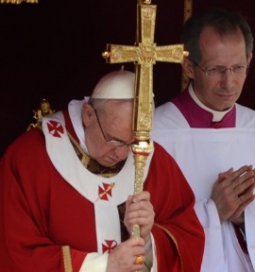
Pope Francis
Dr. Jeff Mirus of Catholicculture.org wrote a brilliant post in regard to the previously mentioned April 16 address by Pope Francis in which he said that the Council "is a beautiful work of the Holy Spirit."  From Dr. Mirus:
Just as the Modernists ignore the Magisterium as a relic of the past, replacing it with the spirit of the current age, the Traditionalists ignore the contemporary Magisterium, replacing it with the spirit of some previous age. But please note that these descriptions are not perfect, and that one can have a fairly liberal or a fairly conservative outlook without really crossing the line into either camp. If we agree that the actual Conciliar texts are a great gift of the Holy Spirit for authentic Catholic renewal, it is safe to say we are in neither group. But in any case, the Pope rebukes both groups, insisting that the Council was a wholly legitimate and continuous growth or development of the Church, which everyone is bound to accept and act upon:
Everybody seems happy about the presence of the Holy Spirit but it’s not really the case and there is still that temptation to resist it…. The Council was a beautiful work of the Holy Spirit…. But after 50 years, have we done everything that the Holy Spirit said to us in the Council? In the continuity of the growth of the Church which was the Council?
Pope Francis, in other words, has the same view of the Council as his predecessors, which is really the only properly Catholic view. The same points were made by Paul VI; and by John Paul II; and by Benedict XVI. Every pope since the Council has insisted upon its faithful implementation. And yet too many of us still find ourselves either in one camp or the other, or else we are all too willing to accept things as they are, and to make a comfortable ecclesiastical place for ourselves in the status quo. Indeed, how many churchmen themselves fall into this more universal third category?
We need to turn off all of the chaos and clamor around us and even our own deceptive voices and open our minds and hearts to the Holy Spirit, allowing Him to guide us into all truth.


Credit:  thesestonewalls.com

Related Posts  0