Sunday, June 23, 2013

If There Is No Humility, Love Remains Blocked

Credit:  www.steveshapiro.com
I have been really struggling lately with blogging.  I've started a lot of posts and found that I just have not been able to finish them.  I have a lot of thoughts and ideas, but when I see them in print, I feel they are a waste of time and no one will benefit from them.

My original purpose in blogging was to reach out to our suffering world and do something to spread the One Truth Faith, which is the Catholic Church.  The Catholic Church is the ark of salvation whose purpose is to bring Jesus Christ to the rest of the world.  As our Holy Father, Pope Francis, recently said, "It’s an absurd dichotomy to think one can live with Jesus, but without the Church, to follow Jesus outside the Church, to love Jesus and not the Church."  The Catholic Church is the only place that has the answers to all the truly important questions in life.  We have been given an ironclad promise by our Founder, Jesus Christ, that the Catholic Church, as imperfect as Her members are, can never lead us astray with her teachings.  


There is no doubt in my mind that the Catholic Church is the one true Church founded by Jesus Christ.  I am intensely loyal to the Holy Father, successor to the Chair of Peter and Christ's representative on earth.  I proudly wear the label "Papist".  But when it comes to my own ideas, I can only parrot the words of John Lennon, "But now these days are gone, I'm not so self assured."

I consider myself to be a "Traditional Catholic."  I love the Traditional Latin Mass and everything connected with it.  I believe such practices as Communion in the hand, altar girls and Extraordinary Ministers of the Eucharist are very harmful to people's faith.  When I was a little girl preparing for my first Communion, my teacher told us that no one but an ordained priest should handle a consecrated Host, and I still believe that is true.  I fully accept that these practices are allowed by the Catholic Church, but they are indults given against the personal wishes of our Holy Fathers.  It is the same as when the ancient Israelites asked for a king.  From I Samuel 8:
6 But when they said, “Give us a king to lead us,” this displeased Samuel; so he prayed to the Lord. 7 And the Lord told him: “Listen to all that the people are saying to you; it is not you they have rejected, but they have rejected me as their king. 8 As they have done from the day I brought them up out of Egypt until this day, forsaking me and serving other gods, so they are doing to you. 9 Now listen to them; but warn them solemnly and let them know what the king who will reign over them will claim as his rights.”
Sometimes God gives us what we ask not because we love Him but because we have rejected Him, and we pay a heavy price, which can now be seen throughout the entire Church.

As much as I love all things Traditional when it comes to Catholicism, I have found that I often have to separate myself from other "Traditionalists." Why? I got the answer today from a man who told me he has been going to a Traditional Latin Mass. He said he loves the Mass and intends to keep going despite certain things that really bother him. What "things" bother him? The people and their attitudes. Many of them have a "I'm right and everyone else is wrong" attitude, very intolerant and uncharitable.

Traditional Catholics tend to be very knowledgeable people. Many of them know the Latin Mass backwards and forwards and in Latin. Many of them have done a tremendous amount of reading and studying, and they know their faith very well. They can quote Pope Pius X verbatim. But what good is this knowledge if it doesn't lead to charity and mercy? As I Corinthians 8:1 says, "while knowledge makes us feel important, it is love that strengthens the church."

Isaiah 66:2 tells us the most important qualities our Lord looks for:  "These are the ones I look on with favor: those who are humble and contrite in spirit, and who tremble at my word."  You think you know the teachings of the Church?  There is one who knows better than you, and that is Satan.  Knowledge does not make you important or righteous.  Knowledge without love and humility does not impress God, and it does not lead to salvation.

I personally have been guilty of this very thing on this blog, and I am doing a mea culpa right here and now.  Being "right" is not what is important to God.  Our Lord doesn't care how much you know.  He cares how much you love.  Beating someone over the head with the truth is not an act of love.

Our Lord said that we must become as little children in order to enter the Kingdom of Heaven.  That doesn't mean that we don't need to learn spiritual truths.  But it does mean that if our knowledge does not include humility and love, we are no better than heretics.

A lot of Traditionalists were very offended by some comments recently made by Pope Francis. On June 10, the Traditionalist blog, Rorate Caeli, posted about a meeting Pope Francis had with CLAR (the Latin American and Caribbean Confederation of Religious Men and Women). According to those who attended the meeting, Pope Francis told them there is a "Pelagian current ... in the Church at this moment."  Pelagianists were heretics condemned by the Church in the 5th Century. They did not believe in original sin and one of their core beliefs was that we can be good without Divine help or grace. This belief led them to put great emphasis upon their physical works. Pope Francis feels that some "restorationist groups" are examples of this in the Church today. Speaking of the "restorationist" groups, Pope Francis said:
I know some, it fell upon me to receive them in Buenos Aires. And one feels as if one goes back 60 years! Before the Council... One feels in 1940... An anecdote, just to illustrate this, it is not to laugh at it, I took it with respect, but it concerns me; when I was elected, I received a letter from one of these groups, and they said: "Your Holiness, we offer you this spiritual treasure: 3,525 rosaries." Why don't they say, 'we pray for you, we ask...', but this thing of counting... And these groups return to practices and to disciplines that I lived through - not you, because you are not old - to disciplines, to things that in that moment took place, but not now, they do not exist today...
Was Pope Francis condemning the Rosary?  Hardly.  Pope Francis prays fifteen mysteries of the Rosary every day.  He has a great devotion to our Lady, and in his first few months as pope, he has already led a couple of public rosaries.  Pope Francis is saying that we should not be putting emphasis upon our works, e.g. counting rosaries.  This is a trap that many Traditionalists are drawn into.    Counting rosaries is an example of putting the emphasis on ourselves by saying "look what I have done."  It precludes humility and love, and as St. Paul said, when this happens we become nothing more than a clanging symbol.

Pope Francis gave a very deep sermon on the subject of humility and love on the Feast of the Annunciation.  You can read an article concerning this sermon here.  According to this article, the central focus of this sermon was "For the Christian, 'making progress' means 'lowering oneself' on the road of humility in order allow God’s love to emerge and be clearly seen."  From the article:
The way of Christian humility rises up to God, as those who bear witness to it “stoop low” to make room for charity. The liturgical feast of the Annunciation occasioned this reflection from Pope Francis, as he celebrated the Annunciation Mass on Monday morning. The Pope said that the road taken by Mary and Joseph to Bethlehem for the imperial census was a road of humility. There was the humility of Mary, who “did not understand well,” but “[entrusted] her soul to the will of God.” Joseph was humble, as he “lowered himself” to take on the “great responsibility” of the bride who was with child.
“So it is always with God’s love,” said Francis, “that, in order to reach us, takes the way of humility.” This was the same way that Jesus walked, a way that humbled itself even unto the Cross. Pope Francis went on to say that, for a Christian, “[T]his is the golden rule,” according to which progress and advancement always come through lowering oneself. “One can take no other road,” he said, adding, “if I do not lower myself, if you do not lower yourself, you are not a Christian.”
Pope Francis went on to say, “Being humble does not mean going on the road,” with “downcast eyes.” Such was not the humility of Jesus, or his mother or his foster father, Joseph. The Holy Father underlined that the way of humility is the one that leads to the triumph of the Resurrection. “Let us ask God for the grace of humility,” he prayed, “that humility, which is the way by which charity surely passes,” for, “if there is no humility, love remains blocked, it cannot go [forward].”
St. Francis, our Holy Father's patron saint, told us to preach always and use words if necessary. I believe this is saying that the best way to bring the saving message of Christ's Gospel to the world is not in words but in actually living the Gospel. I have come to realize that my opinions and ideas are utterly unimportant, that the only thing that matters is if I am humble and loving. Who am I to tell anyone anything? I am a sinner who stumbles and falls many times each day. The only thing of value that I have to offer anyone is to point to our Lord.

I have changed the description of my blog to "The Journey of One Catholic Searching for Truth in a World Gone Mad." Christ told us He is the Way, the Truth and the Life. Since the Catholic Church is Christ's Mystical Body, then the Church, with all her faults and failings, is the Way, the Truth and the Life here on earth. So I know that I have found Objective Truth. My struggle is to purge my own ideas and opinions which mean nothing and replace those empty, barren ideas with the Eternal Objective Truth of our Lord as found in the Catholic Church.

I have made several mistakes in my journey to date. First of all, I have trusted too much in myself. I have learned a few things and become puffed up with pride, thinking I knew it all. Secondly, I have listened to too many other people who, without knowing it, have struggled with this same problem. A little bit of knowledge can make us sound so good, but if there is no Godly Charity, it can bear no fruit.
One other vital lesson that I have learned is that we must always remain loyal to the Holy Father. He is the divinely ordained Vicar of Christ, the one man who can never lead us astray in faith and morals. Far too many of my fellow Traditionalists claim to support the Holy Father but seem to have no difficulty whatsoever in being his harshest critic, constantly second guessing him. I denounce all who do that. I am not saying I understand everything Pope Francis says and does, but what does that matter? As I have previously written, my ideas and opinions mean nothing. Our Lord once said, "Blessed are those who have not seen and yet have believed."  As St. Paul wrote in II Corinthians 5:7 - "We walk by faith, not by sight."

We live in a world that is guided by an evil, supernatural being whose specialty is appearing as an angel of light, transforming good into evil and evil into good. God's Word warns us that he roams about the world seeking whom he may devour. If we are not consciously putting Jesus Christ at the center of our lives, this cunning, deceptive being will fill that vacuum.

Pope Francis, in his first sermon to the bishops after his election said this:
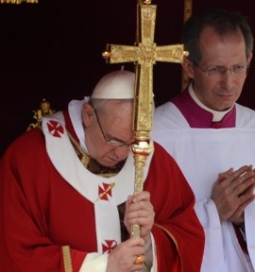
In these three readings, I see a common element: that of movement. In the first reading, it is the movement of a journey; in the second reading, the movement of building the Church; in the third, in the Gospel, the movement involved in professing the faith. Journeying, building, professing.
Journeying. "O house of Jacob, come, let us walk in the light of the Lord" (Is 2:5). This is the first thing that God said to Abraham: Walk in my presence and live blamelessly. Journeying: our life is a journey, and when we stop moving, things go wrong. Always journeying, in the presence of the Lord, in the light of the Lord, seeking to live with the blamelessness that God asked of Abraham in his promise.
Building. Building the Church. We speak of stones: stones are solid; but living stones, stones anointed by the Holy Spirit. Building the Church, the Bride of Christ, on the cornerstone that is the Lord himself. This is another kind of movement in our lives: building.
Thirdly, professing. We can walk as much as we want, we can build many things, but if we do not profess Jesus Christ, things go wrong. We may become a charitable NGO, but not the Church, the Bride of the Lord. When we are not walking, we stop moving. When we are not building on the stones, what happens? The same thing that happens to children on the beach when they build sandcastles: everything is swept away, there is no solidity. When we do not profess Jesus Christ, the saying of Léon Bloy comes to mind: "Anyone who does not pray to the Lord prays to the devil." When we do not profess Jesus Christ, we profess the worldliness of the devil, a demonic worldliness.
Journeying, building, professing. But things are not so straightforward, because in journeying, building, professing, there can sometimes be jolts, movements that are not properly part of the journey: movements that pull us back.
This Gospel continues with a situation of a particular kind. The same Peter who professed Jesus Christ, now says to him: You are the Christ, the Son of the living God. I will follow you, but let us not speak of the Cross. That has nothing to do with it. I will follow you on other terms, but without the Cross. When we journey without the Cross, when we build without the Cross, when we profess Christ without the Cross, we are not disciples of the Lord, we are worldly: we may be bishops, priests, cardinals, popes, but not disciples of the Lord.
My wish is that all of us, after these days of grace, will have the courage, yes, the courage, to walk in the presence of the Lord, with the Lord’s Cross; to build the Church on the Lord’s blood which was poured out on the Cross; and to profess the one glory: Christ crucified. And in this way, the Church will go forward.
My prayer for all of us is that the Holy Spirit, through the intercession of the Blessed Virgin Mary, our Mother, will grant us this grace: to walk, to build, to profess Jesus Christ crucified. Amen.
As we approach the Feast of John the Baptist, I think it is appropriate to quote this most important saint in his attitude towards Christ:  "He must increase, but I must decrease."

Credit:  www.issacharministry.org.au

Wednesday, June 5, 2013

Vatican II: A Case of Selective Hearing


Songwriter Paul Simon of Simon and Garfunkel wrote a song in the 1960's called "The Boxer", which has some great lines it.  For purposes of this posting, I point out the following line:

A man hears what he wants to hear and disregards the rest.  

As far as being a Catholic is concerned, this statement is never truer than when discussing the Second Vatican Council and the ramifications therefrom. Father John Zuhlsdorf recently linked to an article from almost five years ago concerning a letter from Bishop R. Walker Nickless. The article was originally posted on Lifesitenews.com and is entitled "Sioux City Bishop Calls for 'Exorcism' of  'Spirit of Vatican II'".  You can read Father Z's post here. The article refers to the 17-page letter written by Bishop Nickless in 2009. He was the then-newly appointed bishop of that diocese, and this was his first letter as bishop.

Father Z's readers saw this and read it as a bishop condemning Vatican II and all that came from it, despite the fact that this was not in any way the intention of Bishop Nickless. Here is the first part of the article as posted by Father Z (the comments in red are his):

Bp. Nickless (D. Sioux City): we must “exorcize” the “spirit of Vatican II”

I have mentioned Bishop Nickless of Sioux City before.
This is from LifeSite:
Sioux City Bishop Calls for “Exorcism” of “Spirit of Vatican II”
By Kathleen Gilbert
SIOUX CITY, Iowa, October 16, 2009 (LifeSiteNews.com) – Catholics must learn to “exorcise” the so-called “spirit of Vatican II” to end the secularization that has “wreaked havoc” on the Church since the Council, says Bishop R. Walker Nickless of Sioux City, Iowa. [Do I hear an "Amen!"?]
Notice that this very clearly says that the Bishop feels "the spirit of Vatican II" needs to be exorcised, which is not Vatican II itself.  Yet the comments left by readers make it very clear that they completely disregard the words of the Bishop and equate the "spirit" of Vatican II with the Council.  Even the few excerpts from the article made it clear that this was not what His Excellency was saying.  The next two paragraphs as quoted by Father Z make that very plain.   The words in bold are from Father Z's post:
In a pastoral letter issued Thursday to the lay and religious of his diocese, Nickless wrote that he has “no other desire” than to see the reforms of Vatican II implemented properly. However, he said, “It is crucial that we all grasp that the hermeneutic or interpretation of discontinuity or rupture, which many think is the settled and even official position, is not the true meaning of the Council.”
The “hermeneutic of discontinuity,” under the guise of the “spirit of Vatican II,” sees “the Second Vatican Council as a radical break with the past,” explained the bishop. However, “There can be no split … between the Church and her faith before and after the Council.”
This makes it very plain that the Bishop does not believe that Vatican II constitutes a break with the past or a "rupture" in Church teaching. He plainly says that those who teach such are teaching falsehoods. The LifesiteNews article continues, and unless the reader is careful, he can continue to read this as Bishop Nickless condemning the Vatican II council:
This “hermeneutic of discontinuity,” said Nickless, “emphasizes the ‘engagement with the world’ to the exclusion of the deposit of faith.”
“This has wreaked havoc on the Church, systematically dismantling the Catholic Faith to please the world, watering down what is distinctively Catholic, and ironically becoming completely irrelevant and impotent for the mission of the Church in the world,” he said.  “The Church that seeks simply what works or is ‘useful’ in the end becomes useless.”
It is important to note that Bishop Nickless is not condemning Vatican II as "systematically dismantling that Catholic Faith", but blames the false "hermeneutic of discontinuity." As quoted above, His Excellency believes that "There can be no split … between the Church and her faith before and after the Council."

The article was so old that the link to the Bishop's original letter was broken.  Fortunately, one of Father Z's readers provided a working link, and therefore we are able to read the Bishop's entire letter, which is here.  Other than the one reader posting a working link, none of Father's Z's readers seem to question the broken link and are presumably not interested in reading the actual letter.  Father Z originally posted about this letter in 2009, and he quoted from the letter at that time, so I don't understand why he did not correct his readers who got it so wrong, as can be seen from their comments.

Here are some of the comments to Father Z's blog:


  1. Gratias says:
    The Church has been taken over by the outside world and they still are not pleased with us. V2 was a rupture and a mistake.

  2. Bob B. says:
    I’ll bet Fishwrap is having a fit right about now.

  3. backtothefuture says:
    We need to exorcise the whole council on the whole.

  4. Your Excellence, this may be a little more difficult than you think. We have an obstacle in the way of your much needed suggestion: Pope John Paul “the great”:
    “Entrusting myself fully to the Spirit of truth, therefore, I am entering into the rich inheritance of the recent pontificates. This inheritance has struck deep roots in the awareness of the Church in an utterly new way, quite unknown previously, thanks to the Second Vatican Council…”
    This, Bishop Nickless is THE ‘spirit of Vatican II’.
    Kyrie Eleison!
  5. Nancy D. says:
    Vatican II is a rupture because it made the erroneous claim that the Jews and the Moslems worship the same God as we do, when the fact is, we, who are Catholic, worship The True God, The God of our Salvation, Who desires we overcome our disordered inclinations, including our disordered sexual inclinations, so that we are not led into temptation, but rather, sin no more. The Sacrifice of The Cross, Is The Sacrifice of The Holy Trinity, for “God so Loved us, that He sent His Only Son…”.
    God Is Love. Love exists in relationship. There Is only One Spirit of Love Between The Father and The Son.
I find all of these comments to be very disconcerting. Unlike Bishop Nickless, who is attacking the false "Spirit of Vatican II", these comments are attacking the Council itself. None of these readers seem to understand Bishop Nicklass' message. I won't accuse Father Z of encouraging these kind of comments, but I do question why he let these comments stand without some response or correction.

The 17-page letter from Bishop Nickless is actually a wonderful teaching tool as to the real meaning of Vatican II and why it has not borne the anticipated fruit of its founding fathers.

Would Bishop Nickless agree that "V2 was a rupture and a mistake"? Hardly. This is what he wrote in his letter:
I studied and was ordained a deacon and priest during the exciting, almost intoxicating, time of the Second Vatican Council. I am thoroughly a product of that momentous time, the greatest gift of the Holy Spirit to the Church in centuries. It has formed the context and culture of my entire ministerial life. Like Pope John Paul the Great, I have no other desire for my ministry than seeing the hopes and reforms of the Second Vatican Council fully implemented and brought to fruition.
Portions of this excerpt were included in the Lifesite news article, but Father Z did not use these quotes. If he had used these quotes, would Father Z's readers still make such comments as: "Wow, what a great Bishop!" or "Please, dear papal nuncio, Cardinal Ouellet and Pope Francis, we need a few more bishops like this guy!"  Something tells me that their sentiments would be very different if they realized that this is how His Excellency actually views Vatican II.  

As can also be seen from the above quote, Bishop Nickless has great admiration and respect for Blessed John Paul II (who was not a Blessed at the time this letter was written), even calling him "Pope John Paul the Great."  Unlike "Catholic Johnny" above, Bishop Nickless sees Blessed John Paul as anything but an "obstacle."

Bishop Nickless quoted from Blessed John XXIII's opening sermon at the Council:
In opening the Council, Blessed John stated that the “greatest concern of the Ecumenical Council” was twofold: “that the sacred deposit of Christian doctrine should be [both] guarded and taught more efficaciously.” Later in the speech, he elaborated on this: “The substance of the ancient doctrine of the deposit of faith is one thing, and the way in which it is presented is another.” The teachings of the Church, our identity and culture as Catholics, must be loved and guarded, yet brought forth and taught in a way understandable to the modern world. 
Bishop Nickless goes on to explain how this is what the "New Evangelization" is all about.  The substance of the Church's teaching is not new, but the way in which it is presented to a changing world is new.  This is the heart and soul of the meaning of Vatican II, and this was the driving force of the pontificate of Blessed John Paul II:
Pope Paul VI and Pope John Paul the Great constantly preached the same thing in calling for a “New Evangelization” of the faithful, our separated brothers and sisters in Christ, and all those who do not know Jesus Christ or the Church. This New Evangelization was to be “new not in content but in ardor, methods, and expression.”  It is readily apparent from his teaching and ministry that for Pope John Paul the Great, the New Evangelization was the true fruit of the Second Vatican Council. Indeed, the Council was the beginning and blueprint for evangelization in the modern world. He explicitly stated this as his particular mission at the time of his election, and he lived it to the end.  He spent his entire pontificate interpreting and implementing the Council’s documents according to the light of the Holy Spirit, given in virtue of his office, amid the changing circumstances of the Church and the world.
Bishop Nickless readily admits that something has gone terribly wrong since Vatican II.   He quotes from Pope Benedict XVI:
The question arises: Why has the implementation of the Council, in large parts of the Church, thus far been so difficult? Well, it all depends on the correct interpretation of the Council or—as we would say today—on its proper hermeneutics, the correct key to its interpretation and application. The problems in its implementation arose from the fact that two contrary hermeneutics came face to face and quarreled with each other. One caused confusion, the other, silently but more and more visibly, bore and is bearing fruit.
Bishop Nickless is telling us that the false "hermeneutic of discontinuity and rupture" has been the root of the crisis in the Church and has presented a false interpretation of Vatican II:
On the one hand, there is an interpretation that I would call “a hermeneutic of discontinuity and rupture,” it has frequently availed itself of the sympathies of the mass media, and also one trend of modern theology. On the other, there is the “hermeneutic of reform,” of renewal in the continuity of the one subject – Church – which the Lord has given to us. She is a subject which increases in time and develops, yet always remaining the same, the one subject of the journeying People of God. The hermeneutic of discontinuity risks ending in a split between the pre-conciliar Church and the postconciliar Church. It asserts that the texts of the Council as such do not yet express the true spirit of the Council.
Bishop Nickless quotes extensively from Pope Benedict XVI and says:
the “spirit of Vatican II” must be found only in the letter of the documents themselves. The so-called “spirit” of the Council has no authoritative interpretation. It is a ghost or demon that must be exorcised if we are to proceed with the Lord’s work.
Coincidentally, Michael Voris just released a Vortex video, which you can watch here, regarding comments made by Cardinal Walter Kaspar who has suddenly come to the conclusion that the Vatican II documents were purposely made ambiguous as a result of "compromise forumlas" which "open the door to a selective reception in either direction."  Michael Voris finds this "admission" by Cardinal Kaspar to be "stunning, absolutely stunning" . . . "that the (Vatican II) documents were deliberately written in such a way to please everyone and cause confusion and conflict."  Hmmmm.  That is not what Bishop Nickless of Sioux City, Iowa said, nor is it what Pope Benedict XVI has said, or even our current Holy Father, Pope Francis, who called the Council "a beautiful work of the Holy Spirit" in a homily on April 16 of this year (you can read an article about this homily here).

Quote from Cardinal Kaspar
Michael Voris, to bolster his position, goes on to quote from Bishop Athanasius Schneider of Kazakhstan. From the Vortex video:
About two years ago – a very well respected bishop .. Athanasius Schneider of Kazakhstan was addressing a large group of bishops and cardinals in Rome. He suggested that the time has come for a Syllabus of Errors to be published by the Holy Father clearing up the misinterpretations of the documents of the Second Vatican Council which have become so rampant.
Bishop Schneider
You can read the address by Bishop Schneider here.  You will see that he quotes extensively from Vatican II documents and in a very positive light.  Bishop Schneider give us basically the same argument as that of Bishop Nickless:  Vatican II has been grossly misinterpreted, and that has been the cause of the crisis in the Church.  Bishop Schneider has only praise for the true intentions of Vatican II, as can be seen in the following quotes:
According to an expression of Blessed Pope John XXIII in the speech given at the final general congregation of the first session of the Council, December 7, 1962, the one purpose of the Council and the one hope and confidence of the Pope and the Council Fathers consists in this: “To make ever more known to the men of our time the Gospel of Christ, that it be practiced willingly and that it penetrate deeply into every aspect of society.” (loc. cit., pp. 881-882). Can there be a more authentic and more Catholic pastoral principle and method than this?
Bishop Schneider explains what he feels are the reasons we have not seen greater fruit from Vatican II:
In substance, there were two impediments against the true intention of the Council and its Magisterium bearing abundant and lasting fruits. One was found outside the Church, in the violent process of cultural and social revolution in the 1960s, which, like every powerful social phenomenon, penetrated within the Church, contaminating vast ranges of people and institutions with its spirit of rupture. The other impediment showed itself in the lack of wise and intrepid Pastors of the Church who would be ready to defend the purity and integrity of the faith and of the liturgical and pastoral life, not letting themselves be influenced either by praise or by fear (“nec laudibus, nec timore”).
Bishop Schneider sums up his position on Vatican II in his final statement:
Thus there truly is the need for a conciliar Syllabus with doctrinal value, and moreover there is need to increase the number of holy, courageous pastors, profoundly rooted in the tradition of the Church, free from any type of mentality of rupture whether in the field of doctrine or of liturgy. In fact, these two elements constitute the indispensable condition so that doctrinal, liturgical, and pastoral confusion may diminish notably and the pastoral work of the Second Vatican Council may bear many and lasting fruits in the spirit of tradition, which joins us with the spirit that reigns at all times, everywhere, and in all true children of the Catholic Church, which is the one and the true Church of God on the earth.
I have shown in previous posts that Michael Voris tends to make very misleading statements, but I think he has outdone himself this time when he invokes Bishop Schneider to back up his argument that Vatican II has been the source of the crisis in the Church.  Bishop Schneider would be the first disagree with Voris.

Interestingly, Father Z posted in regard to the Vortex video about the Vatican II documents.  Father Z starts out his post by writing, "I will remind the readership that in the greater arc of the Church’s history, Vatican II wasn’t all that important."  He writes further, "Vatican II has taken on a kind of mythic importance in the identity of many Catholics of a certain age."  These statements would seem to indicate that Father Z is not in step in his view of Vatican II with Bishop Nickless, whom he had praised just a few days prior, or with any of our recent Popes, including Pope Francis, or with Bishop Schneider, to name just a few good and holy men of the Church, all of whom defend Vatican II and place great importance on it.

Father Z offers his take on Vatican II: "During Vatican II, after many of the working drafts and schemata were junked, committees and subcommittees, working under pressure and time constraints, cobbled the documents together.  Is it any wonder that the documents have some problems?"  I guess Father Z doesn't give much importance to the influence of the Holy Spirit.

So Father Z agrees with Voris that there are problems with the documents in Vatican II.  Again, he would not seem to be in step with any of the post-conciliar Popes or with Bishop R. Walker Nickless or with Bishop Athanasius Schneider.  It should be noted that in January 2011, Father Z praised Bishop Schneider and even did a podcast on the aforementioned speech, which can be found here.  Yet, Father Z's statements in this last post would seem to be at odds with those of Bishop Schneider.  It all gets quite confusing.

Again, the comments to Father Z's post are more enlightening than the actual post.  The following comment is typical of many that were posted, and to which Father Z made no response:

Johnno says:
There’s a false equivalence here between Vatican II and previous councils.
Previous Councils sought to clarify and nail down certain things and reduce ambguity as much as possible.
Vatican II’s purpose, according to the testimony of those who were involved, seemed primarily set on the objective to purposely further ambiguity and water down the Catholic faith so as to somehow trick Protestants and the world into imagining that they could find common ground with us and therefore join in… An idea so ill-conceivably and amazingly stupid that it makes far more sense to reach the conclusion that the architects of Vatican II didn’t seek to clarify Catholicism or explain ambguities and answer divisive topics like other councils, but rather to destroy tenets of the Catholic Church itself so that it would join the modern world in all its glorious progress.
Regardless of however you want to see it, Vatican II’s supposed goals were never met and are colossal failures, and the only reason we continue to try and find some light in its darkness is to avoid responsibility for it. That and stubborn pride. Whatever good we do salvage from it is likely God making lemonade from the lemons we fostered upon His Church.

The bottom line is this:  All of the Holy Fathers in the last half of the 20th Century and into the 21st Century have told us that Vatican II was an important council and a good and holy council.  The purpose of this council was to aid in spreading the saving message of the Gospel of Jesus Christ to a changing world.  Many have tried to hijack this council and make it into something it was never meant to be:  a reform of the Church.  If we try to belittle the council or worse, condemn it, we have fallen into the trap of Satan himself.  

Pope Francis
Dr. Jeff Mirus of Catholicculture.org wrote a brilliant post in regard to the previously mentioned April 16 address by Pope Francis in which he said that the Council "is a beautiful work of the Holy Spirit."  From Dr. Mirus:
Just as the Modernists ignore the Magisterium as a relic of the past, replacing it with the spirit of the current age, the Traditionalists ignore the contemporary Magisterium, replacing it with the spirit of some previous age. But please note that these descriptions are not perfect, and that one can have a fairly liberal or a fairly conservative outlook without really crossing the line into either camp. If we agree that the actual Conciliar texts are a great gift of the Holy Spirit for authentic Catholic renewal, it is safe to say we are in neither group. But in any case, the Pope rebukes both groups, insisting that the Council was a wholly legitimate and continuous growth or development of the Church, which everyone is bound to accept and act upon:
Everybody seems happy about the presence of the Holy Spirit but it’s not really the case and there is still that temptation to resist it…. The Council was a beautiful work of the Holy Spirit…. But after 50 years, have we done everything that the Holy Spirit said to us in the Council? In the continuity of the growth of the Church which was the Council?
Pope Francis, in other words, has the same view of the Council as his predecessors, which is really the only properly Catholic view. The same points were made by Paul VI; and by John Paul II; and by Benedict XVI. Every pope since the Council has insisted upon its faithful implementation. And yet too many of us still find ourselves either in one camp or the other, or else we are all too willing to accept things as they are, and to make a comfortable ecclesiastical place for ourselves in the status quo. Indeed, how many churchmen themselves fall into this more universal third category?
We need to turn off all of the chaos and clamor around us and even our own deceptive voices and open our minds and hearts to the Holy Spirit, allowing Him to guide us into all truth.


Credit:  thesestonewalls.com

Saturday, June 1, 2013

First Saturday Meditation: The First Luminous Mystery-The Baptism of Jesus


Today, June 1, is the First Saturday of the Month. The First Saturday Devotion to the Immaculate Heart of Mary was first mentioned by Our Lady of Fatima on July 13, 1917. After showing the three children a vision of hell she said, "You have seen hell where the souls of poor sinners go. To save them, God wishes to establish in the world devotion to my Immaculate Heart. If what I say to you is done, many souls will be saved and there will be peace... I shall come to ask for... the Communion of reparation on the first Saturdays..." The First Saturday devotion is as follows:
It consists in going to Confession, receiving Communion, reciting five decades of the Rosary and meditating for a quarter of an hour on the mysteries of the Rosary on the first Saturday of five consecutive months. The Confession may be made during the eight days preceding or following the first Saturday of each month, provided that Holy Communion be received in the state of grace. Should one forget to form the intention of making reparation to the Immaculate Heart of Mary, it may be formed at the next Confession, occasion to go to confession being taken at the first opportunity.
Today I wish to meditate upon the First Luminous Mystery, which is the baptism of our Blessed Lord in the River Jordan by his cousin, John. John and Jesus were born approximately six months apart. When the angel, Gabriel, announced to the Virgin Mary that she was to be the Mother of God, he told her that her cousin, Elizabeth, who was past child bearing age, had also miraculously conceived and was now in her sixth month. Mary immediately went to be at Elizabeth's side. Elizabeth was carrying John the Baptist.  The meeting of Elizabeth and her unborn child and Mary and her unborn child involved the three holiest people who have ever lived:  Jesus, because He was God; Mary, the Mother of God who was conceived without sin; and John the Baptist, who was sanctified by Jesus while still in his mother's womb and about whom Jesus said, "among those born of women there has not risen anyone greater than John the Baptist." 

John could easily have followed in the footsteps of his father, Zachariah, and become a priest in the temple, but he eschewed that easy lifestyle and instead started what could be called a "rogue" ministry, going into the wilderness to announce the coming of the Messiah. He had, in effect, started this ministry while still in his mother's womb when he leaped at the presence of the Lord who was in His mother's womb.  Just as an aside, this meeting of the pre-born John and Jesus is surely one of the strongest arguments that can be had against abortion.


Luke 3:1-3 tells us this concerning John's ministry:
 "In the fifteenth year of the reign of Tiberius Caesar—when Pontius Pilate was governor of Judea, Herod tetrarch of Galilee, his brother Philip tetrarch of Iturea and Traconitis, and Lysanias tetrarch of Abilene— during the high-priesthood of Annas and Caiaphas, the word of God came to John son of Zechariah in the wilderness.  He went into all the country around the Jordan, preaching a baptism of repentance for the forgiveness of sins.
Tiberius Caesar reigned from 14 AD to 37 AD, so this was approximately 29 AD. John 3:3 tells us that the role of John the Baptist was described in the prophecy of Isaiah:
“A voice of one calling in the wilderness,
‘Prepare the way for the Lord,
make straight paths for him.’”
As a central part of preparing the way of the Lord, John began a ministry of baptism, as he explained: "I baptize you with water for repentance. But after me comes one who is more powerful than I, whose sandals I am not worthy to carry. He will baptize you with the Holy Spirit and fire."  (Matthew 3:3) Like Mary, the mother of Christ, everything John said and did was to point away from himself and to Christ. As John said, "He must increase, but I must decrease." (John 3:30) It is no accident that the Feast of the Nativity of John the Baptist is June 24, a time in the Northern Hemisphere when daylight hours begins to decrease. Six months later, when we celebrate the birth of Jesus, daylight hours begin to increase.

John the Baptist had completely separated himself from the established religious leaders of that time, and in fact called them out when they came to see him:  "You brood of vipers! Who warned you to flee from the coming wrath?"  (Matt. 3:7). John, to use the vernacular, "called 'em as he saw 'em." He showed no fear of anyone or anything but just total dedication to his ministry of preparing the way for the Lord. The people were drawn to him no doubt because of the sincerity and forcefulness with which he preached.

Our Lord, who had kept a low, private profile up to this time, came from Galilee to the River Jordan where John was preaching and baptizing. As soon as John saw his cousin walking towards him, the words poured out of his mouth:
Behold the Lamb of God, which taketh away the sin of the world.

These words are used in the Mass to this very day when the priest holds up the consecrated Host for us to adore and worship.

No one had to tell John who Jesus was. He knew, and he shouted it for all the world to hear. Jesus then asked John to baptize him. John was completely taken aback by this request:  "I need to be baptized by you, and do you come to me?"  (Matt. 3:14).  Why would Jesus, who was and is the Son of God, completely without sin, need to be baptized? The same question could be asked of His entire life: why did He have to be born as a helpless babe; why did he have to be purified at the temple after being born; why was He subject to the authority of Mary and Joseph; why wasn't he born as an earthly king with all the privileges that come with such earthly rank?

Our Lord did all of this in order to become one with mankind. While losing none of His Divinity, he became as human as we are, and humbled and subjected himself as completely as possible to the human experience. As Hebrews 5:8 tells us, "Even though Jesus was God's Son, he learned obedience from the things he suffered."  He knows firsthand what it means to be a human being in our fallen world and face the trials and obstacles that we endure. Hebrews 4:15-16 says: "For we do not have a high priest who is unable to empathize with our weaknesses, but we have one who has been tempted in every way, just as we are—yet he did not sin. Let us then approach God’s throne of grace with confidence, so that we may receive mercy and find grace to help us in our time of need."

Jesus was also our trailblazer, cutting out and showing the path to Heaven. Jesus received the sacrament of Baptism to show us that this is the path we also must walk. As Jesus said in answer to John's question, "Let it be so now; it is proper for us to do this to fulfill all righteousness."  (Matt. 3:15).  Our Lord did not leave us in the dark, trying to figure out on our own the way to salvation. He showed the way by putting Himself literally into each step. As Jesus told the Pharisee, Nicodemus, "Very truly I tell you, no one can enter the kingdom of God unless they are born of water and the Spirit. Flesh gives birth to flesh, but the Spirit gives birth to spirit."  (John 3:5-6)

We must be born of water, which is baptism, as shown by our Lord. Jesus also showed us what it means to be born of the Spirit when the Holy Spirit descended upon Jesus in the form of a dove at his baptism, as John the Baptist told us: "I saw the Spirit descending from heaven like a dove, and it abode upon him."  (John 1:32)  We saw something similar to this when, after Jesus ascended to Heaven, the Holy Spirit in the form of tongues of fire descended upon Mary and the Apostles at Pentecost.

The concept of baptism did not start with John the Baptist. St. Peter tells us that the Great Flood in the time of Noah was a baptism (I Peter 3:20-21):
. . . to those who were disobedient long ago when God waited patiently in the days of Noah while the ark was being built. In it only a few people, eight in all, were saved through water, and this water symbolizes baptism that now saves you also—not the removal of dirt from the body but the pledge of a clear conscience toward God.
St. Paul tells us that baptism was also seen when the Israelites passed through the Red Sea while escaping from the Egyptians (I Cor. 10:1-2):
For I do not want you to be ignorant of the fact, brothers and sisters, that our ancestors were all under the cloud and that they all passed through the sea. They were all baptized into Moses in the cloud and in the sea.

Baptism is the way in which our sins are washed away and we are made clean before God.  Our Lord subjected Himself to baptism, leaving us with no excuses.  As Jesus said, we must be born of water and the Spirit, and He showed us exactly how it is done.

When Christ came up out of the waters of baptism, the Holy Spirit descended upon Him, and a voice was heard: "This is my beloved Son, in whom I am well pleased." (Matt. 3:17). The Trinity - Father, Son and Holy Spirit - have placed themselves in the Sacrament of Baptism. This is where Our Lord started His ministry, and this is where we start our Christian walk, cleansed from our sins and born of the Spirit.


Saturday, May 18, 2013

Pentecost is For All Time


Tomorrow is Pentecost Sunday. It is the birthday of the Church, a most glorious day when the apostles received the Holy Spirit while praying in the upper room with Mary, Christ's Blessed Mother. This happened exactly 50 days after our Lord's resurrection from the dead. The disciples of Jesus Christ had experienced 40 days in the physical presence of our Glorified Lord talking with and being taught by Him. The Book of Acts says that Christ spoke about the Kingdom of God during these 40 days. Acts 1:4-5 also says that "On one occasion, while he was eating with them, he gave them this command: “Do not leave Jerusalem, but wait for the gift my Father promised, which you have heard me speak about.  For John baptized with water, but in a few days you will be baptized with the Holy Spirit.”  At this point we can be sure that the apostles had barely a clue as to the meaning of Christ's words.

On the 40th day after the resurrection, Our Lord ascended to heaven in the presence of the disciples. Just before His Ascension, our Lord told the disciples:  "you will receive power when the Holy Spirit comes on you; and you will be my witnesses in Jerusalem, and in all Judea and Samaria, and to the ends of the earth."  (Acts 1:8) Again, we can be fairly certain that these words had little meaning to the apostles. They were still hiding out from the Jews, afraid for their own lives, and certainly in no frame of mind to go out among the outside world which was so hostile to them.

In the days following the Ascension, they stayed in Jerusalem as our Lord instructed them. They were in the same upper room where our Lord had conducted the Last Supper the night He was arrested.  "They all joined together constantly in prayer, along with the women and Mary the mother of Jesus, and with his brothers."  At this time they also chose a replacement for Judas, who had betrayed Christ and hung himself, so there were once again 12 apostles. It is only right that our Blessed Mother would be present at the birth of the Church, the Mystical Body of Jesus Christ, just as she was the one who gave physical birth to our Lord. Mary is the Spouse of the Holy Spirit, and she is never separated from Him.

On the 10th day after the Ascension, they were gathered together to celebrate Pentecost, a Holy Day among the Jews. "Suddenly a sound like the blowing of a violent wind came from heaven and filled the whole house where they were sitting.  They saw what seemed to be tongues of fire that separated and came to rest on each of them.  All of them were filled with the Holy Spirit and began to speak in other tongues as the Spirit enabled them."  (Acts 2:2-4).

All of the groundwork laid by Jesus Christ, all of His teaching and exhortation, suddenly came alive for them. It was like lights had been turned on in a darkened house, and what had seemed so incomprehensible before was now clear and unambiguous. Much as Mary conceived our Lord through the Power of the Holy Spirit, so now the apostles of Christ were filled with Jesus Christ through the Power of the Holy Spirit. The fear which had crippled them was replaced with the Love of God. As the Apostle John later wrote, "Perfect love casts out fear." (I John 4:18). The men who had run away the night of our Lord's arrest, the men who had cowered behind closed doors after the death of our Lord, had now become the strong and fearless witnesses of whom Christ spoke, and not even the fear of death could stop them now.

There were many others in the area who were also in Jerusalem to celebrate Pentecost (Acts 2:5-12). The sound of hearing their own languages drew them:
Now there were staying in Jerusalem God-fearing Jews from every nation under heaven. When they heard this sound, a crowd came together in bewilderment, because each one heard their own language being spoken.  Utterly amazed, they asked: “Aren’t all these who are speaking Galileans?  Then how is it that each of us hears them in our native language?  Parthians, Medes and Elamites; residents of Mesopotamia, Judea and Cappadocia, Pontus and Asia, Phrygia and Pamphylia, Egypt and the parts of Libya near Cyrene; visitors from Rome (both Jews and converts to Judaism); Cretans and Arabs—we hear them declaring the wonders of God in our own tongues!” Amazed and perplexed, they asked one another, “What does this mean?”

Everyone in Jerusalem knew the story of Jesus Christ. They knew He had been crucified as a common criminal and all of His followers seemed to have just dropped off the face of the earth. Nothing had been seen or heard from them after the crucifixion. Now, without any warning, here were these same men speaking perfectly in a multitude of different tongues and preaching "the wonders of God." They showed no fear, no hesitation whatsoever. The Apostle Peter spoke of the prophecies concerning Christ, how he was to come to earth as a Man to be crucified and be resurrected after three days. Peter concluded with, "Therefore let all Israel be assured of this: God has made this Jesus, whom you crucified, both Lord and Messiah."

The words poured out of Peter and the other Apostles and so affected those who heard them that "When the people heard this, they were cut to the heart and said to Peter and the other apostles, “Brothers, what shall we do?"  The apostles baptized 3000 people that day. The beginning of the Church could be compared to the Big Bang that many say started the universe. The Big Bang theory, which is actually very consistent with Scripture, says that there was nothing until - BANG! - the universe was born, and it has been expanding and growing ever since. One moment on the morning of Pentecost, the Church did not exist. Then the Holy Spirit descended, filled the Apostles and - BANG! - the Church was born and, like the Universe, has been expanding ever since then with no end in sight.

There are many lessons associated with Pentecost, but one big lesson is that we are all completely powerless without the Holy Spirit. The Apostles spent 3 years with Christ during His earthly ministry and 40 days with the Risen, Glorified Christ, and yet they were just as carnal and unconverted in their thinking as the day they were born. The Apostles were as unable to grasp the spiritual as an ant is unable to grasp the Laws of Physics. The Holy Spirit, sent by Jesus and the Father, is the One who enlightens our minds and gives us power to be the children of God and do His Work. As Zechariah 4:6 says, "Not by might nor by power, but by my Spirit,' says the LORD Almighty."  Galatians 3:3 says, "Are you so foolish? After beginning with the Spirit, are you now trying to attain your goal by human effort?"  Our Lord said plainly, "I tell you the truth, no one can enter the kingdom of God unless he is born of water and the Spirit. Flesh gives birth to flesh, but the Spirit gives birth to spirit."  (John 3:5-6).

When we start "stalling out", either individually or as a Church, that means we are not allowing the Holy Spirit to work in our lives. We are trying to live our lives under our own power, and that is a sure recipe for disaster. We will be as powerless as the apostles were prior to Pentecost. We each need our own individual Pentecost when we receive and are empowered by the Holy Spirit.

When Pope Benedict XVI was in New York City in 2008, he gave a sermon calling for a New Pentecost in the Church (you can read the full sermon here):
As we give thanks for past blessings, and look to the challenges of the future, let us implore from God the grace of a new Pentecost for the Church in America. May tongues of fire, combining burning love of God and neighbor with zeal for the spread of Christ’s Kingdom, descend on all present!
Stained glass window from outside
In this sermon, Pope Benedict compared the Church to stained glass windows, which look dark from the outside. Their beauty can be seen only from the inside. The same is true of the Church, which can look dark and incomprehensible to those who are not a part of it. It is our duty as Christians to draw people to the light and glory which can be seen only from inside the Church:
It is only from the inside, from the experience of faith and ecclesial life, that we see the Church as she truly is: flooded with grace, resplendent in beauty, adorned by the manifold gifts of the Spirit. It follows that we, who live the life of grace within the Church’s communion, are called to draw all people into this mystery of light.
Light streaming through stained glass window
If the Holy Spirit is acting in our lives, we won't be able to sit back and watch the world go by, no matter what our station in life is. Pope Benedict in his sermon at St. Patrick's Cathedral:
All of you, who fill this cathedral today, as well as you retired, elderly and infirm brothers and sisters, who unite their prayers and sacrifices to your labors, are called to be forces of unity within Christ’s Body. By your personal witness, and your fidelity to the ministry or apostolate entrusted to you, you prepare a path for the Spirit. For the Spirit never ceases to pour out his abundant gifts, to awaken new vocations and missions, and to guide the Church, as our Lord promised in this morning’s Gospel, into the fullness of truth (cf. Jn 16:13).
The Holy Spirit is the Life Force of the Church collectively and in each one of us individually. But the Holy Spirit will never force us to follow Him. Christ told the Apostles, "But when he, the Spirit of truth, comes, he will guide you into all the truth."  (John 16:13) We have to make ourselves available to Him, just as the Apostles did. They received the Holy Spirit at Pentecost because they followed the words of Christ and stayed in Jerusalem. The Holy Spirit was coming to Jerusalem, and if they had not remained in Jerusalem, they would not have received the Holy Spirit.

We must do the same. Today the Holy Spirit resides in the New Jerusalem, which is the Catholic Church, the Church which began on the Day of Pentecost. Our current Holy Father, Pope Francis, said on April 23 of this year that Christ cannot be found outside of the Catholic Church. You can read his full sermon here.
[I]t is not possible to find Jesus outside the Church. The great Paul VI said: "Wanting to live with Jesus without the Church, following Jesus outside of the Church, loving Jesus without the Church is an absurd dichotomy." And the Mother Church that gives us Jesus gives us our identity that is not only a seal, it is a belonging. Identity means belonging. This belonging to the Church is beautiful.
The Catholic Church is where the Holy Trinity resides. The Catholic Church is the only place where the fullness of Truth can be found. Jesus Christ is Life. There is no life outside of Him. Since, as Pope Francis has told us, Jesus cannot be found outside of the Church, there is no life outside of the Church.

We have been given a beautiful gift in the Holy Spirit, who is our Guide, Comforter and Teacher. But like our Blessed Mother, we must say yes to the Holy Spirit or He cannot work in us. The choice is ours.

Related Posts  0