Sunday, October 6, 2013

A Traditionalist Defends Pope Francis

Jesus Christ said the identifying sign of his followers would be that they would love one another.  "By this all people will know that you are my disciples, if you have love for one another."  (John 13:35) If that is the case, then I would suggest the many of those who run Catholic blogs and websites do some real soul searching because you are not displaying a whole lot of loving at the present moment, especially when it comes to our Holy Father, Pope Francis.

The Catholic blogosphere has lit up with rants and raves against Pope Francis in light of his two recent interviews. There have been those who have written favorably of the Holy Father, but I would estimate that they are outnumbered by about 50 to 1. Many have gone right up to the edge of accusing Pope Francis of being a heretic.


Pewsitter.com has gone out of its way in gathering together many of the posts by Catholic bloggers who are on a rant about the Pope. From a blog called "Harvesting the Fruit of Vatican II" (I don't think this particular blogger likes Vatican II):
Having absorbed the bitter reality of yet another revealing papal interview, one that somehow managed to offend Catholic sensibilities even more than the last, all but the most detached among us are now struggling to come to terms with what the future holds under a Bergoglio papacy.

Let’s be honest; modernist popes aren’t exactly the exception to the rule in this post-conciliar age. Hell, we’re even gearing up for their canonization!
So why then are Catholics today reeling in what appears to be an unprecedented way?
Simply put, because they should be.
I think it's obvious where that particular blogger is going.

Pewsitter also linked to a Catholic blogger by the name of Steven Skojec who titles his post, "It Doesn’t Take a Rigorist: Why All Catholics Should Be Concerned About Pope Francis."  It doesn't take a genius to guess what that post will say.

Pewsitter also linked to a gem by a blog called "Mundabor's Blog" in a post entitled, "Letter To A Proddie Friend":
You read now everywhere about the scandal caused by the disgraceful Pope Woodstock, and perhaps you think the man’s antics expose the intrinsic weakness of the Church. Perhaps you even think – in your lack of proper knowledge of Catholicism – that Francis may change the tenets of what you call the Roman (meaning by that the One, Holy, Catholic and Apostolic) Church.
Dear friend, you couldn’t be more wrong. Allow me to explain to you why.
The Pope doesn’t own the Church. He isn’t her CEO, either. He is merely the custodian and the caretaker of the enormous edifice entrusted to him; an edifice he has the duty to transmit, intact and properly maintained, to the next custodian.
The caretaker of a huge palace cannot decide that a wing should now be demolished, and a new one built in its place. He cannot add, or take away, anything from the real estate entrusted to him. His job is to care that everything looks good, everything works properly, the walls remain solid, the garden is properly maintained, and so on.
Granted, the caretaker could be a lazy man. Or he could be corrupted, and steal the money meant for the maintenance. The palace will, at some point, look shabby. The light bulbs will not work, the doors will start to squeak, mildew will appear in the basement, and the gardens will be a proper mess.
In extreme cases – like, well, now – the caretaker will be a kind of socialist hothead, a Che Guevara fan not only uncaring, but outright resentful of the splendour of the palace; a splendour that he considers offensive to the poor outside, living in their small cottages. Don’t ask me why he applied for the job of caretaker, or why no one tells him the poor living in the college love the palace and its splendour, and know that the Palace embraces and makes place for all the good villagers. This letter is not about these issues.
The socialist hothead caretaker will, then, do his work as… badly as he can. The palace will look miserable when seen from the road, and its state of disrepair will be evident to the blind. The caretaker will, in the meantime, go around in the village, boasting that he has brought the palace nearer to the people and clearly implying if he could he would knock down the whole thing and build a sanitised favela instead, where everyone can do pretty much whatever he pleases provided he loves.
This post is dripping in disrespect for the Holy Father, not even trying to understand what he was saying.  Just total condemnation.

Then there is "Ches" who does a blog called, "The Sensible Bond."  He has actually done a few posts about Pope Francis, all involving a large amount of hand wringing, with statements such as the following, which do nothing to add clarity but only to turn people against the Holy Father:
The most visible wreckage of what has just happened lies in the confusion, disillusion and demoralization of faithful men and women - small ones and those at the very top of the Church's life - whose battles against the culture of death or with the perversity of post Vatican II liberal Catholicism was travestied by Francis's radically ahistorical portrayal of the Church as doctrinally obsessive, imbalanced and small minded.
Father Z has tried his best to point out to his mostly Traditional Catholic readers what he feels is positive about the Pope's remarks.  But he does so with statements such as this:  "Sigh… are we going to have to do this everyday? Is this now my fate?"

There are dozens, maybe hundreds, maybe thousands more blog posts like these out there, but they all say basically the same thing.   The Pope has gone off the rails and doesn't even sound Catholic anymore.

But there was one blogger in particular who really intrigued me.  His blog is called ebougis.wordpress.com, and entitled, "FideCogitActio:omnis per gratium."  He entitled his post, "Catholic Is As Catholic Does", which I guess is a take on the Forrest Gump statement, "Stupid is as stupid does", a subtle message to be sure. His name is Elliott Bougis.  I will call him "Fide" from the title of his blog, fide, I assume, being a shortened version of fidelius, which of course means "faithful". I have no doubt Fide sees himself as a faithful Catholic.  But I believe he needs to rethink his position on Pope Francis, as I will show.

Fide starts out with a couple of quotes, one from Pope St. Pius X condemning modernism, and the other from Cardinal Ratzinger telling us that popes need to be able to take criticism.  Fide has set the stage for what is coming.  He tells us that he does pray for the pope, but that his prayer life "is pretty forced and bleary-eyed these days. I'm fortunate enough to attend a parish that has, so far, been free from the spreading 'Francinsanity.' "  Francinsanity?  Hmmm.  We haven't even started the post yet and already he is being disrespectful.

But we'll keep going.

Fide next tells us:
I admire his warmth and vigor as a “people guy”. I value the softening of hearts that is reported to have happened in some quarters in response to his presence. That’s all good and very good! Praise God!

So, if you’re not interested in reading what follow, maybe I can sum it all up like this and spare you the trouble:
I’m having as hard a time adjusting to Pope Francis’s doctrinal voice as I think many had adapting to Benedict XVI’s pastoral awkwardness.
Okay, I can accept this.  Many Catholics operate from a certain paradigm, and the Pope is saying things that do not seem to fit into their paradigms.  So I can understand having problems with some of the Holy Father's statements.

From Fide:
I realize that Pope Benedict said things very much in keeping with some of Francis’s recent head-scratchers, but he always made a distinct effort to speak as carefully as was necessary in virtue of his office. By contrast, I, along with others, can’t shake, and can’t simply abide, Pope Francis’s almost willful obscurity on key matters, since his basic approach is that the details don’t matter as long as people feel loved and the Church looks more “attractive.”
A turnstyle jumper
I have a little different take on that. Bear with me while I explain. New York City had an extremely high crime rate back in the crack cocaine days of the 1980's and into the 1990's. At one point, our murder rate was over 2000 people a year. Neighborhoods were in shambles and people were afraid to walk the streets. Rudolph Giuliani was elected mayor in 1992, and his crime fighting style was to go after "little" crimes like subway turnstyle jumpers. What? People are being gunned down in the street and you're going after people who jump the turnstyles? (Sound anything like "millions of babies are being aborted and you're worried about unemployment?") Well, it turned out that many of those jumpers were also big time criminals. The cops couldn't catch them in the big crimes, but were able to catch them in the "little things" and get them off the street that way. The theory is, take care of the "little problems" and the big problems will take care of themselves. This tactic drove crime down drastically in New York City, and NYC is now the safest big city in the United States.

It seems to me that this is exactly what Pope Francis is doing on a spiritual level. There is no "willful obscuring" going on with Pope Francis. Do you really believe that Pope Francis has no concern about the Culture of Death? He has condemned such things as abortion and same sex marriage many times. But let's face it, the world has not and will not listen to the church on these matters. Abortion and same sex marriage are now accepted worldwide. Even Ireland, once the most Catholic country in the world, has legalized abortion.

So Pope Francis is concentrating on "little" things (which really aren't little at all) like "unemployment among the youth" and "loneliness among the elderly" because these are issues upon which everyone can agree. Lots of Catholics seemed to get very upset at these remarks, but the world at large nodded their head in agreement to these words:  "The old need care and companionship; the young need work and hope but have neither one nor the other, and the problem is they don't even look for them any more. They have been crushed by the present. You tell me: can you live crushed under the weight of the present?"  Because many in the world connected with these words, the Catholic blogosphere pointed to that as proof that the Pope had completely lost it.
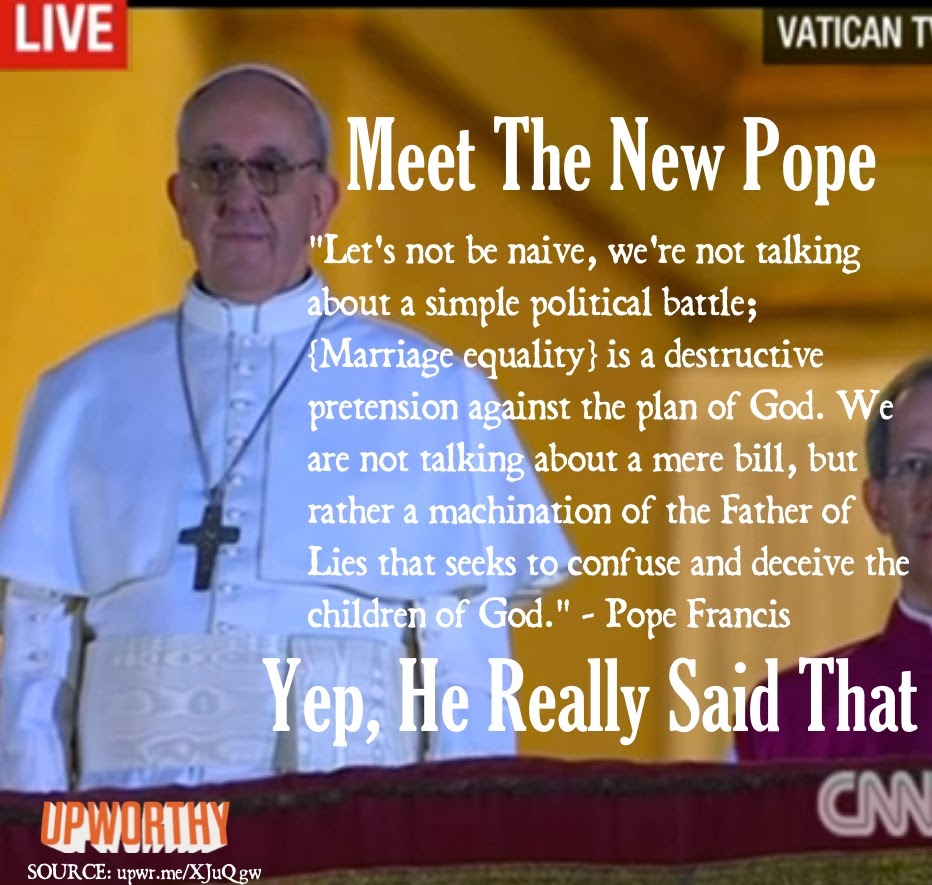

The reason Catholics and other people of faith care about issues such as abortion is because we have hope, which we receive from our faith. This hope helps us see the value of life. Pope Francis pointed to two issues which not only destroy hope but actually engender hopelessness and despair in people. When people see only bleakness in the future, why should they care about anything else? Nothing makes sense. What difference does it make if babies are being killed and families are being destroyed? It's all hopeless. As Pope Francis says, "they have been crushed by the present." If a person is being crushed under a rock, do you think he is going to care about anything else? But if we can give people a sense of hope and help them discover the true value and dignity of life, then they too will start to care about the "big" issues. Only then will things start to change.

Back to Fide and his blog post.  Fide tells us that he is actually doing Pope Francis a favor by being critical of him because:
The intransigent feeling I have about Francis comes from Luke 6:26, “Woe to you, when all men speak well of you, for so their fathers did to the false prophets.” Thus, the hand-wringing by many of his conservative brethren is, in a very real way, saving Pope Francis from the “woe” of being liked by the world for bearing a corpseless Cross.  [The "corpseless Cross" attack is going too far and is a very unfair and untrue attack on His Holiness. Pope Francis has never backed down from the Suffering Christ.  See below]  I express my “extreme” disasppointment [sic] with Pope Francis on some matters precisely because I esteem him as the Pope.
Huh?? I'm afraid this statement shows Fide's confused state of mind. Beating someone up is doing them a favor? Especially when that someone is the Vicar of Christ?  As far as the "corpseless Cross" comment, here is what Pope Francis said about the Cross on the Feast of the Exaltation of the Holy Cross (from Vatican Radio):
At the Mass for the Feast of the Exaltation of the Holy Cross, Pope Francis said the mystery of the Cross is a great mystery for mankind, a mystery that can only be approached in prayer and in tears.

In his homily, the Pope said that it is in the mystery of the Cross that we find the story of mankind and the story of God, synthesised by the Fathers of the Church in the comparison between the tree of the knowledge of good and evil, in Paradise, and the tree of the Cross:

“The one tree [tree of knowledge of good and evil in the Garden of Eden] has wrought so much evil, the other tree [the tree of the Cross upon which Our Lord hung] has brought us to salvation, to health. This is the course of the humanity’s story: a journey to find Jesus Christ the Redeemer, who gives His life for love. God, in fact, has not sent the Son into the world to condemn the world, but that the world might be saved through Him. This tree of the Cross save us, all of us, from the consequences of that other tree, where self-sufficiency, arrogance, the pride of us wanting to know all things according to our own mentality, according to our own criteria, and also according to that presumption of being and becoming the only judges of the world  This is the story of mankind: from one tree to the other.”
Hmmm.  "Self-sufficiency, arrogance, the pride of us wanting to know all things according to our own mentality, according to our own criteria, and also according to that presumption of being and becoming the only judges of the world." Now why would His Holiness use these words?

Back to Fide.  He admits he has gone against I Tim. 5:1 which says not to rebuke an elder but exhort him as a father, and I Thes. 5, which says to respect those who labor among you.
I admit that I have erred against the above counsels by excessive sarcasm here and there, and that I need to trust as much as I can in God’s redemptive power over the power of scandal and compromise.
Well, I’m trying.
So, without further ado…
Fide then tells us that he is a Catholic convert, but not a Traditionalist.  He actually sees some benefits of the Second Vatican Council (some benefits?) and doesn't have a "strong hankering for the Tridentine Rite."  So this seems to be his way of saying he is not an "extremist."   (BTW, I love the Traditional Mass and all things traditional Catholic and I have very little problem with Vatican II.  And no, that is not a contradiction.)  But he says that "As a convert, though, I am extremely sensitive to the distinctive realities of being Catholic."  He wants Catholics to be Catholic and not try to be anything else just to please the world. That is why he is upset with Pope Francis' statement that "there is no Catholic God." Fide ties himself up into knots over this. He tells us in a very confusing statement, "If, then, there is no Catholic God, and if God is the One who calls the Church into being, then there can be no Catholic Church as, precisely, that communion called by the God known in Catholic teaching."

Fide, you wrote this:
Indeed, I have no recollection of a Pope, much less any Catholic priest or orthodox theologian, ever saying, "there is no Catholic God," full stop. This is yet another case of the Pope resorting to needlessly abstruse and scandalous phrases when just a few extra words would have clarified his point. HELP! WHAT AM I MISSING? In what follows, I want my analysis to be shown to be faulty, based on translation problems, dogmatic teachings, etc.
What are you missing?  Read on if you really want your "analysis to be shown to be faulty."  It is actually quite faulty.

The Catholic Church's teachings are a direct reflection of God, and that cannot be said about any other religion in the world. But does reflecting God in our teachings make God Catholic?

The Catholic Church was
born from the side of
Jesus Christ
I don't know how much Church history you have studied, Fide, but it is obvious from your post that you are very intelligent, so I'm sure you know that the Church was founded in 33 A.D., at the time that the spear was thrust into Christ's side and blood and water gushed out. There was no Catholic Church prior to that time. If God was Catholic, He would have to be a convert like you. Up to that time, God was working through the Israelites, which is why He came to us as a Jew. Does that mean God was a Jew? Of course not. Jesus was a Jew in his human form, but was his Divine nature Jewish? Obviously not. God predated the Jews and the Israelite nation. He predated the Catholic Church. He existed before time itself!!!! God always was and always will be, no beginning and no end. We as human beings have a beginning and the Catholic Church also had a beginning, meaning there was a time when the Church did not exist.

No, Fide, God is not human and God is not Catholic. God is not subject to the rules and regulations of the Catholic Church. Unlike we sinful human beings, God does not need the church in order to exist.  Also, God is not subject to the Pope's authority to which we Catholics are subject (no Pope, no Church).

The reason for founding the Catholic Church is the same reason for the building of Noah's ark. Noah, on the orders of God, built his ark to physically save mankind from the flood. But commanding the building of the ark didn't make God an ark. The ark was distinct and separate from God. Jesus built the Catholic Church to spiritually save mankind from eternal damnation.  We must become Catholics because it is the only way to inherit eternal life with our Creator. But our Creator exists above and apart from the Church. He does not need the Church to inherit eternal life. He founded and built the Church, but that does not make Him Catholic.  His identity is independent from the Catholic Church.

God created Catholicism to save us, but He is much bigger than the Catholic Church, just as He was much bigger than Noah's ark.  He is bigger than the universe, bigger than our finite minds can ever grasp.

You jumped to some pretty startling conclusions because you are trying to reduce God to your level.
For all you fans of “context” these days [context has nothing to do with it], keep in mind that the run up the Pope’s denial of the Catholic God is that he asks Scalfari the following question: “I am asking what you think is the essence of the world, indeed the universe.” Scalfari answers, “I believe in Being, that is in the tissue from which forms, bodies arise,” whereupon Francis, not, mind you, having been asked about religious pluralism or Catholic chauvinism, but as from the bottom of his heart, says, “And I believe in God, not in a Catholic God, there is no Catholic God, there is God and I believe in Jesus Christ, his incarnation.”
The mind reels.
Fide, your mind should not "reel" at this statement from the Holy Father. It does make perfect sense. God is far, far beyond the Catholic Church. God cannot be contained by anything, not even by His own Church. By the way, I do know of at least one other priest who said God is not Catholic: Father Benedict Groeschel. Take a look at the following video from EWTN (less than a minute).  Hopefully, with the explanation I just gave you it will make sense and not send your mind "reeling":


You also wrote this, Fide:
The key here is that Pope Francis explicitly pits a “Catholic God” against “God” per se, and thus implies that we must choose between them: “Are you with me for God, or are you with the restorationists for a Catholic God?” [The Pope nowhere says or implies this]  In Francis’s eschatology, when we finally see God as He is, it will turn out all those Catholic-God features were just accessories, concessions, illusions, and mere metaphors–Praise God, turns out God’s not Catholic, after all! [Again, you are attributing ideas to Pope Francis that he nowhere conveyed] For whatever reason, Francis favors a God of whom the distinctively Catholic theology (theory?) of God is at best only contingently and partially applicable, for if it were wholly and essentially true of God, then God would by his very nature be a “Catholic God.”
Think about it: by saying that he does not believe in the Catholic God, the Pope is saying that he does not believe in the God of Catholicism.
You probably aren't aware of this, but shortly after Pope Francis was elected, he gave a sermon on April 23 in which he said the following (you can read the entire sermon here):
And so the Church was a Mother, the Mother of more children, of many children. It became more and more of a Mother. A Mother who gives us the faith, a Mother who gives us an identity. But the Christian identity is not an identity card: Christian identity is belonging to the Church, because all of these belonged to the Church, the Mother Church. Because it is not possible to find Jesus outside the Church. The great Paul VI said: "Wanting to live with Jesus without the Church, following Jesus outside of the Church, loving Jesus without the Church is an absurd dichotomy." And the Mother Church that gives us Jesus gives us our identity that is not only a seal, it is a belonging. Identity means belonging. This belonging to the Church is beautiful.
Do you think Pope Francis is contradicting himself by saying on the one hand that Christ cannot be found outside the Church, and then saying he does not believe in a "Catholic" God? There is no contradiction here. Who and what is God? Jesus told us He is "the Way, the Truth and the Life" in John 14:6. I John 4:8 tells us, "God is Love." None of these verses say "God is Catholic."
Noah's Ark
What makes us human beings Catholic? How do we identify as Catholics? Why do we need to be Catholics? The reason for Catholicism, as stated above, is the same reason as for the construction of Noah's ark. It is to save mankind. Those who were not in Noah's ark perished, and those who are not a part of the Catholic Church (and that doesn't mean just being on a parish membership role, which actually means nothing in the long run) will perish spiritually. Yes, the Catholic Church proceeds from God and leads us to God, but unlike us, God does not need saving. So why does God need to be Catholic? He doesn't. God didn't need to be saved in Noah's ark, and He doesn't need the Catholic Church to survive, either. God is infinitely bigger than the Church. 

To say God's identity is wrapped up in Catholicism or any other belief is to limit Him to the level of sinful human beings. Do you now understand the faultiness of your statement: "by saying that he does not believe in the Catholic God, the Pope is saying that he does not believe in the God of Catholicism"? A "Catholic God" and the "God of Catholicism" are two different things. To conflate the two as one is to completely miss the meaning of Pope Francis' statement.

Fide then goes beyond the Pope's statement about a Catholic God:
The above analysis concerns only one of the Pope’s statements lately that have unsettled many in the flock. As lengthy as my analysis might have seemed, it’s actually just indicative of the more fundamental worry I have with Pope Francis: he often seems oblivious to, or even to disdainful of, the fact that he is never not speaking on behalf of the Church. [This is your emphasis, Fide].
Which is where what I’ll call the Papal Categorical Imperative comes into the picture:
In light of his duty always to form consciences according to the truth, every word the Pope utters, regardless of the anterior context, and regardless of the interlocutor–but especially when it’s uttered from a global platform–is to be judged based on whether the Church itself could and should consistently speak in the same manner.  [Again, Fide, this is your emphasis]
I mean no disrespect, but the hubris contained in this statement is breathtaking. Do you realize that what you are actually saying is that if the Pope won't agree with you, then he had better just shut up. Do you honestly believe that you know better than the one specifically chosen and led by the Holy Spirit? Or do you believe Pope Francis is a false pope. You can't have it both ways. You either believe Pope Francis is the Vicar of Christ or he is an imposter.  And if you believe he is the Vicar of Christ, then as a Catholic, you owe him respect and allegiance, no matter what your personal feelings are.

Our greatest role model is our Blessed Mother., and certainly no one ever showed as much allegiance and loyalty as she did.  She was often perplexed by the words and actions of her Son and by the events in her life. But never once did she speak out against Jesus or His Father, never once did she question events and circumstances that seemed to make no sense. For example, Christ was lost for three days, nowhere to be found. After being sick with worry, she and Joseph finally found Jesus in the Temple. Mary asked him why he had worried her so. He did not give her an answer except to say He had to be about his Father's business. The scriptures tell us she did not understand this, but she "kept it in her heart."

In 2013, when so many of us have access to the Internet and a public voice, we don't keep anything in our hearts.  We forget the Pope is the Vicar of Christ - Christ's literal representative on earth, answerable only to Christ Himself (which also makes him subject to a much harsher judgment than any of the rest of us will face).  We look at the Pope as just another political figure, and when he doesn't meet our expectations, we feel completely justified in hammering him.  We never stop to think that it may just be possible that we have an incomplete understanding, or that it is possible we don't have the clear picture that the Holy Father has.   We just know he doesn't agree with our thinking and therefore, he must be wrong and he better shut up.

I can only wonder what would happen if Christ walked the earth now and said for the first time to His followers, "You must eat my body and drink my blood or you have no life in you."  What if we saw Christ consorting with prostitutes and the lowest of society.  What if we saw Christ going against the important religious rules of our time, such as picking food on the Sabbath and not washing His hands as commanded in the Law!   We would be no different than the Pharisees.  The blogosphere would light up with condemnation, telling us that this is a mad man.

When I first read the headlines about the interviews with the Pope, I admit to being concerned. The Pope says abortion and same sex marriage aren't important issues? The Pope says all we need to do is follow our own conscience? How can this be? Then I took the time to read the interviews, and was both enlightened and delighted at the message of love and compassion from the Holy Father. I saw the words of a man who truly loves humanity and wants, above all else, to save as many souls as he can. In other words, I saw Christ in Pope Francis.

No, I'm not some soft hearted liberal. I'm about as conservative and traditional as any Catholic you will find. I listen to and read Venerable Fulton Sheen all the time (so much so that I'm beginning to feel like he is a personal friend). My iPad is filled with traditional Catholic prayers and devotions and spiritual reading from 100 years and more ago (right now I'm reading a book by Fr. William Frederick Faber about the Sorrows of Mary). As stated, I love the Traditional Mass. I wouldn't receive communion in the hand for any amount of money or even if my life depended on it. I go to confession frequently and pray the Rosary every day. I'm not stating any of this to impress people, but to let you know that I love the Catholic Church - the traditional Catholic Church - and I love Pope Francis. The two, despite all of the ranting and raving on the Internet, are not only not exclusive, they are very much inclusive.

For all of you who think Pope Francis is a left wing liberal out to do away with the clear teaching of the Church, remember that he says 15 mysteries of the Rosary every day and spends an hour every day in Eucharistic Adoration.  Pope Francis is one of the busiest people in the world, and yet he still manages to do this.  How many of us can say we do as much?  Pope Francis obviously has a deep love for our Lord, for his Church and for people in general.  He is the Vicar of Christ.  We need to listen to him, and like our Blessed Mother, when we don't understand something, we need to keep it in our hearts and ask for the understanding, not announce to the world that Our Holy Father is a crazed lunatic. When it comes to doubt, the first one to doubt is always ourselves.  

Fide ended his blog with this (after sarcastically renaming the Holy Father, "Pope Guido"):
And so I write.

And write.

And keep writing.

But do I defect? Do I renounce the Pope as a heretic?

I do not. I remain Catholic. For that is what being Catholic means: to abide with Christ as revealed in the Scriptures, the Tradition, the Liturgy, the Magisterium, and the brethren even in spite of many headdesks [head aches??] that “the world’s parish priest”, or any other of the brethren, may induce in me. Despair is not an option, but groaning out loud certainly is. (Scroll back up to see the first papal intention for this month.)
When you decide you need to "groan out loud," first remember who the accuser of the brethren is. Make sure you're not aligning yourself with him.

Saturday, September 28, 2013

The Message of Pope Francis According to The New York Times

Without question, the most misunderstood person in the entire history of mankind is Jesus Christ. He was misunderstood at the time he lived when the religious leaders of the day called him a devil. Down through history both saints and sinners used his words and teachings to justify their actions, good or bad. Warmongers use the words of the Lord who preached love and mercy to justify war. His words of truth and justice have been used to browbeat people into submission. Rarely is our Lord presented as He truly was - our Creator who came to pour out His Blood for the salvation of mankind. The same has been true of the Church founded by Jesus Christ, the Catholic Church. As the late great Venerable Fulton Sheen once said, “There are not one hundred people in the United States who hate The Catholic Church, but there are millions who hate what they wrongly perceive the Catholic Church to be.”

I would submit that the most misunderstood person in the world today is Christ's representative and the head of the Catholic Church, our Holy Father, Pope Francis. This papacy could easily be labeled, "The Litmus Papacy". Listening to people talk about Pope Francis doesn't really give one as much insight into Pope Francis as it does into the person speaking about Pope Francis.

THE INTERVIEW (and if you don't know what I'm referring to, it can only be because you were either in a coma for the last couple of weeks or on another planet) is a prime example of how the world sees Pope Francis through their own individual ideas and prejudices.  The Pope covered many topics in this interview, but the one that almost everyone picked up on was the following statement:
We cannot insist only on issues related to abortion, gay marriage and the use of contraceptive methods. This is not possible.
NARAL got so excited over this remark that they posted the following on their Facebook page:


Chris Rock, hardly a conservative Christian, tweeted, "I might be crazy but I got this weird feeling that the new pope might be the greatest man alive."  On the opposite end of the spectrum, many conservative Catholics felt the Holy Father was going off the rails, just another example of the destruction wrought by Vatican II.

The truth is that Pope Francis was not saying anything new in this interview but merely echoing the words of Our Lord from 2000 years ago.  Pope Francis said we should not be concentrating on people's individual sins but more on their spiritual healing and bringing them to Christ.   In making this statement, he was merely following the lead of his Boss, Jesus Christ.

Our Lord with the woman caught in adultery
Our Lord rarely pointed out people's sins. We see this in the story of the woman taken in adultery, as told in John 8, when the Jews were demanding she be stoned. This is what the law demanded, but how does our Lord treat her? Jesus writes on the floor and one by one, the woman's accusers leave. Only then does Jesus address the woman:
Jesus straightened up and asked her, “Woman, where are they? Has no one condemned you?”“No one, sir,” she said.“Then neither do I condemn you,” Jesus declared. “Go now and leave your life of sin.”
While certainly acknowledging that the woman taken in adultery was a sinner, Jesus did not condemn her but instead showed compassion and mercy. His only acknowledgement of her sin was to tell her to sin no more. Our Lord did not see a sinner when he looked at this woman. He saw a human being in need of healing. There was no obvious sign of repentance from the woman, no indication that she intended to change her life, but that did not prevent Him from extending His Love and Forgiveness. Pope Francis echoes our Lord's words and actions with these words:
A person once asked me, in a provocative manner, if I approved of homosexuality. I replied with another question: ‘Tell me: when God looks at a gay person, does he endorse the existence of this person with love, or reject and condemn this person?’ We must always consider the person. Here we enter into the mystery of the human being. In life, God accompanies persons, and we must accompany them, starting from their situation. It is necessary to accompany them with mercy. When that happens, the Holy Spirit inspires the priest to say the right thing.
Matthew 9 relates the story of our Lord having dinner at the apostle Matthew's house, which was attended by many tax collectors and sinners.  Not only was he having dinner and socializing with these known sinners, I can assure you he was also not telling them that they were sinners and headed to hell. He was a charming and entertaining guest who made them feel very comfortable and accepted.

Credit:  newdaychurch.info
Think of our Lord having dinner with likes of the heads of Planned Parenthood, the leaders of the homosexual movement, etc. You think he would never do such a thing? From Matthew 9:11-13:
When the Pharisees saw this, they asked his disciples, “Why does your teacher eat with tax collectors and sinners?”
On hearing this, Jesus said, “It is not the healthy who need a doctor, but the sick. But go and learn what this means: ‘I desire mercy, not sacrifice.’ For I have not come to call the righteous, but sinners.”
Our Holy Father, Pope Francis, summed up this sentiment exactly with these words:
“I see clearly that the thing the church needs most today is the ability to heal wounds and to warm the hearts of the faithful; it needs nearness, proximity. I see the church as a field hospital after battle. It is useless to ask a seriously injured person if he has high cholesterol and about the level of his blood sugars! You have to heal his wounds. Then we can talk about everything else. Heal the wounds, heal the wounds.... And you have to start from the ground up.”
Credit:  www.tillhecomes.org
One of the best interpretations of the Pope's remarks that I have read comes from what many call the Secular Bible, The New York Times. This is an opinion piece, entitled "The Pope’s Radical Whisper", written by Frank Bruni, a very traditional liberal. It can be found here, although I am reprinting the entire editorial below:
IT’S about time. The leader of the Roman Catholic Church has surveyed the haughty scolds in its ranks, noted their fixation on matters of sexual morality above all others and said enough is enough. I’m not being cheeky with this one-word response. Hallelujah.
But it wasn’t the particulars of Pope Francis’ groundbreaking message in an interview published last week that stopped me in my tracks, gave fresh hope to many embittered Catholics and caused hardened commentators to perk up.
It was the sweetness in his timbre, the meekness of his posture. It was the revelation that a man can wear the loftiest of miters without having his head swell to fit it, and can hold an office to which the term “infallible” is often attached without forgetting his failings. In the interview, Francis called himself naïve, worried that he’d been rash in the past and made clear that the flock harbored as much wisdom as the shepherds. Instead of commanding people to follow him, he invited them to join him. And did so gently, in what felt like a whisper.
What a surprising portrait of modesty in a church that had lost touch with it.
This is exactly what Pope Francis is talking about.  As I stated in a previous post, we live in a world in which people have completely lost their way.  Like the people of Nineveh in the Book of Jonah, the world today does not know their left hand from their right.   They are the walking wounded, lost in darkness and not even aware of it.  They feel something is not right, and in their moments of solitude and silence - which they try to avoid as much as possible - they keenly feel this sense of loss. They are not in need of our condemnation but like the woman taken in adultery, they need compassion and love to bring them to the only One who can heal them.

Mr. Bruni notes how different is the tone of Pope Francis compared with the rest of the world:
And what a refreshing example of humility in a world with too little of it.
That’s what stayed with me, not the olive branch he extended to gay people or the way he brushed aside the contraception wars but his personification of a virtue whose deficit in American life hit me full force when I spotted it here, in his disarming words. Reading and then rereading the interview, I felt like a bird-watcher who had just stumbled upon a dodo.
I’m hardly the first to flag this pope’s apparent humility or the fact that it extends beyond his preference for simple dress over regal costumes, for a Ford Focus over a papal chariot, for modest quarters over a monarch’s suite. Less than two months ago, when he answered a question about gay priests with a question of his own — “Who am I to judge?”— the self-effacement in that phrase was widely and rightly celebrated. Was a pope really acting and talking like this?  
But Francis’ tone so far is interesting not just as a departure for the church but as a counterpoint to the prevailing sensibility in our country, where humility is endangered if not quite extinct. It’s out of sync with all the relentless self-promotion, which has been deemed the very oxygen of success. It sits oddly with the cult of self-esteem.
Mr. Bruni continues to contrast Pope Francis with the ways of our contemporary world, and how deeply impressed he is with the humility and sincerity of the Holy Father.  Mr. Bruni doesn't realize it, but what he is really seeing is the difference between the ways of the world and the ways of Jesus Christ:
Humility has little place in the realm of social media, which is governed by a look-at-me ethos, by listen-to-me come-ons, by me, me, me. And humility is quaintly irrelevant to the defining entertainment genre of our time, reality television, which insists that every life is mesmerizing, if only in the manner of a train wreck, and that anyone is a latent star: the housewife, the hoarder, the teen mom, the tuna fisher. Just preen enough to catch an audience’s eye. Just beckon the cameras close.
Politics is most depressing of all. It rewards braggarts and bullies, who muscle their way onto center stage with the crazy certainty that they and only they are right, while we in the electorate and the news media lack the fortitude to shut them up or shoo them away. They disgust but divert us, or at a minimum wear us down. Maybe we get the showboats we deserve.
FOR a textbook case of humility gone missing, consider right-wing Republicans’ efforts to derail Obamacare by whatever crude and disruptive means necessary. The health care law has its flaws, some of them profound, but it was legitimately passed, in accordance with the rules, and to stray outside them in order to make it go away is to believe that they don’t apply to you, that your viewpoint trumps the process itself. It’s the summit of arrogance.
Humility doesn’t work in the cross-fire of our political combat. Certainty and single-mindedness are better fuels.
This is exactly what Pope Francis talked about in his interview when he told us we must always leave room for self doubt:  "Yes, in this quest to seek and find God in all things there is still an area of uncertainty. There must be. If a person says that he met God with total certainty and is not touched by a margin of uncertainty, then this is not good. For me, this is an important key. If one has the answers to all the questions—that is the proof that God is not with him. It means that he is a false prophet using religion for himself."

Mr. Bruni then contrasts Pope Francis with the liberal icon of our age, Barack Obama:
How exactly does President Obama fit in? While his Syria reversals may well have diminished him, they had a sort of humility to them, reflected a willingness to yield to the strong feelings of others and deserve some acknowledgment along those lines. Leadership, more art than science, should be a mix of rallying people to your cause and recognizing when you stand too far away from them.
But in Obama there’s a recurrent deflection of criticism and a refusal to abide certain political customs and efficiencies — the stroking, the rewarding, the mantra-style repetition of a simplified argument for a distracted populace — that work against his success and smack of excessive pride. He could take a page from this pope.
Credit:  www.driftwoodandcherry.com
Mr. Bruni next shows how the genuineness of Pope Francis has even helped to heal the wounds so recently inflicted upon the Church, at least in the eyes of the writer:
I never expected to write that. For too many years I watched the chieftains of the church wrap themselves in lavish pageantry and prioritize the protection of fellow clergy members over the welfare of parishioners. They allowed priests who sexually abused children to evade accountability and, in many cases, to abuse again. That cover-up was the very antithesis of humility, driven by the belief that shielding the church from public scandal mattered more than anything else.
For too many years I also watched and listened to imperious men around the pope hurl thunderbolts of judgment from the Olympus of Vatican City. But in his recent interview, Francis made a plea for quieter, calmer weather, suggesting that church leaders in Rome spend less energy on denunciations and censorship.
He cast himself as a struggling pastor determined to work in a collaborative fashion. He characterized himself as a sinner. “It is not a figure of speech, a literary genre,” he clarified. “I am a sinner.”
In his final paragraphs, Mr. Bruni makes it clear that he is not ready to convert, but he is ready to listen, and that is a huge step. Mr. Bruni, unlike too many Catholics, understands that the Pope is not going to change the teachings of the Church. However, he does see Pope Francis as someone who has something to give to the world, and he is open to this message:
He didn’t right past wrongs. Let’s be clear about that. Didn’t call for substantive change to church teachings and traditions that indeed demand re-examination, including the belief that homosexual acts themselves are sinful. Didn’t challenge the all-male, celibate priesthood. Didn’t speak as progressively — and fairly — about women’s roles in the church as he should.
But he also didn’t present himself as someone with all the answers. No, he stepped forward — shuffled forward, really — as someone willing to guide fellow questioners. In doing so he recognized that authority can come from a mix of sincerity and humility as much as from any blazing, blinding conviction, and that stature is a respect you earn, not a pedestal you grab. That’s a useful lesson in this grabby age of ours.
The message of Jesus Christ has mercy and forgiveness at its core, as shown above in the quote from Matthew 9.  Our job is not to condemn the world but to bring to it the healing message of Jesus Christ. That is exactly what Pope Francis has done, and Frank Bruni of The New York Times got this message loud and clear.   My prayer is that those who call themselves followers of Jesus Christ will hear this message as well.

Credit:  fr-fr.facebook.com


Sunday, September 22, 2013

The Lesson From Pope Francis On Preaching the Gospel to a Post-Christian World

“I see clearly that the thing the church needs most today is the ability to heal wounds and to warm the hearts of the faithful; it needs nearness, proximity. I see the church as a field hospital after battle. It is useless to ask a seriously injured person if he has high cholesterol and about the level of his blood sugars! You have to heal his wounds. Then we can talk about everything else. Heal the wounds, heal the wounds.... And you have to start from the ground up.” 
Pope Francis

Pope Francis has now given what may be the most controversial interview in papal history, and it also may be one of the most important interviews ever given. The media, as expected, has colored it with their own interpretation. Bloomberg News summed it up with this headline "Pope Says Church Should Stop Obsessing Over Gays, Abortion." The New York Times headline was, "Pope Says Church Is ‘Obsessed’ With Gays, Abortion and Birth Control." Many Traditionalists and conservatives were very upset by the Pope's remarks. Others came out trying to defend the Pope's remarks. Bill Donohue of The Catholic League, in trying to defend Pope Francis, said that "people are tied up with these little micro issues on the left and the right." Father John Zuhlsdorf wrote a post, which you can read here, that he is keeping at the top of his blog in defense of the Pope's remarks. As he wrote, "I read what the Pope says. Then I try to figure out what he is really saying, apart from my own preferences about how he should say it." Father Z's basic premise is that the Pope has not said anything new. The Pope is merely repeating what the Catholic Church has always taught, which is basically hate the sin and love the sinner.

I, like most people, really didn't know what to think when this all came out.  The life issues, i.e., abortion and homosexuality and the destruction of the family, are most assuredly very grave issues and intrinsically evil.  So why should our Holy Father say we need to de-emphasize these issues in the Church?

So I took the time to read the actual interview, and I believe that Pope Francis, in this historical interview, is giving us the answers and guidelines we need to preach the Gospel to our spiritually and morally bankrupt world.  Every Catholic should read this interview, which can be found here. 

I think we should first take into consideration the times in which we live.   We live in one of the most morally and spiritually bankrupt of all times in the history of man.  If anyone has any questions about the morality, or lack thereof, of our times, look at the recent release of "Grand Theft Auto 5" which involves graphic violence and sex, including murder and rape, and which pulled in almost $1 billion on its first day of release.

We are now at a point in our culture where the only recognized sins are smoking (this is not even allowed in our entertainment anymore) and "intolerance." "Intolerance" is defined as believing in absolute truth and the difference between good and evil and trying to impose this belief on others. That is no longer accepted in our post-Christian society. Our world has accepted the philosophy of John Lennon: "Whatever gets you through the night, it's all right." The only moral commands in our society are to be "nice" and don't judge others. Nothing else really matters.

Christians, and more specifically, the Catholic Church, are now aliens in society. We are the counter culture. We are the the non-conformists. We are the ones struggling to swim against the tide. Talk of sin and hell and damnation is a language that is completely rejected and no longer understood by those around us. Methods of preaching the Gospel that were effective in a Christian-based society will not work anymore.  

Pope Francis is facing a world that most of his predecessors would not recognize.  Immorality and spiritual bankruptcy are not new.  What is new is that our world considers immorality to be normal and morality to be abnormal.    

So how do we who believe in absolute truth approach those who do not? We are commanded by our Lord to "preach the Gospel to all nations." It is our duty as Christians to bring spiritual salvation to as many people as we can. In the past, when society still believed in the difference between good and evil, we could appeal to them on moral grounds. When the Church told people that it was a mortal sin to be sexually promiscuous, people believed it even if they didn't like it. Sexual promiscuity is now considered a normal lifestyle. Homosexuality was never accepted by our society until recent years. Now you are considered a bigot if you don't accept it.

The Pope tells us that the two of the most important tools we need in approaching the contemporary world with the Gospel are discernment and humility. We should always give great thought and prayer to our actions and words. We should never feel that we have all the answers, that we can never be wrong:
I am always wary of decisions made hastily. I am always wary of the first decision, that is, the first thing that comes to my mind if I have to make a decision. This is usually the wrong thing. I have to wait and assess, looking deep into myself, taking the necessary time. The wisdom of discernment redeems the necessary ambiguity of life and helps us find the most appropriate means, which do not always coincide with what looks great and strong.
In connection with this, the Pope speaks of the importance of humility, of always leaving room for doubt in ourselves:
If a person says that he met God with total certainty and is not touched by a margin of uncertainty, then this is not good. For me, this is an important key. If one has the answers to all the questions—that is the proof that God is not with him. It means that he is a false prophet using religion for himself. The great leaders of the people of God, like Moses, have always left room for doubt. You must leave room for the Lord, not for our certainties; we must be humble. Uncertainty is in every true discernment that is open to finding confirmation in spiritual consolation.
“The risk in seeking and finding God in all things, then, is the willingness to explain too much, to say with human certainty and arrogance: ‘God is here.’ We will find only a god that fits our measure. The correct attitude is that of St. Augustine: seek God to find him, and find God to keep searching for God forever. Often we seek as if we were blind, as one often reads in the Bible. And this is the experience of the great fathers of the faith, who are our models. We have to re-read the Letter to the Hebrews, Chapter 11. Abraham leaves his home without knowing where he was going, by faith. All of our ancestors in the faith died seeing the good that was promised, but from a distance.... Our life is not given to us like an opera libretto, in which all is written down; but it means going, walking, doing, searching, seeing.... We must enter into the adventure of the quest for meeting God; we must let God search and encounter us.
This next statement from Pope Francis shows his understanding of our spiritually lost world, and that those who wish to return to methods of the past are not seeing the real world of today:
If the Christian is a restorationist, a legalist, if he wants everything clear and safe, then he will find nothing. Tradition and memory of the past must help us to have the courage to open up new areas to God. Those who today always look for disciplinarian solutions, those who long for an exaggerated doctrinal ‘security,’ those who stubbornly try to recover a past that no longer exists­—they have a static and inward-directed view of things. In this way, faith becomes an ideology among other ideologies.
How do we know when we've lost our way, when we are no longer serving other people but our own ideologies?  From Pope Francis:
When does a formulation of thought cease to be valid? When it loses sight of the human or even when it is afraid of the human or deluded about itself. The deceived thought can be depicted as Ulysses encountering the song of the Siren, or as Tannhäuser in an orgy surrounded by satyrs and bacchantes, or as Parsifal, in the second act of Wagner’s opera, in the palace of Klingsor. The thinking of the church must recover genius and better understand how human beings understand themselves today, in order to develop and deepen the church’s teaching.
The great moral truths of the Church can never change, but our understanding of them does grow. And the way in which we present the Gospel must change because the world changes. We must speak in a language and approach people in a way that they will understand.
St. Vincent of Lerins makes a comparison between the biological development of man and the transmission from one era to another of the deposit of faith, which grows and is strengthened with time. Here, human self-understanding changes with time and so also human consciousness deepens. Let us think of when slavery was accepted or the death penalty was allowed without any problem. So we grow in the understanding of the truth. Exegetes and theologians help the church to mature in her own judgment. Even the other sciences and their development help the church in its growth in understanding. There are ecclesiastical rules and precepts that were once effective, but now they have lost value or meaning. The view of the church’s teaching as a monolith to defend without nuance or different understandings is wrong.

And first and foremost, we must realize that we are dealing with the walking wounded who do not even realize just how wounded they are. We must always remember that just as God extends mercy to us, we must extend mercy to others. Pope Francis made a statement in this interview that we should all take to heart in dealing with those opposed to us. This philosophy was the guiding philosophy of all the great saints, and most particularly of one of the greatest Catholics in the 20th Century, Blessed Mother Teresa:
I have a dogmatic certainty: God is in every person’s life. God is in everyone’s life. Even if the life of a person has been a disaster, even if it is destroyed by vices, drugs or anything else—God is in this person’s life. You can, you must try to seek God in every human life. Although the life of a person is a land full of thorns and weeds, there is always a space in which the good seed can grow. You have to trust God.
If we see Jesus in every human being, no matter how degenerate they may be, we will be reaching out to that person with love and devotion, not judgment and damnation.

In this interview, Pope Francis gave us his idea of the way in which the church's ministers should relate to the people:
“How are we treating the people of God? I dream of a church that is a mother and shepherdess. The church’s ministers must be merciful, take responsibility for the people and accompany them like the good Samaritan, who washes, cleans and raises up his neighbor. This is pure Gospel. God is greater than sin. The structural and organizational reforms are secondary—that is, they come afterward. The first reform must be the attitude. The ministers of the Gospel must be people who can warm the hearts of the people, who walk through the dark night with them, who know how to dialogue and to descend themselves into their people’s night, into the darkness, but without getting lost. The people of God want pastors, not clergy acting like bureaucrats or government officials. The bishops, particularly, must be able to support the movements of God among their people with patience, so that no one is left behind. But they must also be able to accompany the flock that has a flair for finding new paths.
“Instead of being just a church that welcomes and receives by keeping the doors open, let us try also to be a church that finds new roads, that is able to step outside itself and go to those who do not attend Mass, to those who have quit or are indifferent. The ones who quit sometimes do it for reasons that, if properly understood and assessed, can lead to a return. But that takes audacity and courage.”
When we read these other statements of Pope Francis in light of our contemporary fallen world, we can understand why he would make the following statement:
We cannot insist only on issues related to abortion, gay marriage and the use of contraceptive methods. This is not possible. I have not spoken much about these things, and I was reprimanded for that. But when we speak about these issues, we have to talk about them in a context. The teaching of the church, for that matter, is clear and I am a son of the church, but it is not necessary to talk about these issues all the time.
I mentioned Mother Teresa above, and I think she is a wonderful example of how to preach the Gospel. Her main mission in life was to live the Gospel, to see Jesus Christ in every human being and treat them with dignity and love. She picked up her Cross daily. She saw Jesus Christ in the world, and, as a result, the world saw Jesus Christ in her. She preached the Gospel more effectively than almost anyone else in our contemporary times. She did it by her actions, by showing love and mercy. Then, when she had occasion, such as when she received the Nobel Peace Prize, she would tell the world where it had gone wrong, and the world listened to her. From her acceptance speech for the Nobel Peace Prize:
Let us thank God for the opportunity that we all have together today, for this gift of peace that reminds us that we have been created to live that peace, and Jesus became man to bring that good news to the poor. He being God became man in all things like us except sin, and he proclaimed very clearly that he had come to give the good news. The news was peace to all of good will and this is something that we all want - the peace of heart - and God loved the world so much that he gave his son - it was a giving - it is as much as if to say it hurt God to give, because he loved the world so much that he gave his son, and he gave him to Virgin Mary, and what did she do with him?
As soon as he came in her life - immediately she went in haste to give that good news, and as she came into the house of her cousin, the child - the unborn child - the child in the womb of Elizabeth, leapt with joy. He was that little unborn child, was the first messenger of peace. He recognised the Prince of Peace, he recognised that Christ has come to bring the good news for you and for me. And as if that was not enough - it was not enough to become a man - he died on the cross to show that greater love, and he died for you and for me and for that leper and for that man dying of hunger and that naked person lying in the street not only of Calcutta, but of Africa, and New York, and London, and Oslo - and insisted that we love one another as he loves each one of us. And we read that in the Gospel very clearly - love as I have loved you - as I love you - as the Father has loved me, I love you - and the harder the Father loved him, he gave him to us, and how much we love one another, we, too, must give each other until it hurts. It is not enough for us to say: I love God, but I do not love my neighbour. St. John says you are a liar if you say you love God and you don't love your neighbour. How can you love God whom you do not see, if you do not love your neighbour whom you see, whom you touch, with whom you live. And so this is very important for us to realise that love, to be true, has to hurt. It hurt Jesus to love us, it hurt him. And to make sure we remember his great love he made himself the bread of life to satisfy our hunger for his love. Our hunger for God, because we have been created for that love. We have been created in his image. We have been created to love and be loved, and then he has become man to make it possible for us to love as he loved us. He makes himself the hungry one - the naked one - the homeless one - the sick one - the one in prison - the lonely one - the unwanted one - and he says: You did it to me. Hungry for our love, and this is the hunger of our poor people. This is the hunger that you and I must find, it may be in our own home.
This is not to say we must never speak of the issue of abortion, homosexuality, etc.  Pope Francis has made that quite clear, when just the day after this interview was published he made a very strong statement about the evil of abortion.  Mother Teresa herself spoke of the evil of abortion on various occasions, as she did when accepting the Nobel Peace Prize:
I feel the greatest destroyer of peace today is abortion, because it is a direct war, a direct killing - direct murder by the mother herself. And we read in the Scripture, for God says very clearly: Even if a mother could forget her child - I will not forget you - I have carved you in the palm of my hand. We are carved in the palm of His hand, so close to Him that unborn child has been carved in the hand of God. And that is what strikes me most, the beginning of that sentence, that even if a mother could forget something impossible - but even if she could forget - I will not forget you. And today the greatest means - the greatest destroyer of peace is abortion.
If we want the world to come to Christ, if we want to stop abortion, if we want to save our families, we must show them the Love of Christ, His mercy, His forgiveness.  Father Z put a statement from the Pope Francis interview at the top of his blog:  "I see the Church as a field hospital after battle."  I cannot think of a better way of summarizing the purpose of the Church.  Our job is to care for the sick and wounded, and we are surrounded by them.  From Mother Teresa:
There is so much suffering, so much hatred, so much misery, and we with our prayer, with our sacrifice are beginning at home. Love begins at home, and it is not how much we do, but how much love we put in the action that we do. It is to God Almighty - how much we do it does not matter, because He is infinite, but how much love we put in that action. How much we do to Him in the person that we are serving.
This, I believe is the message of our Holy Father, Pope Francis. 

I hope you will take the time to read the entire interview with Pope Francis.  It is long, but there is so much to be learned from it.

Wednesday, September 11, 2013

St. Alphonsus Liguori and Immorality in the 21st Century

Miley (ugh!) Cyrus
I have to say that I was actually somewhat heartened by the response to the vulgar, obscene display by Miley Cyrus at the Video Music Awards a couple of weeks ago. Most people were revolted by it. But that doesn't change the fact that promiscuity and immorality are accepted and even encouraged in our modern world.

Sexual immorality has become so rampant and such an integral part of our culture and of our entire world that we hardly give it a second thought anymore.  We are now so deadened to immorality that the word "scandal" is on its way to becoming archaic.  If someone gets out of high school without having lost their virginity, they are considered "weird."  A man and woman living together without benefit of marriage and even having children together hardly gets a raised eyebrow.  Having sex on a first or second date without even a hint of commitment is considered normal.  Some relationships consist totally of sex without even friendship being a part of it, which is known as "hooking up".  A few weeks ago there was an article in the New York Times entitled, "She Can Play That Game, Too".  As the article says, "The guys on college campuses want to have casual sex, and the girls want romance, right?  Increasingly, however, women are the ones looking to hook up."   If you want, you can read this article here.  Following are the opening paragraphs to the article:
At 11 on a weeknight earlier this year, her work finished, a slim, pretty junior at the University of Pennsylvania did what she often does when she has a little free time. She texted her regular hookup — the guy she is sleeping with but not dating. What was he up to? He texted back: Come over. So she did. They watched a little TV, had sex and went to sleep.

Their relationship, she noted, is not about the meeting of two souls.
“We don’t really like each other in person, sober,” she said, adding that “we literally can’t sit down and have coffee.”
Homosexual couple featured in the New York Times
And, of course, homosexuality, once described by Oscar Wilde as "the love that dares not speak its name", is now considered, in some circles, more normal than heterosexuality. Any who speak against it are considered bigots and intolerant. Again, the New York Times had an article just this past weekend about two homosexual lovers who have been together for 58 years. This one was entitled, "Two Men, 58 Years and Counting. A Love Story." The article starts out with their "fond remembrances":
In the last apartment they are likely ever to live in together, Kenneth Leedom and Peter Cott were talking about eros and the public life of New York — which is to say, sex on a moving subway train. Mr. Leedom is 88; Mr. Cott is 89.

Mr. Cott, seated beside an upright piano in the couple’s sunny yellow living room, listened intently, then spoke as if delivering his lines from a stage.
“We all gravitated to the connection between the two trains,” he said, recalling a time from half a century ago. “And that was sexville.”
Mr. Leedom shook his head at the memories.
“Unbelievable,” he said. “And the toilets in the subways — in those days if you traveled, say, 14th Street to 59th Street, you had to make at least three stops on the way, to check out every toilet.
“And there was always gay activity going on in the toilets. And I think it cost a nickel to get in in those days.”
The Catholic Church condemns sexual immorality and declares it a mortal sin. One mortal sin, unrepented of and unconfessed, is enough to shut us out of heaven for eternity. Yet, our world seems to be awash in mortal sin and even, as seen in these two articles from the New York Times, revels in it.

Many people complain that our priests generally don't address these issues from the pulpit. When was the last time that you heard a good sermon about mortal sin and the consequences thereof? Well, our Lord never leaves us without an excuse. We may not hear of these things from the pulpit, but such sermons and talks can easily be found. I downloaded a book from Amazon entitled, "Sermons For All the Sundays In the Year."  This book is completely filled with hard hitting, to-the-point sermons that pull no punches.  This is a collection of sermons by St. Alphonsus of Liguori, who lived from 1696 to 1787.  As Wikipedia tells us, St. Alphonsus of Liguori "was an Italian Catholic bishop, spiritual writer, scholastic philosopher and theologian, and founder of the Redemptorists, an influential religious congregation. He was canonized in 1839 by Pope Gregory XVI. Pope Pius IX proclaimed him a Doctor of the Church in 1871." This book of his sermons was put together in 1882, so obviously it is following what we now call the calendar of the Extraordinary Form of the Mass. Back then, of course, it was the only calendar. The book from Amazon cost 99 cents, and if you're interested (I highly recommend it), it can be found here.  It could be the best 99 cents you'll spend.

Below is a sermon from this past Sunday, which was the 16th Sunday After Pentecost.  It's amazing how some things never change.  This sermon, written over 200 years ago, gives penetrating insight into what is happening to our world today in the 21st Century.


Sixteenth Sunday After Pentecost: Impurity
by St. Alphonsus De Liguori

"Homo quidam hydropicus erat ante illum."
"And behold, there was a certain man before him, who had the dropsy."--Luke, xiv. 2


The man who indulges in impurity is like a person laboring under the dropsy. [Today "dropsy" is better known as "edema" or "congestive heart failure", when there is an excessive accumulation of fluid in the body.] The latter is so much tormented by thirst, that the more he drinks the more thirsty he becomes. Such, too, is the nature of the accursed vice of impurity; it is never satiated. "As," says St. Thomas of Villanova, "the more the dropsical man abounds in moisture, the more he thirsts; so, too, is it with the waves of carnal pleasures." I will speak today of the vice of impurity, and will show, in the first point, the delusion of those who say that this vice is but a small evil: and, in the second, the delusion of those who say that God takes pity on this sin, and that he does not punish it. 

1. Delusion of those who say that sins against purity are not a great evil.
The unchaste, then, say that sins contrary to purity are but a small evil. Like the sow wallowing in the mire, they are immersed in their own filth, so that they do not see the malice of their actions; and therefore they neither feel nor abhor the stench of their impurities, which excite disgust and horror in all others. Can you, who say that the vice of impurity is but a small evil--can you, I ask, deny that it is a mortal sin? If you deny it, you are a heretic; for as St. Paul says: Do not err. Neither fornicators, nor adulterers, nor the effeminate, etc., shall possess the kingdom of God. It is a mortal sin; it cannot be a small evil. It is more sinful than theft, or detraction, or the violation of the fast. How then can you say that it is not a great evil? Perhaps mortal sin appears to you to be a small evil? Is it a small evil to despise the grace of God, to turn your back upon Him, and to lose His friendship, for a transitory, beastly pleasure? 

Credit:  www.evangelicaloutreach.org
St. Thomas teaches, that mortal sin, because it is an insult offered to an infinite God, contains a certain infinitude of malice. "A sin committed against God has a certain infinitude, on account of the infinitude of the Divine Majesty." Is mortal sin a small evil? It is so great an evil, that if all the angels and all the saints, the apostles, martyrs, and even the Mother of God, offered all their merits to atone for a single mortal sin, the oblation would not be sufficient. No; for that atonement or satisfaction would be finite; but the debt contracted by mortal sin is infinite, on account of the infinite Majesty of God which has been offended. The hatred which God bears to sins against purity is great beyond measure. If a lady find her plate soiled she is disgusted, and cannot eat. 
[Would you eat from a plate that had just a "little" sewage on it?]  Now, with what disgust and indignation must God, who is purity itself, behold the filthy impurities by which his law is violated: He loves purity with an infinite love; and consequently he has an infinite hatred for the sensuality which the lewd, voluptuous man calls a small evil. Even the devils who held a high rank in heaven before their fall disdain to tempt men to sins of the flesh.  

St. Thomas says that Lucifer, who is supposed to have been the devil that tempted Jesus Christ in the desert, tempted him to commit other sins, but scorned to tempt Him to offend against chastity. Is this sin a small evil? Is it, then, a small evil to see a man endowed with a rational soul, and enriched with so many divine graces, bring himself by the sin of impurity to the level of a brute?" "Fornication and pleasure," says St. Jerome, "pervert the understanding, and change men into beasts." In the voluptuous and unchaste are literally verified the words of David: And man, when he was in honor, did not understand: he is compared to senseless beasts, and is become like to them. St. Jerome says, that there is nothing more vile or degrading than to allow one's self to be conquered by the flesh. Is it a small evil to forget God, and to banish him from the soul, for the sake of giving the body a vile satisfaction, of which, when it is over, you feel ashamed? Of this the Lord complains by the Prophet Ezechiel: Thus saith the Lord God: Because thou hast forgotten Me, and hast cast Me off behind thy back (Ezech. xxiii. 35). St. Thomas says, that by every vice, but particularly by the vice of impurity, men are removed far from God. 


Moreover, sins of impurity on account of their great number, are an immense evil. A blasphemer does not always blaspheme, but only when he is drunk or provoked to anger. The assassin, whose trade is to murder others, does not, at the most, commit more than eight or ten homicides. But the unchaste are guilty of an unceasing torrent of sins, by thoughts, by words, by looks, by complacencies, and by touches; so that when they go to confession they find it impossible to tell the number of the sins they have committed against purity. Even in their sleep the devil represents to them obscene objects, that, on awakening, they may take delight in them; and because they are made the slaves of the enemy, they obey and consent to his suggestions; for it is easy to contract a habit of this sin. To other sins, such as blasphemy, detraction, and murder, men are not prone; but to this vice nature inclines them. Hence St. Thomas says, that there is no sinner so ready to offend God as the votary of lust is, on every occasion that occurs to him. The sin of impurity brings in its train the sins of defamation, of theft, hatred, and of boasting of its own filthy abominations. Besides, it ordinarily involves the malice of scandal. Other sins, such as blasphemy, perjury, and murder, excite horror in those who witness them; but this sin excites and draws others, who are flesh, to commit, it, or, at least, to commit it with less horror. 


St. Cyprian says that the devil through impurity triumphs over the whole of man. By lust the evil triumphs over the entire man, over his body and over his soul; over his memory, filling it with the remembrance of unchaste delights, in order to make him take complacency in them; over his intellect, to make him desire occasions of committing sin; over the will, by making it love its impurities as his last end, and as if there were no God. I made, said Job, a covenant with my eyes, that I would not so much as think upon a virgin. For what part should God from above have in me (Job, xxxi.)? Job was afraid to look at a virgin, because he knew that if he consented to a bad thought God should have no part in him. According to St. Gregory, from impurity arises blindness of understanding, destruction, hatred of God, and despair of eternal life." St. Augustine says, though the unchaste may grow old, the vice of impurity does not grow old in them. Hence St. Thomas says, that there is no sin in which the devil delights so much as in this sin; because there is no other sin to which nature clings with so much tenacity. To the vice of impurity it adheres so firmly, that the appetite for carnal pleasures becomes insatiable. Go now, and say that the sin of impurity is but a small evil. At the hour of death you shall not say so; every sin of that kind shall then appear to you a monster of hell. Much less shall you say so before the judgment-seat of Jesus Christ, who will tell you what the Apostle has already told you: No fornicator, or unclean, hath inheritance in the kingdom of Christ, and God? The man who has lived like a brute does not deserve to sit with the angels. 

Most beloved brethren, let us continue to pray to God to deliver us from this vice; if we do not, we shall lose our souls. The sin of impurity brings with it blindness and obstinacy. Every vice produces darkness of understanding; but impurity produces it in a greater decree than all other sins. Fornication, and wine, and drunkenness take away the understanding (Os iv. II). Wine deprives us of understanding and reason; so does impurity. Hence St. Thomas says, that the man who indulges in unchaste pleasures, does not live according to reason. Now, if the unchaste are deprived of light, and no longer see the evil which they do, how can they abhor it and amend their lives? The Prophet Osee says, that blinded by their own mire, they do not even think of returning to God; because their impurities take away from them all knowledge of God. They will not set their thought to return to their God: for the spirit of fornication is in the midst of them, and they have not known the Lord (Os. v. 4)." Hence St. Laurence Justinian writes, that this sin makes men forget God. "Delights of the flesh induced forgetfulness of God." And St. John Damascene teaches that "the carnal man cannot look at the light of truth." Thus, the lewd and voluptuous no longer understand what is meant by the grace of God, by judgment, hell, and eternity. Fire hath fallen upon them, and they shall not see the sun! Some of these blind miscreants go so far as to say, that fornication is not in itself sinful. They say, that it was not forbidden in the Old Law; and in support of this execrable doctrine they adduce the words of the Lord to Osee: "Go, take thee a wife of fornication, and have of her children of fornication (Os. i. 2)." In answer I say, that God did not permit Osee to commit fornication; but wished him to take for his wife a woman who had been guilty of fornication: and the children of this marriage were called children of fornication, because the mother had been guilty of that crime. This is, according to St. Jerome, the meaning of the words of the Lord to Osee. "Therefore," says the holy Doctor, "they are to be called children of fornication, because born of a harlot." But fornication was always forbidden, under pain of mortal sin, in the Old, as well as in the New Law. St. Paul says: No fornicator or unclean hath inheritance in the kingdom of Christ and of God (Ephes. v. 5). Behold the impiety to which the blindness of such sinners carry them! From this blindness it arises, that though they go to the sacraments, their confessions are null for want of true contrition; for how is it possible for them to have true sorrow, when they neither know nor abhor their sins? 


The vice of impurity also brings with it obstinacy. To conquer temptations, particularly against chastity, continual prayer is necessary. Watch ye, and pray, that ye enter not into temptation (Mark, xiv. 38). But how will the unchaste, who are always seeking to be tempted, pray to God to deliver them from temptation? They sometimes, as St. Augustine confessed of himself, even abstain from prayer, through fear of being heard and cured of the disease, which they wish to continue. "I feared," said the saint, "that Thou wouldst soon hear and heal the disease of concupiscence, which I wished to be satiated, rather than extinguished." St. Peter calls this vice an unceasing sin. Having eyes full of adultery and sin that ceasest not. Impurity is called an unceasing sin on account of the obstinacy which it induces. 


Some person addicted to this vice says: I always confess the sin. So much the worse; for since you always relapse into sin, these confessions serve to make you persevere in the sin. The fear of punishment is diminished by saying: I always confess the sin. If you felt that this sin certainly merits hell, you would scarcely say: I will not give it up; I do not care if I am damned. But the devil deceives you. Commit this sin, he says: for you afterwards confess it. But, to make a good confession of your sins, you must have true sorrow of the heart, and a firm purpose to sin no more. Where are this sorrow and this firm purpose of amendment, when you always return to the vomit? If you had had these dispositions, and had received sanctifying grace at your confessions, you should not have relapsed, or at least you should have abstained for a considerable time from relapsing. You have always fallen back into sin in eight or ten days, and perhaps in a shorter time, after confession. What sign is this? It is a sign that you were always at enmity with God. If a sick man instantly vomits the medicine which he takes, it is a sign that his disease is incurable. 

St. Jerome says that the vice of impurity, when habitual, will cease when the unhappy man who indulges in it is cast into the lire of hell. "O infernal fire, lust, whose fuel is gluttony, whose sparks are brief conversations, whose end is hell." The unchaste become like the vulture that waits to be killed by the fowler, rather than abandon the rottenness of the dead bodies on which it feeds. This is what happened to a young woman, who, after having lived in the habit of sin with a young man, fell sick, and appeared to be converted. At the hour of death she asked leave of her confessor to send for the young man, in order to exhort him to change his life at the sight of her death. The confessor very imprudently gave the permission, and taught her what she should say to her accomplice in sin. But listen to what happened. As soon as she saw him, she forgot her promise to the confessor and the exhortation she was to give to the young man. And what did she do? She raised herself up, sat in bed, stretched her arms to him, and said: Friend, I have always loved you, and even now, at the end of my life, I love you: I see that, on your account, I shall go to hell: but I do not care: I am willing, for the love of you, to be damned. After these words she fell back on the bed and expired. These facts are related by Father Segneri. Oh! how difficult is it for a person who has contracted a habit of this vice, to amend his life and return sincerely to God! how difficult is it for him not to terminate this habit in hell, like the unfortunate young woman of whom I have just spoken. 

2. Illusion of those who say that God takes pity on this sin.


The votaries of lust [this is a play on words, a votary being a person bound by vows to live a life of religious worship or service] say that God takes pity on this sin; but such is not the language of St. Thomas of Villanova. He says, that in the sacred Scriptures we do not read of any sin so severely chastised as the sin of impurity. We find in the Scriptures, that in punishment of this sin a deluge of fire descended from heaven on four cities, and in an instant, consumed not only the inhabitants, but even the very stones. "And the Lord rained upon Sodom and Gomorrah brimstone and fire from the Lord out of heaven. And He destroyed these cities, and all things that spring from the earth (Gen. xix. 24)." St. Peter Damian relates, that a man and a woman who had sinned against purity were found burnt and black as a cinder.

Salvian writes that it was in punishment of the sin of impurity that God sent on the earth the universal deluge, which was caused by continued rain for forty days and forty nights. In this deluge the waters rose fifteen cubits above the tops of the highest mountains; and only eight persons along with Noah were saved in the ark. The rest of the inhabitants of the earth, who were more numerous then that at present, were punished with death in chastisement of the vice of impurity. Mark the words of the Lord in speaking of this chastisement which he inflicted on that sin: My spirit shall not remain in man forever: because he is flesh (Gen. vi. 3). "That is," says Liranus, "too deeply involved in carnal sins." The Lord added: For it repenteth Me that I made man" The indignation of God is not like ours, which clouds the mind, and drives us into excesses: his wrath is a judgment perfectly just and tranquil, by which God punishes and repairs the disorder of sin. But to make us understand the intensity of his hatred for the sin of impurity, he represents himself as if sorry for having created man, who offended him so grievously by this vice. We, at the present day, see more severe temporal punishment inflicted on this than on any other sin. 

Go into the hospitals, and listen to the shrieks of so many young men, who, in punishment of their impurities, are obliged to submit to the severest treatment and to the most painful operations, and who, if they escape death, are, according to the divine threat, feeble, and subject to the most excruciating pain for the remainder of their lives. [This is long before AIDS.]  Thou hast cast Me off behind thy back; bear thou also thy wickedness and thy fornications (Ezech. xxiii. 35).


St. Remigius writes that, if children be excepted, the number of adults that are saved is few on account of the sins of the flesh. In conformity with this doctrine, it was revealed to a holy soul that as pride has filled hell with devils, so impurity fills it with men. St. Isidore assigns the reason. He says that there is no vice which so much enslaves men to the devil as impurity. Hence St. Augustine says that with regard to this sin, "the combat is common and the victory rare." Hence it is that on account of this sin hell is filled with souls. 


All that I have said on this subject has been said, not that any one present, who has been addicted to the vice of impurity, may be driven to despair, but that such persons may be cured. Let us, then, come to the remedies. These are two great remedies-- prayer, and the flight of dangerous occasions. 


1. Prayer, says St. Gregory of Nyssa, is the safeguard of chastity. And before him, Solomon, speaking of himself, said the same. And as I knew that I could not otherwise be continent, except God gave, it . . . I went to the Lord, and besought Him (Wisd. viii. 21). Thus it is impossible for us to conquer this vice without God's assistance. Hence as soon as temptation against chastity presents itself, the remedy is to turn instantly to God for help, and to repeat several times the most holy names of Jesus and Mary, which have a special virtue to banish bad thoughts of that kind. I have said immediately, without listening to, or beginning to argue with, the temptation. When a bad thought occurs to the mind, it is necessary to shake it off instantly, as you would a spark that flies from the fire, and instantly to invoke aid from Jesus and Mary. 

2. As to the flight of dangerous occasions, St. Philip Neri used to say that cowards that is, they who fly from the occasions gain the victory. Hence you must, in the first place, keep a restraint on the eyes, and must abstain from looking at young women. Otherwise, says St. Thomas, you can scarcely avoid the sin. Hence Job said: I made a covenant with my eves that I would not so much as think upon a virgin (Job, xxxi. I). He was afraid to look at a virgin; because from looks it is easy to pass to desires, and from desires to acts. St. Francis de Sales used to say that to look at a woman does not do so much evil as to repeatedly look at her a second time. If the devil has not gained a victory the first, he will gain the second time. And if it be necessary to abstain from looking at women, it is much more necessary to avoid conversation with them. Tarry not among women. We should be persuaded that, in avoiding occasions of this sin, no caution can be too great. Hence we must be always fearful, and fly from them. A wise man feareth and declineth from, evil; a fool is confident? A wise man is timid, and flies away: a fool is confident, and falls. 

Sexual sin and immorality are nothing new.  We have taken it to extremes never before seen, such as "marriage" between homosexuals, and with technology, the ability to engage in pornography anywhere at any time.  Just as our military weapons are more deadly than the world has ever seen, so are the weapons of immorality.  But the result is the same: lost souls.  We, as Christians, are obligated to pray continually for those who have been trapped by this evil.  We need to pray and offer up reparations.  It is not up to us to judge people (thank God!).  But we do need to judge actions and consequences and realize that it is truly only through the Grace of God that any of us can escape the immorality which has engulfed our world.


Related Posts  0