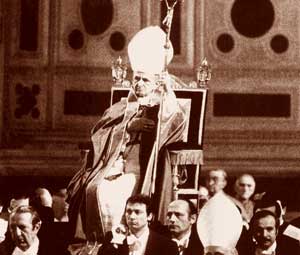
I recently did a post [HERE] in which I discussed Father Z's reaction to the "whoopdeedoo", as he referred to it, regarding the 50th anniversary of the first celebration of a Mass in the vernacular. His response to this "whoopdeedoo" was to re-post his article satirically criticizing the New Mass and the one he names as the architect of that Mass, Msgr. Annibale Bugnini. Father Z feels the salvation of the Church lies in the Traditional Latin Mass.
Most other traditionalists agree with Father Zuhlsdorf. I recently came across an article from Crisis Magazine regarding this very same subject entitled, "Spiritual Renewal Paul VI Spoke of Has Not Yet Materialized" written by Christian Browne. The only information we are given about Mr. Browne is that he is a New York attorney who got his J.D. at Fordham University in 2004, which probably means he is fairly young, in his 30's. Mr. Brown is also a board member of the Nassau County Catholic Lawyers Guild. This is his only article to date published by Crisis Magazine.
Mr. Browne quoted from the homily of Blessed Paul VI from that first celebration of the vernacular Mass:
The welfare of the people demands this care, so as to make possible the active participation of the faithful in the public worship of the Church. It is a sacrifice that the Church has made of her own language, Latin; a sacred, sober, beautiful language, extremely expressive and elegant. She has sacrificed the traditions of centuries and above all she sacrifices the unity of language among the various peoples, in homage to this greater universality, in order to reach all.
And this [also] for you, faithful, so that you may know better [how to] join yourselves to the Church’s prayer, so that you may know [how to] pass from a state of simple spectators to that of participating and active faithful, and if you truly know how to correspond to this attention of the Church, you will have the great joy, the merit and the chance of a true spiritual renewal.
New York City, where I live, has really been devastated by the flu outbreak. Lots of people out sick at work, lots of coughing and sneezing on the subway, emergency rooms flooded by flu victims. Not a pretty sight.
But in Boston, there is one very good consequence of the flu:
Because of the flu outbreak and the declaration of a health emergency in Boston, the Archdiocese of Boston Wednesday afternoon instructed priests that they can suspend the distribution of wine [uh, Precious Blood] during Communion from a common chalice out of “pastoral caution and prudence.”
Auxiliary Bishop Robert P. Deeley also notified priests that may encourage worshipers to exchange the “Sign of Peace” by bowing to nearby parishioners instead of shaking hands. [No running around the church to shake everyone's hand]
Archdiocese spokesman Terrence Donilon said in an e-mail that Communion hosts will continue to be given because “it is central to the celebration’ of Mass. But priests will “use extra caution if people receive (the host) on the tongue and are to use extra caution in washing their hands before and after Mass.” [If people kneel, it is much less likely that the priest will touch the communicant's mouth]
Thus saith the Lord; A voice was heard in Ramah, lamentation, and bitter weeping; Rachel weeping for her children refused to be comforted for her children, because they were not. Thus saith the Lord; Refrain thy voice from weeping, and thine eyes from tears: for thy work shall be rewarded, saith the Lord; and they shall come again from the land of the enemy. And there is hope in thine end, saith the Lord, that thy children shall come again to their own border.
Jeremiah 31:15-17
Although Christmas has become one of the biggest holidays of the year, the real message and meaning of Christmas has become so completely lost that we don't even call it by its rightful name anymore. It is now a "holiday", a time of fun and festivities and parties, lights and glitter. We forget the story of a husband and wife away from home, about to have a baby with nowhere to go, and the eventual birth of this baby in a lowly little manger. We are so involved in our celebration of "Christmas" that we completely push God out of the picture. As our Holy Father pointed out in his Christmas sermon, the story of Joseph and Mary finding no room in the inn symbolizes the place of God in our modern world and and in the lives of far too many individually, and by extension how we treat one another:
Do we really have room for God when he seeks to enter under our roof? Do we have time and space for him? Do we not actually turn away God himself? We begin to do so when we have no time for him. The faster we can move, the more efficient our time-saving appliances become, the less time we have.
And God? The question of God never seems urgent. Our time is already completely full. But matters go deeper still. Does God actually have a place in our thinking? Our process of thinking is structured in such a way that he simply ought not to exist. Even if he seems to knock at the door of our thinking, he has to be explained away.
If thinking is to be taken seriously, it must be structured in such a way that the "God hypothesis" becomes superfluous. There is no room for him. Not even in our feelings and desires is there any room for him. We want ourselves. We want what we can seize hold of, we want happiness that is within our reach, we want our plans and purposes to succeed. We are so "full" of ourselves that there is no room left for God. And that means there is no room for others either, for children, for the poor, for the stranger.
* * *
Family members of Newtown's victims
What are the consequences of pushing God out of our lives, of allowing the material and profane to take the place that God should have, of having no time for anyone or anything other than our own wants and desires? We recently saw one very visible result in Newtown, Connecticut when a young man shot 28 people to death, 20 of whom were only 6 and 7 years old. We know the murderer spent his days playing violent video games and was involved with the occult, that he even had a website dedicated to Satan. Our great adversary, whose main goal is to destroy us, had taken the place of God in the life of Adam Lanza, and as a result, evil invaded an elementary school in its worse form.
The massacre in Newtown, Connecticut was eerily reminiscent of that which took place shortly after the birth of Christ 2000 years ago. December 28 is Feast Day of the Holy Innocents in which we honor those small children, all under the age of 2 years, who were massacred by King Herod in his quest to kill the Christ Child, whom he saw as a threat to his kingship. As in the case of Newtown, this was a time when we saw evil at its ugliest, destroying innocence and purity.
It may seem strange to some that Holy Mother Church would have a feast day to actually celebrate these tiny martyrs, especially three days after celebrating the birth of our Lord and Savior. Christmas is suppose to be a time of joy, right? "Tis the season to be jolly, Fa la la la la", etc. One day after Christmas, we celebrated the martyrdom of St. Stephen who was killed by stoning, and now we're celebrating the gruesome massacre of innocent babies.
What's with this Church?
The Feast of the Holy Innocents
by Father Francis Xavier Weninger, 1876
I have copied below an excellent homily on this subject that was posted on a website run by five Jesuit Priests called "Whosoever Desires." They do not tell us who gave this sermon, but we are told it was "Delivered in St. Louis, Missouri at the Jesuit Formation Gathering 2010." They entitled this post, "Feast of the Holy Innocents: A Homily". I think this sermon really shows the seeming contradictions contained in Christmas, that it is not just egg nog and "good cheer", but as this sermons starts out, "the most complex season of the church year":
Christmas is the most complex season of the church year.
For the past few years at these formation gatherings, Paddy Hough has made us sing a song entitled the Seven Joys of Mary. It has an infuriatingly upbeat melody, several jolly Britishisms, and a list of seven purported joys that Mary experiences. Some of the joys are really stretching the concept of joy. One of them is Jesus being nailed to the Cross.
To hear the song once is to have it etched on your brain forever, and if you’ve not yet heard it then just wait, I’m sure it’s coming sometime in the next few days, perhaps even at this very mass. But what really bothers me about the song is the fact that it’s considered a joy to watch your son being nailed to a cross and even more stupefying is the fact that it’s a Christmas song. Christmas is all about the joy. But here we are with Jesus, still fresh from the womb and we’re already calling his crucifixion a joy. It’s enough to make you schizophrenic.
Lighting the Advent Candle, a contradictory mixture of
purple for penance and rose for joy
Whatever holy Englishman came up with those words, though, was onto something. Christmas is the most complex feast on the Christian calendar. Just judging by the liturgical colors one can see that it’s the least stable liturgical season of the year. If you include advent, and for the purposes of this homily I will, if you include the colors of advent we have the purples of pentinence, the blush of gaudete joy, the white of the star of David. And the red, yes, the red of the blood of the martyrs. All of this transpires over a period of a few weeks. This is not the seemingly unrelenting white of the fifty days of Easter. The Advent and Christmas seasons have a panoply of colors—and of experiences. Elizabeth, once barren, now conceives. Mary, unwed, yet betrothed to Joseph, also conceives. There’s no unalloyed joy in that annunciation. In one gospel passage, John the Baptist leaps for joy and then later on he languishes in prison.
The Stoning of St. Stephen
On Christmas day the whole world exults in joy over the birth of a child, then, typically, the next day we Christians remember the blood of the first martyr to die on behalf of our faith. On Christmas day, we remember a child born on an inky dark night pierced by a searing star, then only a few days later we remember the slaughter of a host of children—we wear the color of the blood of martyrs too young to know why they died the vicious death they did.
Christmas is the most complex season on the Christian calendar. The real Christmas story is not only the PG-13 affair we see so often on Christmas cards and in crèches. But the real Christmas also has all of the violence and darkness of rated-R film—Christ has not been born into a shake-up snow globe. He’s been born into this world of ours, full of inky darkness and complexity. Rather than the pastoral scenes of warmth and intimacy of the manger, we have a much darker reality unfold before us.
We place the celebration of the incarnation amidst a miasma of reds, purples and blacks. It’s as if to remind us exactly what sort of world is the setting for such an event as the incarnation. It’s a dark stage on which this drama first begins to unfold and to paraphrase a poem by Mary Karr, Satan spider-like stalks the orb of dark surrounding Eden, looking for a wormhole into paradise.
If there ever was a wormhole into paradise, then it’s the destruction of the holy innocents at the hands of Herod. Feeling threatened by some unknown king to come, Herod cracks open the happy orb of Eden; as soon as the new Adam is born we have a new Cain in Herod who dashes the skulls of the innocents against the rocks of fear and distrust.
Rubens' Massacre of the Holy Innocents
This is not the Christmas of fluffy sheep, kindly magi, and lowing cattle. The night of Christmas night is certainly silent but there in the silence is the still small scratching of evil at the doorstep. Silent night indeed. Christmas it would seem is a horror story worthy of Stephen King. It’s no wonder then that the secularization of Christmas replaces such images and stories as these with Santa Claus and Rudolph. The Grinch is about as dark as the secular world is willing to go, and even the Grinch has a miraculous change of heart—his heart grows three sizes and then he’s motivated to return all that he had stolen. No real lasting damage is done.
What Herod stole—the lives of all those children in Judea—cannot be replaced, even had he experienced a change of heart.
What are we to do with the story of the holy innocents? We could just breeze through it—and most do just that, since the story is only heard by those who go to daily mass. We could just disregard since it’s an event from just one of the gospels.
But to do so would be to miss one of the main themes of Matthew’s gospel account of the birth of Christ. Evil exists in the world and it will stop at nothing to counteract the good, in the form of God, who so desperately wants to enter our world and make his dwelling with us.
Strangely and perhaps even paradoxically, one of the Christmas messages is about the nature of evil in our world. On the flipside, and this is the good news of Christmas, the good, in the form of God who lives among us is at one and the same time very fragile and very resilient. God comes into our world as a infant—a human infant. One of the most helpless of all God’s creatures. Resilient in that he survives his escape into Egypt—a place not known for it’s hospitality towards the children of Abraham.
As religious men what do we take away from this complex situation? As companions of this fragile and resilient Jesus, what are we to do in the 21st century where God still desperately desires to pitch his tent among us?
In one sense, the holy family offers a model for religious life in the 21st century. Like Mary we are to ponder all of this complexity in our hearts. Like Joseph we are to father forth the good God who loves us. Mary notices everything and ponders all in her heart. Joseph shepherds the young family on what must have been a wild journey into the deserts of Egypt. Mary was no Pollyanna. Joseph was not a man ruled by his fears and anxieties, as was Herod. Our spiritual exercises teach us to contemplate the good alongside the bad. Our spiritual exercises also teach us to follow and pursue consolation—not a silly, postcard happiness—but a freedom from anxiety, a freedom from upsetting doubts.
At the end of this formation gathering we will recommit ourselves to our religious vows, and we could do very well to take Mary, Joseph and Jesus, The young holy family, as our guides and models for religious life in the 21st century. We heard yesterday that we, as Christians, are perpetually running. Paul says he’s run a good race, and we too must run faithfully.
Joseph and Mary fleeing to Egypt with the Christ Child
We are on the road to Egypt with the Holy Family. A road that is more unknown than known, more dangerous than it is peaceable. To ignore this would be to ignore the Christmas message—evil exists and good is fragile and resilient.
Thankfully our fragility is made even more resilient in the food we are about to consume. This is not the milk and cookies left out for Santa, but the body and blood of our savior.
* * *
The Truth from heaven is always much bigger and grander and more complex than anything man can invent. The story of Christmas is far more than a charming little children's story about angels and shepherds. As was told in this most eloquent homily, it is the real story of "God, who so desperately wants to enter our world and make his dwelling with us" notwithstanding the fact that "evil exists in the world and it will stop at nothing to counteract the good, in the form of God."
Planned Parenthood Clinic, Tulsa, Oklahoma
Our world is becoming more godless by the day, and as a result, is becoming more evil by the day. What civilized society has ever had legal killing fields, also known as abortion clinics, as we have. What culture has ever been so determined to destroy the family, without which no society can function? We are now talking about arming our teachers with guns in order to keep our children safe, and not even questioning how we have ever got to this point. We rightfully mourn the tragic killing of our children in Connecticut, but we blithely walk by abortion clinics which are killing our children by the thousands every day, and think nothing of it.
From the Holy Father's Christmas message:
If God’s light is extinguished, man’s divine dignity is also extinguished. Then the human creature would cease to be God’s image, to which we must pay honour in every person, in the weak, in the stranger, in the poor. Then we would no longer all be brothers and sisters, children of the one Father, who belong to one another on account of that one Father. The kind of arrogant violence that then arises, the way man then despises and tramples upon man: we saw this in all its cruelty in the last century.
Only if God’s light shines over man and within him, only if every single person is desired, known and loved by God is his dignity inviolable, however wretched his situation may be. On this Holy Night, God himself became man; as Isaiah prophesied, the child born here is "Emmanuel", God with us (Is 7:14). And down the centuries, while there has been misuse of religion, it is also true that forces of reconciliation and goodness have constantly sprung up from faith in the God who became man.
Into the darkness of sin and violence, this faith has shone a bright ray of peace and goodness, which continues to shine.
The Catholic blogosphere has become somewhat agitated over the Father Z/Michael Voris "Lenten cruise". I posted my reaction to the "Lenten cruise" on December 5. There have been some great reactions from other bloggers, my favorite being from Terry Nelson at Abbey-Roads. I love this:
"Well it's really quite simple, I'll say the black
and do the red, and you collect the bread."
"That's swell Ollie! We should put that on a mug."
Most Catholic bloggers do not think it is a great idea to have a luxury cruise during Lent. There are exceptions, but even they are couching their statements, thinking maybe a cruise during Lent is not the best thing to do, but let's not be judgmental. They seem to think it is all about bashing Michael Voris. I can't speak for others, but trust me, in my case that is absolutely not true.
Then there is Tancred over at The Eponymous Flower. He is in full support of this cruise, no holds barred, and he seems to have little regard or patience for those who disagree with him.
Tancred starts out by giving us the "modern, contemporary" view of Lent, which is that it is basically just like any other time of year, and there is really nothing special you have to do during those 40 days. He says that those who do feel is it a more solemn, sacred time of year are part of a "newfound Jansensim", and says this view "borders on the hypocritical."
Edit: is there a rule against taking some form of recreation even during Lent? In a time when most Catholics don't fast during Lent , much less avoid meat [how sadly true], this newfound Jansenism on the part of some borders on the hypocritical.
Tancred seems to either have forgotten or just does not know that all Catholics were required to do the Great Fast until the time of now Venerable Pope Paul VI in 1966, when he said Catholics should voluntarily fast. Of course, that resulted in no fasting, but that's for another time. So Tancred's accusation of "newfound Jansenism" is completely wrong, in that this view is neither "newfound" nor "Jansenism."
Then Tancred tries to justify the cruise by saying well, going on a cruise with Father Z is a whole lot better than those Catholics who support birth control, abortion or homosexuality. I certainly can't disagree with that. But how does that make a Lenten cruise a good idea?
For what could be worse? Supporting abortion, sodomy, the distribution of condoms and Marxist schemes using the Catholic name, or going on a cruise during Lent with Father Z?
Surely, some of these effete newly austere navel gazers [ah, the name calling that adds so much to his argument] have the purest motives when they attack Michael Voris and FatherZ for holding a Lenten Retreat aboard a ship bound for the Caribean islands. [I, for one, am not attacking either Voris or Father Z. I am attacking the idea of a Lenten cruise - there is a big difference]
Tancred now tries to tell us that those of us who oppose the idea of a Lenten cruise "would do well to take a close look at what they're objecting to."
A retreat can be a a beautiful place, even a kind of hothouse, with good food and companions, where a man can withdraw, retreat, from the rigors of his life to take stock, still his heart and listen for God's voice.
Christ's "companion" in the desert
Is Lent about going to a "beautiful place, a kind of hothouse, with good food and companions"? I don't think that is what our Lord did when he went into the desert for 40 days. First, I wouldn't call the desert exactly beautiful. Secondly, our Lord went there with absolutely no food or water and no companions other than an occasional scorpion or other desert creature. He most certainly did "withdraw, retreat, from the rigors of his life . . . still his heart and listen for God's voice," but He sure didn't do it on a luxurious cruise ship with great food, entertainment, and surrounded by others intent on worldly pursuits. Thankfully, we are not required to follow the literal example of Jesus Christ, but we should try to emulate it as much as we are able to, at least spiritually.
Then Tancred tries to tell us that a cruise ship is a foretaste of heaven:
Most retreat facilities fall nothing short of luxurious and might be accused of providing a vision of heaven and are comparable to an above average to luxurious hotel. After all, what is a cruise ship but a hotel on the water? Even the more austere retreat houses are far from uncomfortable, but not all of us are Carthusians, or meant to be.
This is heaven?
A cruise ship provides "a vision of heaven"? Does this mean that "The Love Boat" was the closest representation of heaven that we have ever seen? I remember reading that "No eye has seen, no ear has heard, no mind has conceived what God has prepared for those who love him." (I Cor. 2:9). I don't think the Apostle Paul would agree with Tancred that a cruise ship is a good representation of heaven.
Tancred, the problem is, not very many of us are ready for heaven, and in the meantime, we have to say no to our desires and wants, at least once in a while, and turn away from luxury and creature comforts so that we can eradicate the sin in our lives. Holy Mother Church has given us Lent, a liturgical period when we can concentrate on eradicating sin in our lives in a more intense manner than at any other time of the year. I'm certainly not saying that we can never go on a luxury cruise. There is a time and place for this, but it ain't Lent!
Tancred now resorts once again to name calling:
Any way, the Catholic Church's own puritanical Jacobins are up in arms all over the place and the usual suspects are making themselves heard. Some of the most vocal critics have been on"apologetics" cruises themselves, which were quite expensive and frankly decadent, upwards of 10,000 dollars.
I have never been on a cruise, so I really can't speak to this. But at least these "apologetics" cruises were not held during Lent.
Tancred tries now to tell us that this cruise is actually quite cheap:
The cost of going on a Father Z and Michael Voris cruise is $1,000-$2,000, which is rather Spartan in comparison.
The cheapest price for this cruise is $1,083.89, double occupancy. Then of course you have to figure in the cost of air fare, transportation to and from the airport, clothes and other sundry items you may need to buy, taking time off from work, getting someone to watch your house and/or kids and/or pets. (At this price, unless you are truly wealthy, a family is not going to go with the kids. It will be, at best, Mom and Dad.) And, of course, you know you will be spending more money when you're actually on the cruise itself. If you're really interested in what a typical cruise costs, you can go here. It's far more than the base figure given in the ad. For a married couple to go on this cruise at the cheapest price will probably be close to $5000. Tancred may consider this spartan. Most of us out in the real world do not.
I can completely understand those who want to do this cruise. They really like and admire these two men, and the chance to spend an entire week with them in beautiful surroundings is truly tempting. It's not tempting to me, but that's neither here nor there.
It is ironic that both Voris and Father Z represent themselves as "traditional" Catholics who support traditional Catholic practices. One of the strongest traditions in the Church was the Great Lenten Fast. Yet, by offering this cruise during Lent, Voris and Father Z are actually pressuring people to turn away from the Great Fast and instead, do the exact opposite by indulging their material senses.
I can only conclude this the same way I concluded my first post on this subject. I know how the DH and I are going to save thousands of dollars this coming Lent.
The Holy Father has now declared Pope Paul VI to be Venerable, the second stage to beatification and then canonization. The grumblings and rantings have started among "Traditional" Catholics. I posted a response to one such traditional blogger here. John Vennari of Catholic Family News has not disappointed me in his response, either. I'm afraid he is the voice of many Catholics who call themselves "traditional". Notice the sarcastic, dismissive tone Vennari uses against the men chosen by the Holy Spirit to lead the Church, including and most especially our current Holy Father, Pope Benedict XVI.
The proposed beatification of Paul VI is nothing more than the triumph of wayward sentiment. Again we see Catholic terms stripped of their meaning. A beatification or canonization, once a sure sign of the heroic virtue of the person canonized, is now degenerated to the level of the Academy Awards. In the case of both Paul VI and John Paul II, it is a special achievement medal bestowed by revolutionary prelates on leaders who advance modernist causes.
Pope Benedict XVI, a life-long Vatican II progressive to this day, has shown himself first and foremost a disciple of the New Theology by agreeing to beatify its star icons.
John Vennari
Vennari, who considers himself a very devout Catholic, now blasts us with cynicism and condemnation of the Church, completely rejecting the Authority of the Pope:
The beatification of Paul VI and John Paul II also serve another purpose: it is a means of canonizing Vatican II and the conciliar revolution. The new program of Vatican II cannot withstand genuine Catholic scrutiny. It is a rupture with the past; it finds no support in Scripture, Tradition or reason.
The Conciliar revolution thus must be imposed by intimidation; not an intimidation at gunpoint, but an intimidation that overwhelms Catholics by proclaiming the alleged[??] saintliness of its most determined innovators. “Blessed “ John XXIII, “Venerable” Paul VI, “Blessed” John Paul II, new saints for the new religion [new religion? What does this mean?], all elevated to their exalted status by a new canonization process that dispenses with the devil’s advocate, and no longer insures the miraculous beyond all natural explanation.
The new conciliar program reveals its propagators as churchmen who publicly betrayed their Oath Against Modernism [he is including our Holy Father, Pope Benedict XVI, in this condemnation], solemnly sworn to God on the night before their ordination. The eminent theologian Msgr. Joseph Clifford Fenton warned in 1960 that the man who took the Oath Against Modernism, and who then promoted Modernism himself, or allowed it to be promoted, “would mark himself not only as a sinner against the Catholic Faith but also as a common perjurer.”[6] Pope Benedict’s Vatican “beatifies” such men.
I truly hope that any Catholic who reads the words of John Vennari completely rejects them for the hate-filled, anti-papal venom that they are. John Vennari is no different from the progressives that he condemns. He rejects the authority of the Magesterium just as much as any pro-abortion, pro-homosexual politician or "nun on the bus" does. Satan doesn't care how he gets us, just as long as he does. One way is as good as another, as far as he is concerned.
Father John Zuhlsdorf
I took a look at Father Z's blog to see what he and his readers are saying. Father Z took a much more mainline approach, basically just reporting the facts and not making any comment one way or the other. But his readers didn't hold back:
Here are just a few comments that sound very similar to John Vennari:
Gratias says:20 December 2012 at 9:51 am Venerable Paul VI, defender of communism in Hungary, Poland and USSR, destroyer of Catholic worship through Vatican Council II and Liberator of the Seminaries.
* * *
restoration says:20 December 2012 at 10:12 am If dismantling the Church brick by brick is considered “heroic virtue”, we have many more “Venerables” out there who need to be recognized. What a sick joke this “Saint Factory” has become. What a failure of leadership and truth. This Roma Curia soils the name of those declared Venerable in the past with this abominable declaration. I am ashamed that the Holy Father allowed this nonsense to be promulgated. Pope Paul VI was no hero to anyone but the Masons. The nightmare of his Papacy has not ended for the average Catholic in the world today.
Everyone makes mistakes, but a genuine hero would have begun to reverse course once the damage was obvious and fought the forces of evil that dwelled in the Church. Humane Vitae notwithstanding, Paul VI continued leading the Church deeper into chaos long after it was evident to all that he had made terrible choices . His pride and obstinate refusal, unto death, to reverse his errors is only an example to others for what NOT to do. God have mercy on his soul!
* * *
Athanasiussays:20 December 2012 at 10:54 am All I can say is, thank God these types of decrees are not infallible, because there is a lot to be said against. Not just Paul VI’s betrayal of Cardinal Mindsentzy for sake of being nice to the Soviets, but his presiding over and giving the Church over to the devil. He did not speak with a clear voice, he did not defend the Church. Bl. Pius IX, the truly great Pope of the 19th century, by contrast, fought heroically against actual physical persecution, namely that the freemasons took up arms to kill him twice and in the end succeeded in making him a prisoner in the Vatican. He never gave into the world, or presided over pro-abortion and pro-eugenics bodies like the UN.
This just seems to me, in nearly communist fashion, to beatify anyone who had anything to do with the Council. If we want a hermeneutic of continuity, how about raising to the altars Popes like Pius XII, for whom there is a documented miracle of John Paul II telling a man not to pray to him, but to pray to Pius XII instead. I see things like this and my eyes glaze over. More reason to ignore about anything coming out of Rome.
* * *
jacobi says:20 December 2012 at 12:37 pm It’s all a bit puzzling. At worst this trend devalues the concept of sainthood.
I cannot judge whether or not John XXIII or Paul VI displayed heroic virtue or not.
But objective observation suggests that John XXIII was naive and impetuous, and that Paul VI was vascillating and easily manipulated. Both were frankly out of their depth in dealing with the acute and pre-planned machinations of the liberal and Modernist elements at work during and more importantly after Vatican II.
John Paul II was initially too pre-occupied with his native Eastern Europe and only belatedly woke up to the problems of the wider world.
Thank God for Benedict. [At least this guy is supportive of our present Holy Father, but that doesn't excuse his condemnation of the predecessors of Pope Benedict XVI]
* * *
shinsays:20 December 2012 at 2:10 pm So have the Post-Conciliar authorities tinkered with sainthood and all that leads up to it too?
After all, nothing else was left untouched.
* * *
kallman says:20 December 2012 at 6:12 pm This must surely be, at least in part, an attempt to “shore up” the status of the post conciliar Church during a time of increasingly critical retrospectivity [What the heck is retrospectivity?].
Pope Paul VI and Father Joseph Ratzinger
There were also some great comments supporting Pope Benedict's decision to declare Pope Paul VI venerable. There was one in particular that I really applaud:
charismatictrad says:21 December 2012 at 9:38 am Perhaps it’s been said before, but in order to compensate for all of the negative comments, I’ll say my .02, too.
Pope St. Gregory VII, in His Holiness’ “Dictatus Papae,” says that no one shall judge the pope. The essence of Protestantism is that each man becomes his own pope. Unfortunately, some of those in the traditional crowd fall into the error of making themselves their own pope. Just as anti-Catholic Protestants are hyper-judgmental of the Faith, so too are some traditionalists. On the one hand, they say “Hooray for Summorum Pontificum,” while on the other they condemn our Holy Father’s decision to recognize Pope Paul VI as Venerable. On the one hand they say that liberals do not understand Vatican II, but they themselves fail to recognize that the documents of Vatican II did not change the liturgy. I seem to recall hearing that, while addressing an audience, the Venerable Pontiff asked, “What has happened to the liturgy?”
I consider myself a traditionalist, but I have a tendency to prefer “orthodox” because of the connotations that have been (often times) appropriately attached to traditionalists. [emphasis mine]
I very seldom comment on Father Z's blog, but I couldn't restrain myself this time. Father Z evidently doesn't care for my comments because, although he has not kicked me off of his blog, my comments are always held "for moderation."
Here is my first comment. The words in red are Father Z's answer:
Brooklyn says:21 December 2012 at 7:45 am Have we all become our own Magesterium so that now we can second guess the decisions of the Holy Father? Isn’t this what led to the crisis in the Church in the first place?
Am I mistaken, Father Z, that the declaration of venerable and the canonization of saints are among those duties of the Holy Father which are declared infallible? [You are mistaken. The Holy Father's promulgation of the Congregation's decree is not an act of the Roman Pontiff teaching infallibly.]We either believe Matthew 16:19 (“I will give you the keys of the kingdom of heaven; whatever you bind on earth will be bound in heaven, and whatever you loose on earth will be loosed”) or we don’t. If Matthew 16:19 is not true, then we are of all men most miserable.
I followed up with this comment, which Father Z released after editing:
Brooklyn says:21 December 2012 at 11:55 amFather, if what you say is true, “The Holy Father’s promulgation of the Congregation’s decree is not an act of the Roman Pontiff teaching infallibly.”[Yes, what I wrote is true.] then how do we trust when anyone is declared venerable?[You don't have to accept with religious submission of mind and will that this or that person lived a life of heroic virtue.]Are you saying that this is basically a political move and not done under the guidance of the Holy Spirit? Do we have the right to second guess the Pope whenever he declares someone venerable?[You are making this far too complicated.]
In response to my question about trusting the Pope's declaration of venerable, Father Z says: "You don't have to accept with religious submission of mind and will that this or that person lived a life of heroic virtue." Really? This is the same kind of argument that people use about approved apparitions. You don't have to accept them even though they are approved by the Church. If they're approved by the Church, why wouldn't you accept them? And along the same line, if you accept the God-given authority of the Pope, why wouldn't you accept his declarations? Is it really okay to instead sit on the sidelines and throw tomatoes at the Pope?
Further, I have to say, I don't know how I am "making it too complicated" by asking whether we are free to second guess the Pope's declaration of venerable.
Father Z edited out my statement that I was in total agreement with the comment by charismatictrad, in which he spoke against judging the Pope and said that, in this regard, some traditionalists are as bad as progressives in the Church. I also said that both traditionalists and progressives would do well to take note, which was also completely eliminated by Father Z.
I posted one other comment which I knew Father Z would delete, and sure enough, that is exactly what he did. He did, however, send me an email answering the comment. Here is my original comment as contained in the email I received from Father Z:
Author : Brooklyn Comment:Father Z, is there a reason why you will not allow me to say that I agree with @charismatictrad? I've tried twice, and you've deleted both comments. One was at the end of the last comment of mine that you published, and another you deleted entirely.
This was Father Z's answer in the email he sent:
Say it in a separate comment. Also, I don't allow discussion of my moderating or editorial choices. Period. It wastes my time and everyone else's. Blessings, Fr. Z
Father Z certainly has a right to put whatever he wants on his own blog. He does not have to post anything from me or anyone else. But as you can see, he refuses to answer my question about why he edited out my comment about being in agreement with charismatictrad. Why would he allow some readers to post downright disrespectful comments against the Holy Father, but not allow me to post in support of the Pope's actions? Is it just me taking this too personally, or does Father Z seem to side with those who condemn the declaration of Pope Paul VI as Venerable?
Here is one comment supporting Venerable Pope Paul VI. Father Z's comment is in red:
Maria says:20 December 2012 at 1:07 pm I hope Pope Paul VI becomes a saint. [You realize that Paul VI died in 1978, right?]
What difference does it make when Pope Paul VI died? As I posted in another place, St. Gregory the Great was canonized on the day he died. St. Anthony of Padua was canonized less than a year after his death. Father Z's comment seems very prejudicial in regard to Pope Paul VI. I don't like what seems to be between the lines.
I know that Father Z has his ardent supporters who think he can do no wrong, and if any of them should happen to read this post, they will get very upset with me for daring to question Father John Zuhlsdorf. But we must always use the critical part of our thinking. There is only one person in this world whom you can totally trust, and then only what he says in regard to faith and morals. That person is our Holy Father. With every other person in the world, we must listen with a critical ear and ask for the guidance of the Holy Spirit to know what is right and wrong. At the same time, if you should ever hear anyone criticizing and/or condemning the Pope, just turn around and walk away, because you are not in the presence of the Holy Spirit.
The real reason for all of the criticism leveled at the Holy Father, from both conservatives and progressives, is a lack of humility. We think our opinion is right, and no one else has as good an understanding of what is happening as we do. If we don't like something, we feel we have every right to be as critical as we want to be, even it involves the Holy Father and the Magesterium.
We have some horrific times ahead of us. Here in the United States we are suffering from the very beginnings of persecution, but in other parts of the world there is outright martyrdom. We will not survive the shaking that is to come if we are not grounded in the Foundation of Jesus Christ. A major part of that Foundation is the Vicar of Christ. It is not important that we understand or personally agree with everything the Pope says and does. But we must not judge him. Only our Lord has the right to judge His Vicar. We are standing on very shaky ground once we allow ourselves to become critical and dismissive of our Holy Father.
I do want to make it clear that I am not condemning Father Z. He does a lot of good things. I have been at Masses where he was the celebrant, and he says the Mass with great reverence and skill. I certainly admire his knowledge of the Church and theology. But he is not the Pope. We can't just accept everything he or anyone else says on face value without critical thinking. None of us, including and most especially yours truly, are exempt from falling.
I'm just a little piece of the Catholic blogosphere. Father Z gets more hits in an hour than I do all day on my little blog. What I write here isn't going to make a whole lot of difference to anyone. But for what it's worth, I do want to remind everyone that Pope Benedict XVI is the Vicar of Christ, he is the one we should look to as our final authority on earth. Our Lord gave us an ironclad promise that He would never allow His Vicar to lead the church astray. I do pray that all Catholics, both liberal and traditional, will stop all this arguing and bickering, finger pointing and condemning, and come to unity in the Holy Spirit. We are faced with a fierce enemy who has taken control of a vast portion of our world. He will be defeated in the end, but we need to make sure we are not one of his victims.
Macy's Thanksgiving Day Parade,
the official start of the "Christmas Season"
Amen, amen I say to you, that you shall lament and weep, but the world shall rejoice; and you shall be made sorrowful, but your sorrow shall be turned into joy.
John 16:20
Many people bemoan the fact that our society no longer waits until Thanksgiving to start the official "Christmas season." For several generations our society has viewed the Macy's Thanksgiving Day Parade as the official start of the Christmas season, and many feel it is just wrong to start the Christmas season any sooner than that.
But even the Macy's Parade is an entire month before Christmas. How is it that we are celebrating Christmas when it hasn't even started yet? Is there really any difference between starting the "Christmas season" 30 days before Christmas as opposed to 90 days before? Either way, when Christmas Day actually arrives, most people are so sick of it they just want it over with.
And what the heck has a big Snoopy float got to do with the true story of Christmas? The real Christmas story is about God in the second Person of the Trinity coming down to earth and taking on the nature of man in order to "save us all from Satan's power when we have gone astray", or as Philippians 2:6-7 says:
Who being in the form of God, thought it not robbery to be equal with God: But emptied himself, taking the form of a servant, being made in the likeness of men, and in habit found as a man.
Today, December 2, is the beginning of Advent. The dictionary gives us two definitions for the word Advent:
1. The arrival of a notable person, thing or event.
2. The first season of the church year, leading up to Christmas and including the four preceding Sundays.
The Liturgical Year
beginning with Advent
Certainly Christmas is about the arrival of the most notable Person in human history - the arrival of God to this earth in the form of a man. And today, the first day of Advent, does indeed mark the beginning of a new liturgical year in the Church calendar. The liturgical year celebrates the life of Christ and the life of the Church, and it all began with the seemingly inconspicuous birth of a baby in a manger in a small, unimportant town called Bethlehem. We know that in the weeks and months preceding the birth of our Lord, only a handful of people on the entire earth were aware of Our Lord's imminent coming, that being Mary, Jesus' mother, and Joseph, the husband of Mary, and Elizabeth and Zacharias, the parents of John the Baptist, and most probably Mary's parents, Anne and Joachim. The rest of the world was in complete ignorance that their Creator was about to be born as a man.
Thus, there were no parades, no parties, no festive lights, no gift giving, no rushing about in stores and knocking each other down to get the latest gadget. There were just two people who were silently preparing themselves to welcome their Lord and Savior into the world.
When it comes to Christmas, as with almost everything else in life, the world has it completely backwards from the way God intended. Everywhere we go we see lights, decorations, Christmas trees (now referred to as "holiday trees."). People are already starting to wish each other Merry Christmas, if they don't feel too intimidated by the secular left to instead say Happy Holidays. I have found the ad campaign by Macy's this year to be particularly interesting. It is one word: "Believe." They don't tell us exactly what it is we are to believe, but it seems they would like us all to believe in Santa Claus. There is certainly no hint of the Christ Child anywhere in their ads or anywhere in their stores, so we know that can't be it. They don't even have the word "Christmas" anywhere in their ads. The closest we come is "holidays." And of course, "Santa Claus", who has become the patron saint of capitalism.
Advent, in contrast to Christmas, is all about looking forward, preparing, anticipating. Advent is NOT a time of celebration. The main color for Advent is purple, which is a color of penance. This is the same color that is used during Lent. Our Savior is coming and we need to be cleansing our hearts and souls and preparing a place for Him.
There is a wonderful new publication out that is a sort of "Magnificat" magazine for those who prefer the Extraordinary Form of the Mass, or the Traditional Latin Mass as many of us call it. It is called "Laudamus te" and the first issue just came out. It contains the ordinary of the Mass along with readings for each day, and other articles and features as well. This first issue is, unsurprisingly, dedicated to observing Advent. It contains an article written by Father James Fryar, FSSP, entitled "An Anxious Waiting." Father Fryar answers the question of whether we should be playing Christmas music during Advent, or putting up Christmas decorations or even attending Christmas parties during the season of Advent.
Father Fryar writes:
The reason society celebrates Christmas after Thanksgiving is primarily for commerce -- which is completely wrong. We should not be celebrating Christmas in order to make a profit and sell merchandise. This is clear. However, during the time of Advent, we should be longing for and awaiting the time of Our Savior, just as the patriarchs of the Old Testament did. Many of the holy texts of the Mass point us in that direction:
To Thee have I lifted my soul; in Thee, O my God, I put my trust, let me not be ashamed: neither let my enemies laugh at me: for none of them that wait on Thee shall be confounded. (Ps 14:1, First Sunday of Advent.)
I will be the first to admit that all the lights, decorations and even a lot of the music are very alluring. They give us a "good feeling." But Advent is not about "feeling good." Advent is a time of prayer, penance, reflection and preparation for the coming of Christ to earth. Father Fryar tells us:
Christmas parties are definitely not what we want to do during Advent. During Advent we want to mortify ourselves and fast. We want to keep vigil with the virgins with their lamps, awaiting the coming of the bridegroom (Mt. 25). Our Divine Master once posed the question to the Pharisees: 'Can the children of the marriage fast, as long as the bridegroom is with them?' (Mk. 2:19). Likewise, we could say it is not right to feast before the bridegroom arrives.
The world uses these important weeks before Christmas not to prepare for the coming of our Lord and Savior, but to party and carouse. Business people exploit this time of year to make a profit. We hear all about the material aspects of what is called Christmas but none of the spiritual meaning. Our Enemy does everything he can to divert our attention from where it should be. He wants us all to concentrate on material desires and just "feel good" so that we think that is all Christmas is about. Satan's way is always to draw you in with the expectation of fulfilling your desires, and then leave you with emptiness and meaninglessness in your life because you have effectively shut God out. God's way is one that demands self denial and penance, a way that does not appeal to our carnal senses. But the end of that hard road of self denial is a reward of great joy and fulfillment beyond our understanding.
All of the lights and celebration are there to draw us in, to celebrate a season that has nothing to do with the coming of our Lord Jesus Christ. Christmas is not until December 25. Ironically, the world considers December 25 to be the end of Christmas. The lights, trees and decorations will be coming down shortly after Christmas Day. You will not hear any more Christmas music after December 25. There will be no more "Christmas" shows on TV, no more "Christmas" parties. The "celebration" will be at an end. Just at the time when the True Light will have come into the world beckoning us to come to Him, the world will turn its back and return to the darkness and emptiness.
But December 25 will be just the start of a time of celebration for those of us who will have spent the prior weeks as a time of mortification and penance. December 25 is not the end of Christmas but just the beginning. There are 12 days of Christmas, as the song says, which takes us to January 6, the time of the Epiphany. This will not be a time of drunken carousing and crass materialism, but a time of celebration of the birth of our Lord and Savior, who is come to save the world from death and darkness.
But from now until December 25 we should all be preparing our minds and hearts to welcome our Lord Jesus Christ and to understand more completely the great significance of His coming to Earth. It means separating ourselves from the illusions of the world and turning towards the reality of God. As we are told in the readings from today's Mass:
May we receive Thy mercy, O Lord, in the midst of Thy Temple, that we may with becoming honor prepare for the approaching solemnities of our redemption.